

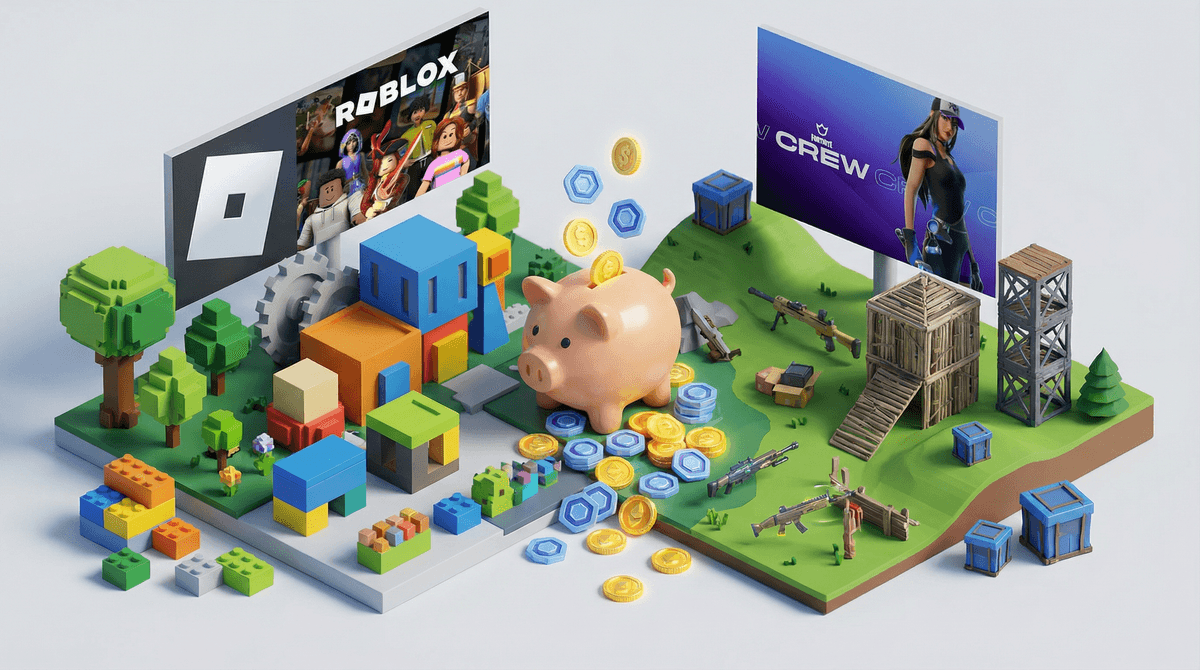
Let's start with the basics: Robux is the currency for Roblox, and V-Bucks is the currency for Fortnite. Both are virtual currencies that kids use to buy digital items in their respective games. And both are purchased with real money—your real money.
Here's the breakdown:
- Robux buys avatar accessories, game passes, developer products, and premium subscriptions in Roblox
- V-Bucks buys character skins, emotes, battle passes, and cosmetic items in Fortnite
Neither currency gives players a competitive advantage (mostly—we'll get to that), but they're central to the social experience of these games. Your kid isn't just buying a digital hat. They're buying identity, status, and the ability to participate in the culture of the game.
If you're thinking "it's just fake money for a video game," I get it. But here's the thing: to kids, this currency is very real. It represents social capital, creative expression, and sometimes even real entrepreneurship.
In Roblox, kids can actually earn Robux by creating games other players enjoy. Some teenagers are making legitimate income through Roblox development. That's genuinely cool and teaches real skills.
In Fortnite, V-Bucks are purely cosmetic—you can't earn them through gameplay, only purchase them. But the social pressure to have the latest skin or emote is intense. Missing out on a limited-time collaboration (like a Marvel or Star Wars crossover) can feel like genuine FOMO to a 10-year-old.
The real issue? Both systems are designed to be confusing and to encourage spending. The pricing doesn't match neatly (you can't buy exactly what you need), the real-money conversion requires mental math most adults struggle with, and the games constantly surface new items to want.
Let's talk actual dollars:
Robux pricing:
- 400 Robux = $4.99
- 800 Robux = $9.99
- 1,700 Robux = $19.99
- 4,500 Robux = $49.99
V-Bucks pricing:
- 1,000 V-Bucks = $7.99
- 2,800 V-Bucks = $19.99
- 5,000 V-Bucks = $31.99
- 13,500 V-Bucks = $79.99
Notice how neither currency maps to actual dollars in a way that makes sense? That's intentional. It's the same psychology casinos use with chips—it doesn't feel like real money when you're spending 800 Robux instead of $10.
A typical Roblox game pass costs 25-1,000 Robux. Avatar items range from 5 Robux to thousands. In Fortnite, a single skin costs 800-2,000 V-Bucks, and the battle pass (which unlocks a progression system with rewards) costs 950 V-Bucks.
Ages 6-9: At this age, kids don't really understand the real-money connection. They see Robux or V-Bucks as just another game resource, like coins in Mario. If you're allowing purchases, you need to be directly involved in every transaction and explicitly connect it to real money: "This costs 800 Robux, which is $10 from our family budget."
Ages 10-13: Kids this age understand money but are highly susceptible to social pressure and FOMO. They can start to learn budgeting through these currencies, but they need clear limits. A monthly allowance of virtual currency (with no exceptions for "limited time" items) teaches delayed gratification and priority-setting.
Ages 14+: Teens can handle more autonomy here, especially if they're earning their own money through chores or jobs. This is actually a great age to let them make their own spending decisions and learn from mistakes—a $20 regret purchase in Fortnite is cheaper than many real-world financial lessons.
The pressure is real and constant. Both games use sophisticated engagement tactics: limited-time offers, daily item rotations, social visibility of purchases, and peer influence. Your kid isn't weak-willed for wanting these things—they're up against billion-dollar behavioral psychology.
Not all purchases are equal. In Roblox, game passes can actually enhance gameplay and creativity. Some are worth it. In Fortnite, everything is purely cosmetic—it literally doesn't affect the game. Understanding this distinction helps you guide decisions.
The "it's just cosmetic" argument has limits. Yes, skins don't affect gameplay. But in social games, appearance is part of the experience. Dismissing this entirely invalidates what actually matters to kids in these spaces. The goal isn't to eliminate all spending—it's to make it intentional and boundaried.
You can earn some Robux. Unlike V-Bucks, Robux has a creator economy. If your kid is interested in game development, Roblox Studio is genuinely educational. Some kids fund their own Robux habit by creating games. That's a different conversation than pure consumption.
Both platforms have parental controls. You can require approval for all purchases, set spending limits, and monitor transactions. Learn how to set up Roblox parental controls and Fortnite parental controls if you haven't already.
Here's what actually works in real families:
The monthly budget approach: Give your kid a set amount of virtual currency per month (or let them earn it through chores/allowance). When it's gone, it's gone. No exceptions for limited-time items. This teaches budgeting and priority-setting.
The matching system: For every dollar of their own money (allowance, gift money, earnings) they want to spend, you match it. This gives them skin in the game while still supporting their interests.
The approval system: Every purchase requires a conversation. Not to say no, but to ask: "Why do you want this? Will you still care about it next week? What else could you buy with this money?" This builds decision-making skills.
The earning system: Tie virtual currency to real contributions—extra chores, grades, reading goals. This connects digital rewards to real effort and teaches work ethic.
The cold turkey approach: No purchases, period. This is valid too, especially for younger kids or if spending has become problematic. Both games are fully playable without spending money.
Robux and V-Bucks aren't inherently good or bad—they're tools that can teach financial literacy or enable mindless spending, depending on how you approach them.
The key is treating virtual currency like real money (because it is), setting clear boundaries, and using these systems as teaching opportunities rather than just saying yes or no reflexively.
Your kid will survive without the latest Fortnite skin. They'll also survive with it. What matters is that they're learning to make intentional decisions about money, understand trade-offs, and recognize when they're being marketed to.
And hey, if you're going to spend money on digital items, at least Roblox has a creator economy where kids can actually learn something. Fortnite is pure consumption, but sometimes that's okay too—we all have our guilty pleasures.
- Check your recent transaction history in both games (you might be surprised)
- Set up parental controls and spending limits if you haven't already
- Have a conversation with your kid about their wish list and why they want specific items
- Decide on a system that works for your family—and stick to it
- Learn more about the Roblox creator economy
 if your kid is interested in game development
Remember: this is just one small piece of their digital life. The goal isn't perfection—it's intentionality.