

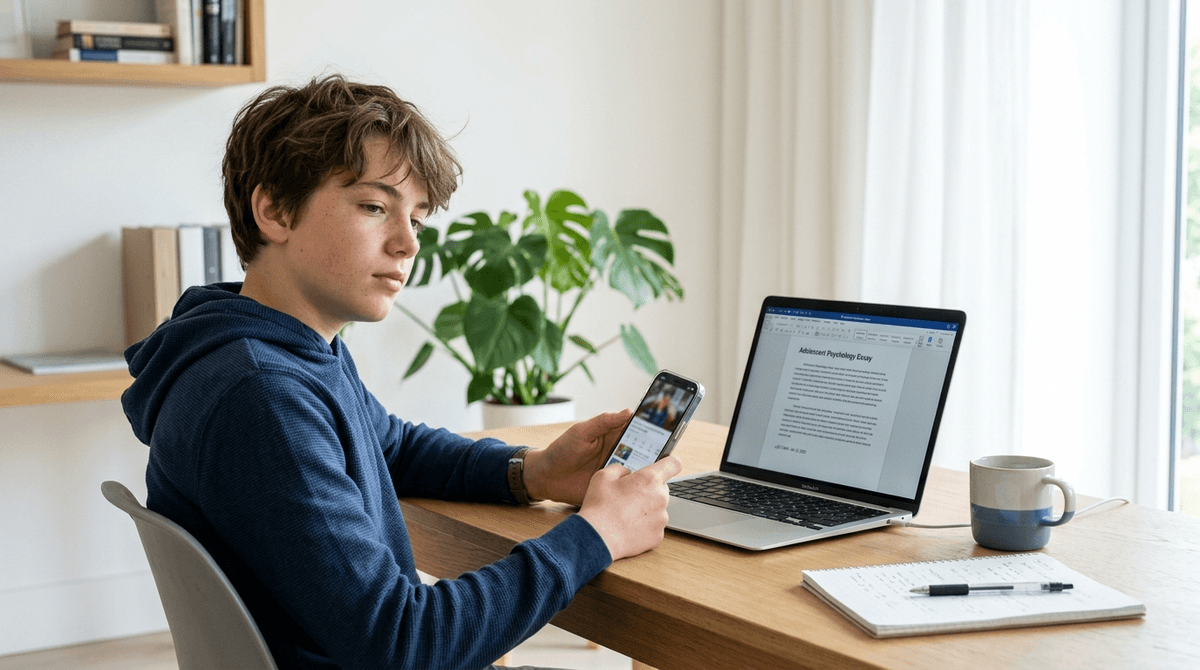

Teens who log heavy hours scrolling social feeds and streaming video show measurable dips on cognitive screening tests, but time spent on laptops for schoolwork carries no such penalty.
Recreational screen time correlates with lower cognitive scores in adolescents, while digital schoolwork shows zero negative link. The sharpest risk appears when daily recreational use pushes total screen exposure past nine hours.
Stop policing every screen equally and start policing the content. If your teen spends three hours on a laptop researching a history project or coding, that time does not carry the cognitive drag parents frequently fear.
Lumping all digital media into a single "screen time" bucket creates pointless friction at home. You can safely let up on school-related laptop sessions while keeping hard boundaries around passive entertainment, short-form video loops, and late-night gaming.
The cognitive drag tracked with leisure, not learning:
- School screens got a clean pass. Educational screen time showed no significant relationship with lower cognitive performance.
- Entertainment screens drove the drop. Hours spent on recreational media moderately correlated with lower scores on standardized cognitive screening.
- Every extra hour mattered. Each additional hour of daily screen use was associated with a 0.24-point drop on the cognitive assessment scale.
- A nine-hour red flag. Adolescents logging roughly nine hours or more of total daily screen exposure were nearly three times as likely to score in the impaired range compared to lighter users.
- Brain maturity still won out. Older teens scored higher across the board regardless of their digital habits, reflecting normal adolescent neurodevelopment.
The real culprit is almost certainly displacement, not pixels damaging brain tissue.
When an adolescent burns through eight or nine hours of media a day, vital developmental inputs get squeezed out of their schedule. Sleep gets delayed, physical activity falls to zero, and rich, in-person social interaction vanishes. A lower score on a cognitive test often reflects chronic sleep debt and fragmented attention spans rather than screens directly impairing neural circuits.
Treat the specific "nine-hour threshold" as a rough warning sign rather than a strict medical cutoff.
The researchers evaluated only 67 students from a single private school in Indonesia during pandemic remote learning. Crucially, they used the Montreal Cognitive Assessment (MoCA)—a screening tool developed to spot early-stage dementia in adults over 55, not to map nuanced executive function in healthy 13-year-olds. Because the study was observational, it cannot prove screen time caused the cognitive drops; adolescents who already struggle with executive function and focus may simply drift toward their phones more frequently.
- If your teen needs long stretches on a laptop for homework, step back and let them work without rationing the clock, since academic screen use showed no link to cognitive dips.
- If total daily screen use creeps toward eight or nine hours, audit their non-school phone and console habits to ensure recreational use is not crowding out sleep.
- If you need to pick a single boundary to enforce, ban phones and tablets from the bedroom overnight to protect the restorative sleep that drives daytime focus.
You do not need to panic over the hours your middle schooler logs completing digital schoolwork, but letting recreational scrolling spill past eight hours a day robs their brain of sleep and focus. Protect bedtime, ease up on homework screens, and cut off passive algorithmic feeds before they consume the evening.
Gunawan PY, Andraina A, Wijaya JH et al. (2026). Screen time patterns and cognitive screening outcomes (MoCA-Ina) in adolescents: a cross-sectional study. BMC neurology. doi:10.1186/s12883-026-05128-5 — pubmed.ncbi.nlm.nih.gov