

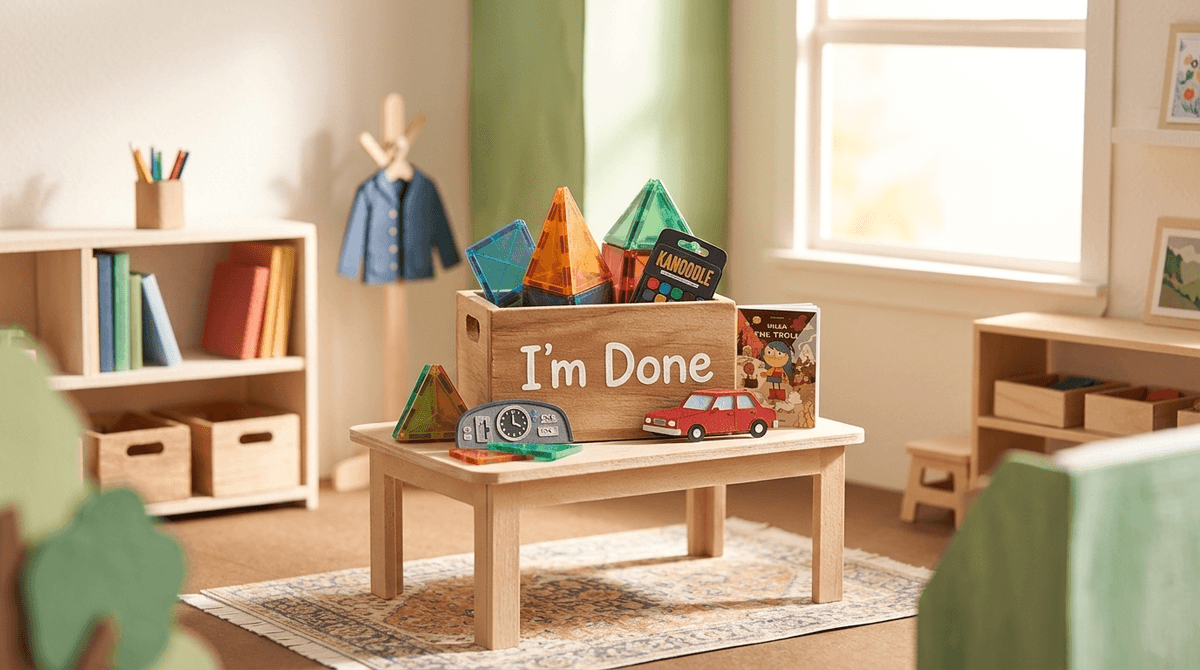
The "I’m Done" bin is the difference between a kid who spends twenty minutes staring at a wall (or annoying their neighbor) and a kid who spends twenty minutes building a cognitive skill they actually care about. It’s not about busy work, and it’s definitely not about "extra credit" worksheets that feel like a penalty for being fast. It’s about high-quality, low-mess autonomy that keeps the brain in gear without needing a charging cable.
TL;DR: The best early-finisher bins focus on tactile logic and open-ended creation. Skip the "extra worksheets" and stock the bin with high-focus tools like Kanoodle, Plus-Plus bricks, and Story Cubes. The goal is a "flow state" bridge that respects the kid’s pace and keeps the classroom quiet. For more physical play ideas, browse our board game recommendations.
Some kids need to move their hands to keep their brains from wandering. The trick is finding building toys that don't have a thousand tiny pieces that roll under desks or make a "crash" sound every time a tower falls.
If LEGO is the king of structured building, Plus-Plus is the king of the "fidget build." It’s one shape that interlocks in infinite ways. It’s silent, it’s flat (easy to store in a shallow bin), and it works for both 2D patterns and 3D structures. It’s the ultimate "I have ten minutes" toy because there’s no "finished" state—you just build until the bell rings.
While these can be a bit clunkier, a small stack of Magna-Tiles or similar magnetic shapes is a powerhouse for spatial reasoning. The "click" is satisfying but quiet. For an early-finisher bin, keep the count low (15-20 pieces)—enough to build a cool geometric shape, but not enough to build a floor-to-ceiling skyscraper that disrupts the kid next to them.
The best early-finisher activities are "self-correcting." You don't want the kid raising their hand to ask, "Is this right?" while you're still helping another student with their fractions. You want a game where the game itself tells them if they won.
This is the gold standard for solo classroom play. Kanoodle is a 2D and 3D spatial reasoning puzzle that comes in a pocket-sized case. It starts incredibly easy and scales up to "Wait, how is this possible?" levels. It’s addictive in the best way, and because it’s a puzzle, it feels like a reward, not a chore.
The classic sliding-block puzzle. Rush Hour teaches sequential thinking—if I move the ice cream truck here, the yellow taxi can move there. It’s a masterclass in logic that feels like a game. If your kid is already a logic pro, look for the "Deluxe" or "Safari" versions for a fresh challenge.
Literacy isn't just staring at a page of text. It's narrative structure, vocabulary, and sequencing. For the kid who is "done" with their writing assignment but still has creative energy, these bins are a massive win.
Nine dice, 54 icons, infinite stories. You roll the dice and have to link the images into a narrative. It’s a low-pressure way to practice storytelling. A kid can "write" a story in their head, or you can include a small notepad in the bin for them to jot down the wildest plot they generated. It’s literacy practice disguised as a dice game.
If you’re going to put books in an "I’m Done" bin, make them graphic novels. Hilda by Luke Pearson is perfect because the art is dense and rewarding. A kid can "read" the story through the visual pacing even if they’re burnt out on decoding text for the day. It builds that visual literacy strand of the "reading rope" without feeling like more schoolwork. For more high-engagement reads, see our best books for kids list.
For kids with ADHD or other neurodivergent profiles, "unstructured time" isn't a break—it's a trap. Without a clear "next thing," that energy often turns into disruption or anxiety. Having a bin that offers a high-dopamine, high-focus task (like a logic puzzle or a complex build) helps them regulate their transition from a high-pressure task to the next part of the day.
The "I’m Done" bin works best when the contents rotate. If the same three puzzles sit there for six months, they become background noise.
- The Swap: Rotate one item out every two weeks.
- The Challenge: Tape a "Challenge of the Week" to the lid of the bin (e.g., "Can you build a Plus-Plus bridge that spans the width of the bin?").
- The Documentation: If they build something cool with Magna-Tiles, let them leave it on a "Gallery Shelf" until the end of the day. It validates the effort they put into their "free time."
The biggest friction point with these bins is the "Fairness Doctrine." Other kids might see the early finisher playing with Kanoodle and rush through their own work just to get to the bin.
The pro-tip: Make the bin activities "quiet and deep," not "loud and flashy." If the bin feels like a calm extension of learning rather than a party in a box, the incentive to rush stays low. Also, ensure the bin is only for those who have quality work finished—it’s not a race to the bottom.
Q: Are these bins just a distraction from "real" learning? No. Most of these tools—especially things like Rush Hour and Plus-Plus—build spatial reasoning, fine motor skills, and executive function. It’s "stealth learning" that keeps the brain engaged while the rest of the class catches up.
Q: How do I handle kids who rush through work just to get to the bin? Quality control is key. The bin is a privilege for those who have completed their task to their best ability. If a kid produces sloppy work to get to the Story Cubes, the move is a calm "This isn't your best work yet; finish this part, then the bin is open."
Q: What is the best age for an "I'm Done" bin? The sweet spot is 1st through 5th grade. Younger kids need more supervision with small parts, and older kids might prefer more complex solo games or even "analog" coding activities. But for elementary school, these tactile bins are a lifesaver.
The "I'm Done" bin isn't a babysitter; it's a toolkit for autonomy. By providing high-quality, non-screen options like Kanoodle and Plus-Plus, you're teaching kids how to manage their own time and engage their brains without a teacher (or a tablet) directing every second.
- Browse more screen-free activities for homes and classrooms — active games, building kits, and co-op board games.
- Browse our board game recommendations for more solo- and group-play ideas.
- Explore the best books for kids to find the right graphic novels for your bin.
- Get quiet-time activity ideas
