

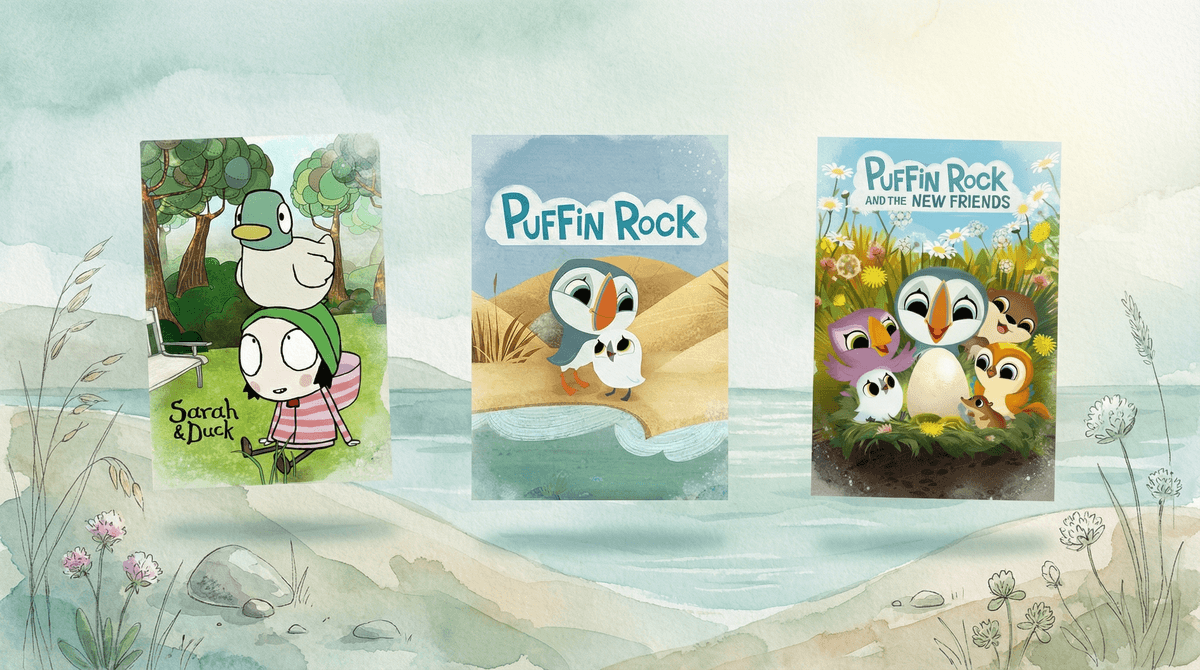
Puffin Rock is an Irish animated series that follows Oona, a young Atlantic puffin, and her little brother Baba as they explore their island home off the coast of Ireland. Narrated by Chris O'Dowd (yes, the guy from Bridesmaids), each episode is about 7 minutes long and focuses on gentle adventures like finding shells, watching whales, or helping friends.
The show originally aired on RTÉ in Ireland and later became available on Netflix and Amazon Prime Video. There are two seasons totaling 78 episodes, plus a longer special called Puffin Rock and the New Friends.
Here's what makes it different: nothing explodes, no one screams, and the educational content feels like actual nature observation rather than a lesson plan. It's the anti-Cocomelon in the best possible way.
In a media landscape dominated by rapid cuts and constant stimulation, Puffin Rock moves at what adults might call a "boring" pace. But here's the thing: that's exactly what makes it work for the 2-5 age range.
The pacing mirrors real childhood exploration. When Oona discovers a tide pool, the camera lingers. When Baba tries to catch a butterfly, we watch his repeated attempts without a laugh track or musical sting. This gives young viewers space to actually process what they're seeing and feeling.
The stories are also genuinely relatable to preschool life. Oona deals with being a big sister, wanting to do things by herself, feeling scared of new experiences, and learning to share. Baba can't talk yet (he chirps), which resonates with toddlers and younger preschoolers who are still developing language.
And honestly? Chris O'Dowd's narration is doing a lot of heavy lifting. His warm, conversational tone feels like a parent or grandparent telling a bedtime story, not a hyperactive host trying to keep attention at all costs.
Best for: Ages 2-5
This is squarely in toddler and preschool territory. The themes, pacing, and emotional complexity are perfect for this developmental stage.
Possibly too young for: Ages 6+
Once kids hit kindergarten or first grade, most will find Puffin Rock babyish. There's nothing wrong with a 7-year-old who still enjoys it (comfort viewing is real!), but don't expect it to hold attention for school-age kids the way Bluey or Wild Kratts might.
Episode length: 7 minutes
This is actually ideal for preschoolers. It's long enough to tell a complete story but short enough that you can watch "just one" without it turning into a 22-minute commitment. You can also use episodes as transition tools: "We'll watch one Puffin Rock, then it's time for lunch."
The educational value is real but subtle. Your kid will learn about tide pools, hibernation, bird migration, and weather patterns without realizing they're learning. The show introduces vocabulary naturally through context rather than through the "let's learn a new word!" approach that can feel forced.
There's genuine emotional learning here. Oona experiences disappointment, jealousy, fear, and frustration in age-appropriate ways. The show doesn't tie everything up with a bow—sometimes Oona stays a little sad, or Baba doesn't get what he wants. This is actually helpful for emotional development.
The Irish setting and accents are a bonus. Exposure to different English accents helps with language development, and the Irish coastal landscape is beautiful. Some American kids might need a moment to adjust to the accent, but most adapt quickly.
Screen time quality matters more than quantity. If you're trying to be intentional about media choices, Puffin Rock is genuinely one of the better options for this age group. It's not overstimulating, it doesn't have ads or in-app purchases (when watched through legitimate streaming services), and it won't leave your kid wired afterward. Learn more about how not all screen time is created equal .
.
Co-viewing makes it even better. The show is calm enough that you can actually watch with your kid and talk about what's happening. "Look, Oona is feeling nervous about the dark cave. Do you ever feel nervous?" This kind of co-viewing turns passive screen time into active learning.
Some kids find it too slow. If your preschooler is already accustomed to fast-paced content like Blippi or Ryan's World, they might initially resist Puffin Rock's gentler pace. This isn't necessarily a reason to avoid it—sometimes introducing calmer content is exactly what's needed—but it might take a few episodes for them to adjust.
Limited diversity. The show features animals on an Irish island, so there's no human character diversity to speak of. This isn't a dealbreaker, but it's worth noting if you're trying to build a media diet with varied representation.
Puffin Rock is a rare gem in preschool programming: genuinely calming, actually educational, and respectful of young children's intelligence and emotional capacity. It won't teach coding or turn your kid into a math genius, but it will give them 7 minutes of gentle storytelling that doesn't leave them (or you) feeling jangled.
In a world where so much kids' content feels designed to create tiny dopamine addicts, Puffin Rock is a breath of fresh Atlantic air. It's the show you put on when you need everyone to just... breathe for a minute.
-
Try the "one episode" rule. Watch a single 7-minute episode with your preschooler and see how they respond. Do they stay engaged? Ask questions? Want another immediately or seem satisfied?
-
Use it strategically. Puffin Rock works beautifully as a wind-down show before nap or bedtime, or as a calm transition between activities. It's less effective as background noise.
-
Explore similar content. If your kid loves Puffin Rock, they might also enjoy Sarah & Duck, Tumble Leaf, or Elinor Wonders Why—all slow-paced, nature-focused shows that respect preschool attention spans.
-
Talk about what you're watching. Ask your kid what they think Oona is feeling, or what they learned about puffins. This turns viewing time into conversation time.
Remember: you're not trying to find the "perfect" show. You're trying to make intentional choices that align with your family's values. For many families with preschoolers, Puffin Rock hits that sweet spot.