

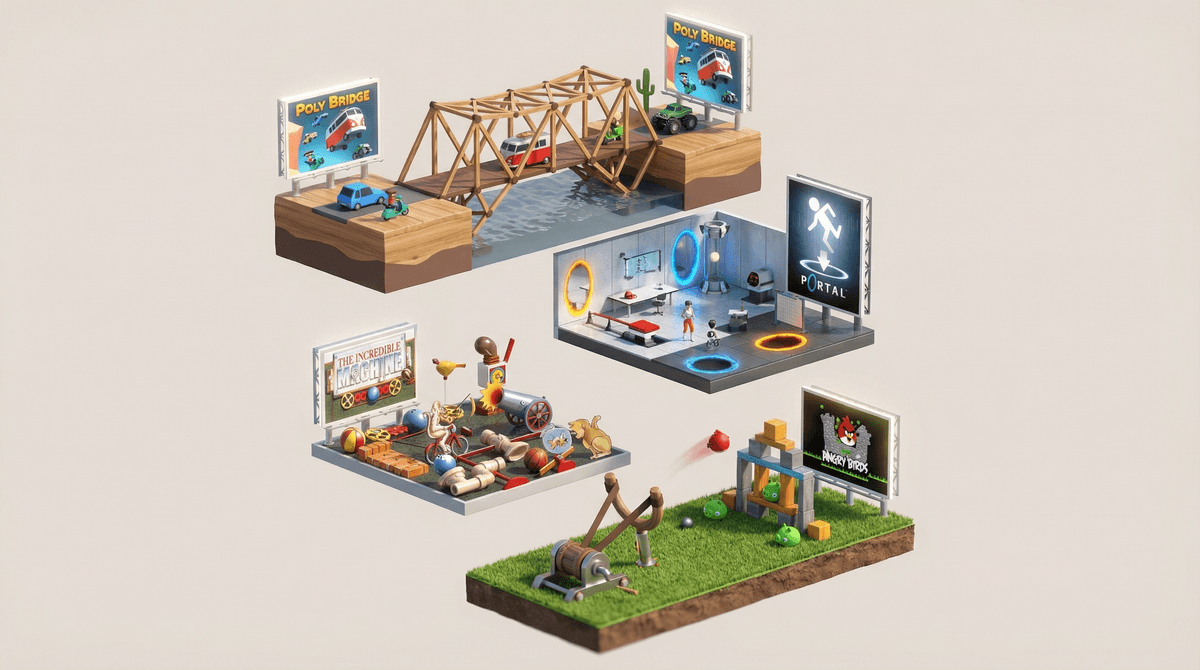
Physics games are puzzle and building games where players manipulate gravity, momentum, force, and other real-world physics principles to solve challenges. Think Angry Birds (trajectory and impact), Portal (momentum and spatial reasoning), or Poly Bridge (structural engineering).
These aren't your typical "educational games" that feel like homework with a cartoon overlay. Physics games are genuinely fun, often wildly creative, and happen to teach legitimate STEM concepts through trial and error. Kids learn about cause and effect, problem-solving, and spatial reasoning while launching birds at pigs or building increasingly ridiculous bridges.
The best part? Kids don't even realize they're learning. They're just trying to beat the next level.
Physics games hit that sweet spot between challenging and satisfying. There's usually no single "correct" solution—just physics principles and creative problem-solving. Your kid might spend 20 minutes building an elaborate Rube Goldberg machine in Incredible Machine or testing different bridge designs in Poly Bridge until one finally holds.
The appeal is in the immediate feedback loop. Drop a boulder? You instantly see how gravity and momentum work. Build a bridge wrong? It collapses spectacularly (and hilariously). This kind of experimentation-based learning is incredibly engaging for kids who might zone out during a traditional science lesson.
Plus, many physics games have a sandbox mode where kids can just mess around without objectives. This unstructured play is where real creativity happens—building elaborate contraptions just to see what's possible.
Here's what makes physics games genuinely valuable beyond just "better than YouTube":
They teach actual STEM concepts: Kids internalize ideas about gravity, force, angles, momentum, and structural integrity through repeated experimentation. A 10-year-old playing Kerbal Space Program learns more about orbital mechanics than most adults know.
They build problem-solving skills: These games require hypothesis testing—"What if I try this angle? What if I add support here?"—which is literally the scientific method in action.
They encourage persistence: Physics games are hard. Bridges collapse. Rockets explode. But because the feedback is immediate and the stakes are low, kids learn to iterate and improve rather than give up. That's a life skill.
They're screen time you can actually feel good about: Look, not all screen time is equal. Twenty minutes of Human Fall Flat is objectively different from twenty minutes of random YouTube shorts.
Ages 5-8: Simple Physics Puzzlers
- Cut the Rope - Timing and gravity basics
- Where's My Water? - Fluid dynamics (sort of)
- Amazing Alex - Rube Goldberg-style chain reactions
These are forgiving, colorful, and focus on one or two physics concepts at a time.
Ages 8-12: Building and Experimentation
- Poly Bridge - Engineering and structural design
- Human Fall Flat - Momentum and spatial reasoning (plus hilarious ragdoll physics)
- Minecraft - Redstone circuits teach logic and basic engineering
- [Crayon Physics Deluxe](https://screenwiseapp.com/media/crayon-physics-deluxe-app - Draw objects that follow real physics
Ages 12+: Complex Problem-Solving
- Portal and Portal 2 - Momentum, spatial reasoning, and mind-bending puzzles
- Kerbal Space Program - Actual rocket science and orbital mechanics
- BeamNG.drive - Realistic vehicle physics and crash simulations
- Besiege - Medieval engineering and destruction
Not all physics games are created equal: Some are genuinely educational. Others just have physics engines that make gameplay fun but don't really teach anything. Angry Birds is entertaining, but after the first few levels, it's more about memorization than understanding trajectory.
Watch for in-app purchases: Many mobile physics games are free-to-play with aggressive monetization. Cut the Rope and similar titles will constantly prompt kids to buy hints or level packs. Set up purchase restrictions before handing over the iPad.
Multiplayer can be a bonus: Games like Human Fall Flat have co-op modes where kids work together to solve physics puzzles. This is great for siblings or parent-child bonding (and yes, it's hilarious to watch).
Some games have steep learning curves: Kerbal Space Program is legitimately difficult. That's not a bad thing, but be prepared for frustration and consider playing alongside younger kids to help them work through challenges.
YouTube tutorials are part of the experience: Kids will absolutely look up how to beat certain levels or build better designs. That's not cheating—it's how modern learning works. Just monitor what YouTube content they're accessing while looking for game help.
Physics games are one of the few screen time categories where the "educational" label actually holds up. They teach real concepts, build genuine problem-solving skills, and keep kids engaged without relying on addictive reward loops or mindless repetition.
Are they a replacement for hands-on STEM activities? No. But they're a solid complement—and honestly, they're teaching concepts that are hard to demonstrate in real life. You can't exactly let your 10-year-old design and test bridge collapses or launch rockets in the backyard.
If you're looking for screen time that feels productive without turning into a battle, physics games are a legitimately good option. Just watch the monetization, set time limits like you would with any game, and maybe sit down and play a few levels together. You might actually learn something too.
Looking for more games that teach without feeling like homework? Check out our guides on coding games for kids and strategy games that build critical thinking.
Want to understand what makes a game actually educational vs. just marketed that way? Here's how to evaluate educational games .
.
Wondering if your kid's current screen time balance makes sense? Take the Screenwise survey to see how your family's habits compare to others in your community and get personalized recommendations.