

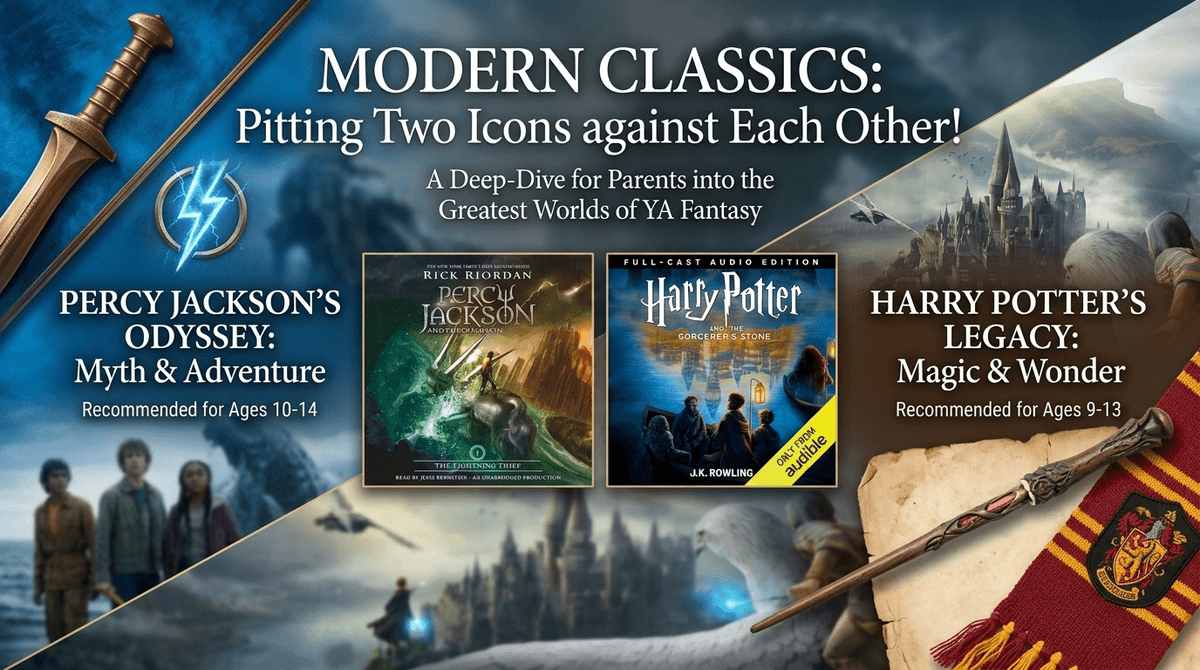
TL;DR: The Quick Verdict
If you’re staring at a bookshelf trying to decide which "Chosen One" should occupy your kid's brain for the next six months, here is the move:
- Start with Percy Jackson if your kid is 8–10, struggles to sit still, loves sarcasm, or has been diagnosed with ADHD or dyslexia. It’s fast, funny, and lower stakes early on.
- Start with Harry Potter if your kid is 9+, has a longer attention span, and wants a "world" to live in. Just be prepared: the series starts as a whimsical bedtime story and ends as a heavy wartime drama.
Check out our full list of middle-grade fantasy recommendations
Find books similar to Percy Jackson
The "Potter vs. Percy" debate is the Pepsi vs. Coke of the middle-grade book world. Both feature an orphaned (or effectively orphaned) boy who discovers he has god-like powers, goes to a secret boarding school, and has to save the world from a nose-less or soul-less ancient evil.
But as any parent who has tried to slog through a 700-page book with a distracted fourth grader knows, the experience of reading these two series is wildly different. One is a slow-burn British mystery; the other is a high-octane American road trip.
Here’s how to figure out which one will actually stick.
Rick Riordan wrote The Lightning Thief specifically for his son who had ADHD and dyslexia. Because of that, the "Screenwise" DNA of this book is built for the modern, easily-distracted brain.
Why Kids Love It
Percy is a narrator who talks like a real kid. He’s sarcastic, he’s frustrated with school, and he’s constantly getting into trouble. The chapters have titles like "I Accidentally Vaporize My Pre-algebra Teacher," which is immediate clickbait for a 9-year-old.
The pacing is relentless. There’s a monster fight every two chapters. For a kid used to the dopamine hits of Roblox or YouTube Shorts, Percy Jackson feels "fast."
The "Superpower" Element
One of the best things about Percy Jackson is how it reframes neurodivergence. In this world, ADHD is actually "battlefield reflexes" and dyslexia is your brain being hardwired for Ancient Greek. If your kid feels like a "problem kid" at school, Percy is going to be their absolute hero.
The Screen Connection
If they like the books, they have the new Percy Jackson and the Olympians (Disney+) series to watch. Unlike the older movies (which were, frankly, hot garbage that ignored the source material), the new show is creator-approved and age-appropriate.
Learn more about the Percy Jackson Disney+ show
Harry Potter is the gold standard for a reason, but it’s a commitment. It’s a "cozy" read that turns into a "trauma" read by the end.
Why Kids Love It
It’s the ultimate wish-fulfillment. Every kid wants to find out they are special and get whisked away to a castle where the ceilings look like the sky and the mail is delivered by owls. The world-building is much deeper than Percy Jackson. While Percy visits real-world places (The Empire State Building, St. Louis Arch), Harry lives in a completely realized magical society.
The Maturity Shift
This is where parents usually get tripped up. The Sorcerer's Stone is a solid 8+ read. But by the time you get to Harry Potter and the Goblet of Fire, characters are dying, and by The Deathly Hallows, it’s basically a book about guerilla warfare and the rise of fascism.
If you start a 7-year-old on Harry Potter, they might hit a "maturity wall" around book 4 or 5 where the content gets too dark or the books get too thick (we’re talking 700+ pages of teenage angst).
The Digital Footprint
The Harry Potter universe is massive. If your kid gets hooked, they’re going to want to play Hogwarts Legacy. Just a heads up: that game is rated T for Teen and features some pretty dark magic (like, literally using "unforgivable curses" on people).
Is Hogwarts Legacy okay for my 10-year-old?
| Feature | Percy Jackson | Harry Potter |
|---|---|---|
| Reading Level | 3rd Grade+ | 4th Grade+ |
| Pacing | Fast & Action-Heavy | Slow & Mystery-Based |
| Tone | Sarcastic & Modern | Whimsical & Classic |
| Complexity | Straightforward | Highly Complex (Later books) |
| Diversity | High (LGBTQ+, Neurodivergent, Ethnic) | Low (Mostly white/heteronormative) |
| "Scary" Factor | Cartoonish Violence | Psychological Horror/Death |
Grades 2-3 (Ages 7-9)
Go with Percy Jackson. At this age, the goal is "reading for fun." Percy’s voice is relatable, and the chapters are short enough for a nightly "one more chapter" negotiation. Harry Potter is doable as a read-aloud, but the British vocabulary (crackers, jumpers, treacle tart) can sometimes be a barrier for independent US readers.
Grades 4-5 (Ages 9-11)
It’s a toss-up. This is the sweet spot for both. If your kid is a "completionist" who likes to collect every detail, they’ll love the lore of Harry Potter. If they want to feel like they’re watching a Marvel movie in book form, they’ll prefer The Lightning Thief.
Middle School (Ages 12+)
Go with Harry Potter (if they haven't read it). The later HP books deal with complex themes of government corruption, sacrifice, and the "gray" areas of morality that middle schoolers are starting to navigate. Percy Jackson might feel a little "young" by this point, though the sequel series like The Heroes of Olympus age up significantly.
The Author Factor
We can't talk about Harry Potter in 2026 without mentioning J.K. Rowling. Her public stances on gender identity have made the series a "no-go" for some families. If your family prioritizes supporting inclusive creators, Rick Riordan is the gold standard. He has actively worked to include LGBTQ+ characters and diverse mythologies (check out Aru Shah and the End of Time for a great Indian mythology spin-off).
The "Brain Rot" Risk
Neither of these is brain rot. Both are "high-protein" media. They require visualization, memory of complex plots, and emotional empathy. However, be wary of the "fandom" rabbit holes on TikTok or YouTube. Harry Potter "shifting" or dark Percy Jackson fan theories can get weird and age-inappropriate quickly.
How to manage your kid's YouTube rabbit holes
If you’re starting one of these, use it as a bridge to other conversations:
- On Percy: "Percy has ADHD, and it’s his greatest strength in a fight. What’s something about you that feels like a 'weakness' at school but might be a 'superpower' somewhere else?"
- On Potter: "Dumbledore says we have to choose between what is right and what is easy. Have you ever had to make a choice like that?"
- On Mythology: Use Percy to jump into National Geographic Kids to look up the "real" Greek myths. (Warning: the real myths are way more R-rated than the books).
If you want to hook a kid who thinks books are boring: Percy Jackson.
If you want to immerse a kid who already loves to get lost in a story: Harry Potter.
Either way, you’re winning. You’re trading 20 minutes of Skibidi Toilet for 20 minutes of epic heroics. That’s a parenting win in any universe.
Next Steps
- Grab the book: Check your local library or the Libby app for the audiobook (the Percy Jackson audiobooks are fantastic).
- Set a "Movie Night" Goal: Tell them once they finish Book 1, you'll watch the movie or show together.
- Compare and Contrast: If they’ve read one, ask them to "pitch" why their favorite hero could beat the other one in a fight. (Spoiler: Percy has a sword; Harry has a stick. My money is on the demigod).