

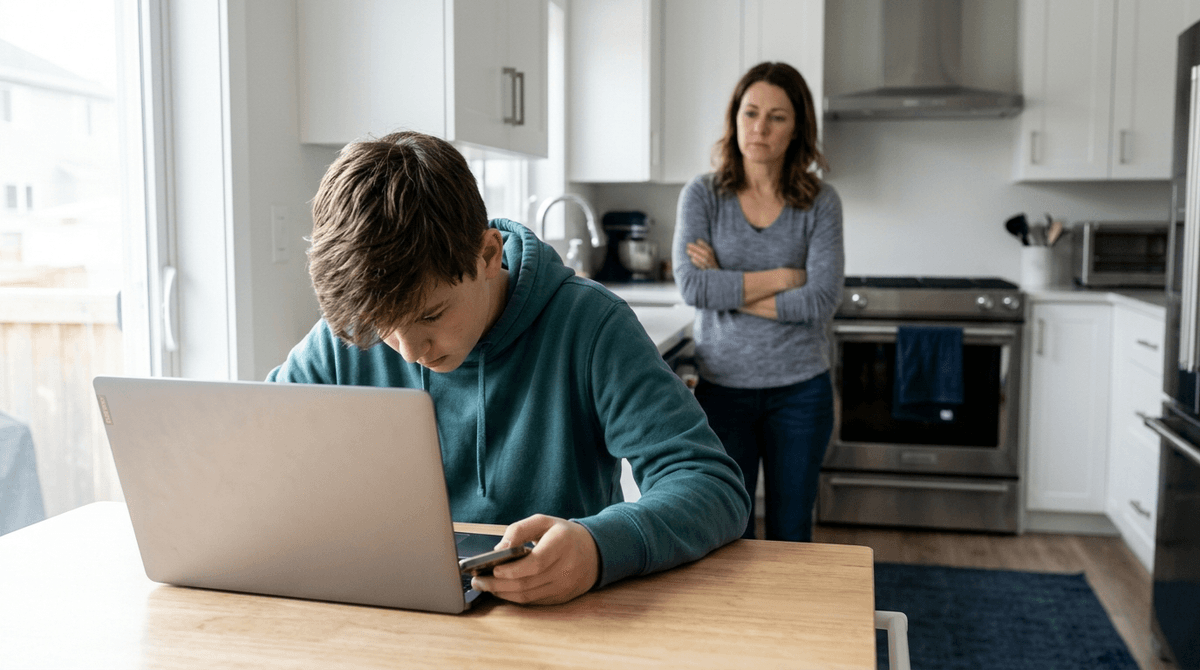

When screen battles become a daily routine, parents often swing between total surrender and constant confrontation—not because they lack discipline, but because modern school devices and addictive apps make middle-ground enforcement feel impossible.
Constant screen friction forces parents into a vicious cycle of escalation, leaving families desperate for external guardrails like school-wide device bans and legal age limits.
Managing digital boundaries in isolation is burning parents out. When school-issued laptops double as entertainment hubs and social life moves entirely online, household rules feel like swimming against a rip current.
Recognizing that this friction is driven by environment—not just personal parenting choices—helps shift the focus from constant daily policing to clear, structural solutions at home and in schools.
Teens estimate they clock six to seven hours of recreational screen time daily, more than double national health recommendations. As middle and high schools fully digitize classrooms, the boundary between required homework and mindless entertainment has effectively collapsed.
Parents feel trapped between protecting family peace and preventing their kids from falling behind socially or academically.
- The peace-versus-policing trap: Every effort to set limits triggers conflict, prompting many parents to drop boundaries entirely just to avoid constant arguments.
- The school-device pipeline: Children easily pivot from assignments to YouTube or games on school laptops, turning study time into a surveillance battle.
- Blurry diagnostic lines: Parents struggle to distinguish typical adolescent social behavior from actual clinical screen addiction, leaving them unsure when to seek professional help.
- Acknowledged upsides: Despite the stress, parents recognize real benefits in targeted screen use, including improved English language skills and creative outlets.
- A demand for real tools: Parents reject passive advice videos and generic pamphlets, demanding interactive expert toolboxes and peer discussion groups instead.
Individual house rules are no longer sufficient against persuasive software and fully digitized schools. Parents are increasingly calling for policy-level interventions—such as phone-free school days and stricter social media age limits—because home enforcement alone feels unmanageable.
This study relied on interviews with just 11 parents in Lund, Sweden—a country with exceptionally high school technology integration. While the qualitative findings capture widespread emotional realities, the small sample size means these specific results cannot be generalized to all populations.
- If your teen claims they need their school laptop in their bedroom for homework... Require school-issued devices to stay in common family areas during study hours to reduce quiet tab-swapping to entertainment platforms.
- If every screen boundary devolves into a screaming match... Step back from constant micro-enforcement and set predictable, non-negotiable device-free windows (like dinner and bedtime) to break the conflict cycle.
- If you cannot tell if your child's screen habits are normal or addictive... Focus on functional impacts like falling grades, missed sleep, or social withdrawal rather than total hours logged, and consult a pediatrician if core routines break down.
- If you feel exhausted managing digital boundaries on your own... Coordinate with other local parents or school boards to advocate for shared rules, like phone-free school hours or standardized homework policies.
Stop blaming yourself for struggling to police an environment engineered for maximum distraction. Focus on high-leverage structural habits at home—like keeping school laptops in shared spaces—while backing community and school policies that take the enforcement burden off your shoulders.
Werner M, Delfechresh F, Barstowe A et al. (2026). Parental perspectives on children's screen use: Exploring impact, challenges, and support needs - A qualitative study. Journal of public health research. doi:10.1177/22799036261462200 — pubmed.ncbi.nlm.nih.gov