

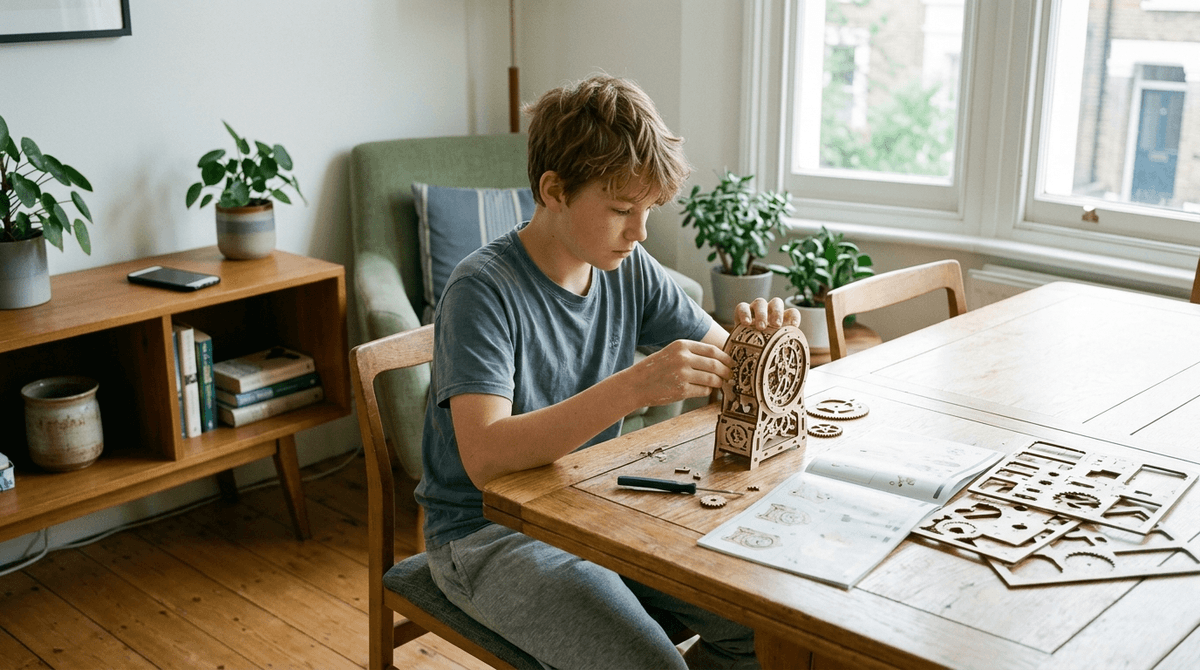

A child’s focus, impulse control, and working memory aren't built solely on exercise routines and screen limits. Their perception of household fairness and having protected personal downtime directly correlate with higher cognitive performance.
A child’s sense of parental fairness and protected personal downtime correlate directly with stronger working memory, focus, and mental flexibility.
Parents often treat executive function—the mental control center for managing homework, suppressing impulses, and staying focused—as a discipline issue or a hardware problem managed through sleep schedules and sports.
This research shifts the focus to psychological climate: how kids perceive justice at home and whether they feel in control of their own free time directly shapes their brain performance.
Researchers wanted to understand how a child's broader quality of life—including home dynamics, personal leisure, and school adjustment—interacts with lifestyle habits to shape executive function in pre-teens and teenagers aged 10 to 17.
In a study of nearly 1,000 children and teens, psychological well-being at home and school proved just as critical for brain performance as physical habits.
- Fairness fuels focus: Children who rated their parents as fair and consistent scored significantly higher in working memory and cognitive flexibility.
- Personal time matters: Kids with dedicated, unstructured downtime performed better on attention-based tasks.
- School adjustment predicts brain power: Feeling successful and adjusted at school was the single most consistent predictor of impulse control and mental adaptability.
- Active living multiplies benefits: Combining high physical activity with low screen time strongly boosted cognitive scores across the board, partly because active kids reported higher overall quality of life.
- The sleep anomaly: Unusually, longer sleep duration in this cohort correlated with lower scores in memory and attention, likely reflecting poor sleep quality or inconsistent schedules rather than the benefit of extra hours.
Structure without perceived justice backfires. When rules feel arbitrary or enforcement varies by a parent's mood, children burn mental energy managing uncertainty rather than sharpening executive control.
Protecting personal time also signals autonomy. Giving young brains space to choose their own activities allows their attention networks room to reset after demanding school days.
The study was observational, meaning it shows strong associations rather than direct cause and effect. We cannot definitively state that parental fairness directly causes better working memory.
Additionally, sleep and physical activity were self-reported via questionnaires rather than measured with wearable sensors, which likely explains the counter-intuitive sleep findings.
- If your child struggles with working memory or following multi-step directions… Establish clear, predictable household rules and explain the reasoning behind discipline so consequences feel consistent rather than arbitrary.
- If your child’s schedule is packed with back-to-back organized activities… Carve out unmanaged personal downtime every day to give their attention-control networks room to recharge.
- If you want to maximize the cognitive payoff of after-school sports… Pair increased physical activity with clear boundaries on screen time, as the combination drives the highest gains in executive function.
Solid executive function takes more than exercise and early bedtimes; it requires a home environment that feels fair and gives kids ownership over their free time. Focus on predictable boundaries and real downtime, and cognitive gains will follow.
Caamaño-Navarrete F, Arriagada-Hernández C, Jara-Tomckowiack L et al. (2026). Personal Time, Parental Fairness, School Adjustment and Physical Activity Levels as Indicators of Executive Functions in Children and Adolescents. Behavioral sciences (Basel, Switzerland). doi:10.3390/bs16060941 — pubmed.ncbi.nlm.nih.gov