

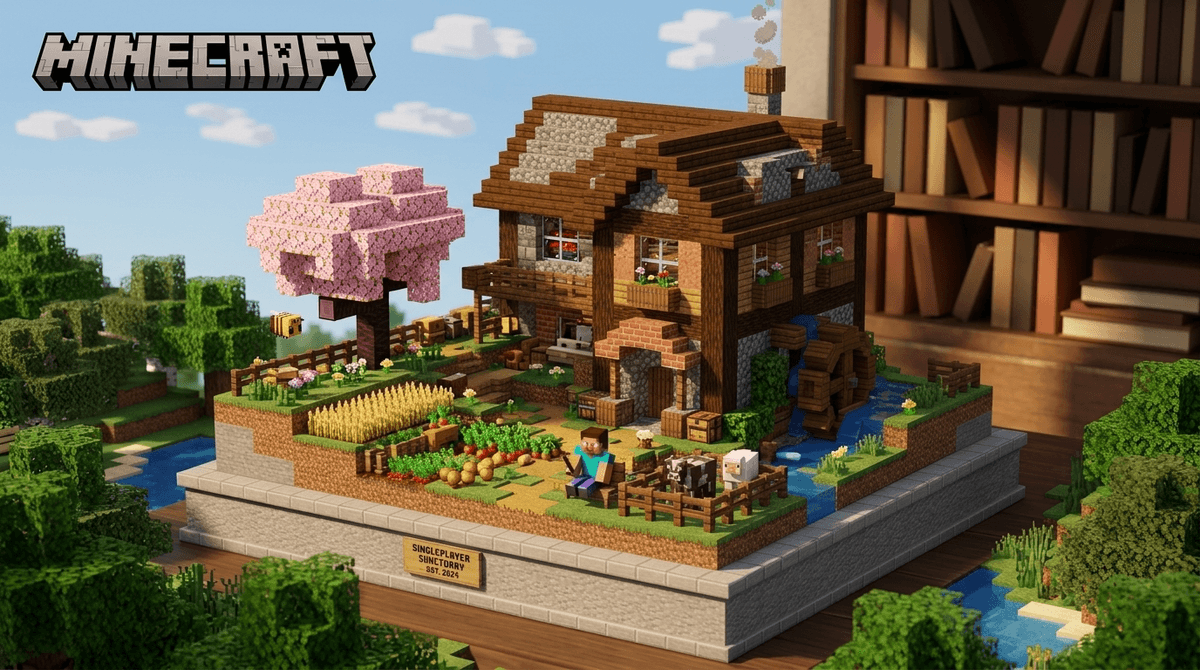
Minecraft is effectively two different games: a high-stress social lobby where teenagers scream at each other, or a peaceful digital garden where the pause button actually works. If you want the version that functions like a high-tech bin of LEGOs rather than a chaotic town square, offline mode—technically called "Singleplayer"—is the only way to fly.
TL;DR: Solo Minecraft turns the world’s most popular game into a private, meditative building sim where your kid is the only person who exists. It eliminates "griefing" (people breaking your stuff) and chat-room toxicity entirely while keeping the creative engine intact. For families who want the gameplay without the social overhead, it’s a masterclass in digital autonomy.
When most parents worry about Minecraft, they’re actually worrying about "Multiplayer." That’s where the public servers live, where the chat scrolls at 100mph, and where a random 14-year-old from halfway across the world can dump lava on your kid’s carefully constructed cat sanctuary.
Singleplayer mode (offline play) deletes all of that. When a kid selects "Create New World" and keeps it local, they are the literal god of that universe. No one can join unless they are physically sitting on the couch next to them (Split Screen) or on the same home Wi-Fi (LAN). It transforms the game from a performative social space into a private workshop.
If you’re deciding whether to let your kid dive in, here is why the offline route is usually the better "onboarding" experience:
- The Pause Button Actually Works: In a multiplayer server, the world keeps moving even if you walk away to eat dinner. Your character can starve or be attacked while you’re gone. In Singleplayer, hitting 'Esc' or 'Home' actually stops time. For a household that values dinner time or "five more minutes" being a real five minutes, this is a game-changer.
- Zero Griefing: "Griefing" is the gaming term for being a jerk—destroying someone’s buildings, stealing their items, or trapping them in a hole. In offline mode, the only person who can destroy a building is the person who built it.
- No Chat Moderation Stress: You don’t have to worry about what "xX_DragonSlayer_Xx" is typing in the bottom left corner of the screen because there is no bottom left corner chat.
- Performance: Public servers can be "laggy" (slow), which leads to frustration and tantrums. A local, offline world runs as fast as your device allows.
Once you’ve committed to the solo life, the game asks you one more question: Creative or Survival? This choice matters more than the offline/online split for the actual vibe of the afternoon.
This is "Unlimited LEGOs" mode. You can’t die, you have every block in the inventory, and you can fly. This is where kids build 1:1 replicas of the Eiffel Tower or elaborate roller coasters. It’s low-stress, high-output. If your kid is an artist or an architect, this is the sweet spot.
This is the "Game" mode. You have to mine for materials, eat food so you don't starve, and hide from "mobs" (monsters like Creepers or Zombies) at night. It teaches resource management and risk assessment. If you want them to practice problem-solving—"I need iron to make a bucket to move water to grow wheat"—this is it.
Pro-tip: You can set Survival mode to "Peaceful" difficulty. This keeps the resource management (mining, farming) but deletes the monsters. It’s the "Goldilocks" setting for younger kids who want to explore without the jump-scares.
If you’re setting this up on a PC, you’ll see two versions. Java Edition is the "classic" PC version—it’s great for "modding" (adding fan-made content), but it’s a bit more technical. Bedrock Edition is the modern version that runs on consoles (Switch, Xbox, PS5), phones, and Windows.
If you want the easiest offline experience, Bedrock is usually the play. It’s more stable and handles "local play" (two siblings on two iPads in the same room) much more gracefully than Java.
If your kid loves the idea of building or exploring but Minecraft feels a bit too "blocky" or aimless, there are other solo-first titles that hit the same notes:
- Terraria: Often called "2D Minecraft," but with way more focus on gear, bosses, and progression. It’s a bit more "gamey" and less "architectural."
- Stardew Valley: If the appeal of Minecraft is the farming and the quiet life, Stardew is the gold standard. It’s offline by default and incredibly cozy.
- A Short Hike: A tiny, perfect exploration game. No combat, no stress, just a bird on a mountain. Great for kids who just want to see what’s over the next hill.
- LEGO Star Wars: The Skywalker Saga: For the kid who loves the building aesthetic but wants a funny, scripted story to follow.
The best thing about offline Minecraft is that it’s a closed loop. You can actually see what they’re doing.
Ask for a "World Tour." Once a week, have them take you through their world. Ask them how they powered their Redstone door or why they chose to build their house in the desert biome. Minecraft is a masterclass in systems thinking; when a kid explains their "automatic wool farm," they’re essentially explaining basic engineering.
Try "Hardcore" (for older kids). If an older kid claims solo Minecraft is "too easy," suggest a Hardcore world. You only get one life. If you die, the world is deleted forever. It turns the game into a high-stakes survival thriller that requires genuine focus and planning.
The biggest "friction point" in offline Minecraft isn't the content—it's the Save File.
Unlike a public server that lives on the internet, a Singleplayer world lives on the device. If your kid builds a masterpiece on their iPad and then wants to play on the Xbox, that world won't be there. This can lead to genuine heartbreak if a device is lost or upgraded. If they’ve built something they’re proud of, look into how to back up the world file (on PC) or ensure your cloud saves are active (on console).
Q: Does Minecraft work without Wi-Fi? Yes. Once the game is downloaded and you've logged in at least once to verify the license, Singleplayer worlds work perfectly without an internet connection. It is the ultimate "airplane mode" game.
Q: Is offline Minecraft safer for my kid? Significantly. By staying offline, you bypass 100% of the risks associated with strangers, unmoderated chat, and predatory server behaviors. It’s just your kid and the code.
Q: Can siblings play together offline? Yes, via "LAN" (Local Area Network). If they are both on the same Wi-Fi, one kid can "Open to LAN" and the other can join. This is the "digital basement" experience—all the fun of multiplayer with none of the outside world.
Q: What is the age rating for Minecraft? Minecraft is rated E10+ for Fantasy Violence (you hit monsters with swords, and they disappear in a puff of smoke). In Creative mode or Peaceful Survival, the violence is virtually non-existent.
Offline Minecraft isn't "Minecraft Lite"—it’s the purest version of the game. It’s a private laboratory where kids can fail, iterate, and build without the pressure of a digital audience. If you want to encourage the "good" parts of gaming—spatial awareness, logic, and creativity—without the "bad" parts of the internet, keeping it solo is a pro move.
- Check out our best games for kids list for more offline-friendly titles.
- Read our digital guide for elementary school to see where Minecraft fits into a healthy media diet.
- Get a Minecraft starter challenge
