

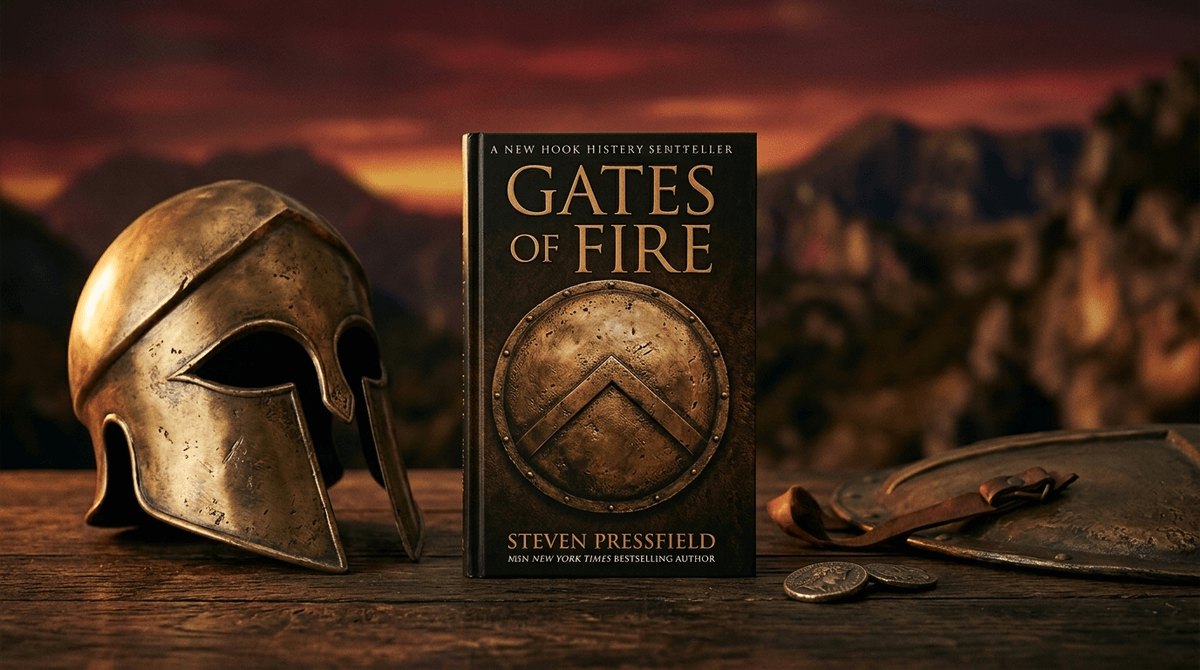
Gates of Fire is the definitive "grown-up" version of the 300 Spartans story—it trades the slow-motion abs and CGI monsters of Hollywood for the crushing, muddy, and profoundly moving reality of ancient warfare. If your kid is ready to move past the sanitized mythology of Percy Jackson and wants to know what it actually felt like to stand in a bronze shield wall against an empire, this is the book, but it doesn't pull a single punch regarding the trauma, grit, and visceral brutality of the Spartan way of life.
Gates of Fire is a masterpiece of historical fiction that explores honor, sacrifice, and the "warrior ethos" through the Battle of Thermopylae. It’s an ideal "step-up" book for mature teens who love military history or epic narratives like The Killer Angels, provided they can handle graphic descriptions of ancient combat and the harsh reality of Spartan upbringing.
Most kids come to the story of the 300 through memes or movies, but Steven Pressfield’s novel is a deep-tissue massage of historical detail. The story is narrated by Xeones, a "squire" to the Spartans who is captured by the Persians after the battle. As he tells his life story to King Xerxes' historian, we get a ground-level view of the Agoge—the brutal Spartan training system—and the psychological conditioning required to turn a human being into a living weapon.
This isn't a dry history lesson. It’s a study in "laconic" wit, brotherhood, and the specific type of love that exists between soldiers. For a teenager, the themes of finding one's place in a high-pressure society and the cost of excellence are going to hit hard. Pressfield doesn't just show the glory; he shows the fear, the exhaustion, and the absolute discipline required to overcome them. It’s a masterclass in character development disguised as a war novel.
Let’s talk about the violence, because it is the primary "friction point" for parents. Pressfield writes combat with a terrifying, sensory-focused clarity. You aren't just reading about a battle; you’re reading about the smell of copper (blood), the weight of a seventy-pound shield, the "shove" of the phalanx, and exactly what happens when a bronze-tipped spear meets a human face.
It is graphic, but it isn't "slasher movie" graphic. The violence in Gates of Fire serves a purpose: it emphasizes the stakes of the sacrifice. If the battle wasn't this horrific, the Spartans' decision to stay and die wouldn't mean as much. For a kid who is already into military history or tactical games, this level of detail is usually a draw rather than a deterrent—it feels "real" in a way that most YA fiction avoids.
The reason Gates of Fire is still on the reading lists of the U.S. Marine Corps and various leadership academies isn't because of the killing—it's because of the philosophy. Pressfield explores the concept of phobos (fear) and how the Spartans used "habituation" to defeat it.
There are conversations in this book about what makes a leader worth following, the difference between "strength" and "hardheartedness," and the role of women in Spartan society (who are depicted as being just as tough, if not tougher, than the men). It’s the kind of book that starts conversations about what it means to be a man, a citizen, and a friend. If your kid is at the age where they’re starting to think about their own "code," this book provides a lot of high-quality fuel for that fire.
If Gates of Fire lands well, they’ve officially graduated to "Big Kid" historical fiction. Here’s where to point them next:
If the tactical brilliance and internal monologues of the generals were their favorite part, this Pulitzer-winning novel about the Battle of Gettysburg is the logical next step. It hits the same "you are there" notes without the ancient-world brutality.
For a kid who wants the Greek setting but is more interested in the emotional and interpersonal relationships between warriors, this is a beautiful, though equally tragic, companion piece. It’s less about the "meat grinder" and more about the heart.
If they loved the "brotherhood in a high-stress environment" vibe, the Aubrey-Maturin series is the gold standard. It’s the Napoleonic Navy version of Spartan discipline, filled with specific historical detail and incredible characters.
If they want to blow off some steam after all that heavy Spartan philosophy, this is the best Greek-themed game on the market. It’s fast, stylish, and actually respects the source material while being an absolute blast to play.
The "Agoge" sections of the book involve some pretty harsh treatment of children/teens—bullying, starvation, and ritualized fighting. It’s historically accurate for Sparta, but it’s a far cry from a modern school environment. If your kid is sensitive to "kids-in-peril" themes, you might want to give them a heads-up that the first third of the book is a rough ride.
Also, the language is "soldier talk." It’s not gratuitous, but it’s honest to the setting. If they’ve seen a PG-13 war movie, they’ve heard worse, but it’s worth noting if your household is strict on profanity.
Q: What age is Gates of Fire appropriate for? Most kids are ready for this around 14 or 15 (high school age). It’s a sophisticated read with complex vocabulary and graphic violence. If you have a particularly mature 12 or 13-year-old who is a history buff, they’ll likely be fine, but the emotional weight of the ending hits harder when you're a bit older.
Q: Is Gates of Fire better than the movie 300? "Better" is subjective, but it’s definitely more accurate and deeper. While 300 is a stylized comic book fever dream, Gates of Fire is a grounded, psychological study of what it actually took to be a Spartan. Most readers find the book significantly more moving.
Q: Does the book contain sexual content? There are references to the Spartans' "communal" lifestyle and some brief, non-explicit mentions of sexual relationships (both heterosexual and homosexual, as was common in Spartan history), but the book is far more interested in the "erotics of the battlefield"—the bond between soldiers—than it is in graphic sex scenes.
Q: How historically accurate is the book? Very. Steven Pressfield did his homework. While the narrator Xeones is a fictional creation, the major players (Leonidas, Dienekes, Xerxes) and the tactical details of the battle are drawn directly from Herodotus and other ancient sources. It’s often used in history classrooms for a reason.
Gates of Fire is a "growing up" book. It’s the kind of novel that changes the way a kid thinks about courage—moving it away from "not being afraid" and toward "doing your job even when you're terrified." It’s brutal, yes, but it’s also noble, and in a world of "mid" YA fiction, it stands like a bronze monument.
- If they loved the ancient world setting, check out our best books for kids list for more historical picks.
- For more mature-themed media that handles big topics well, see our digital guide for high schoolers.
- Ask our chatbot for more "warrior ethos" recommendations
