

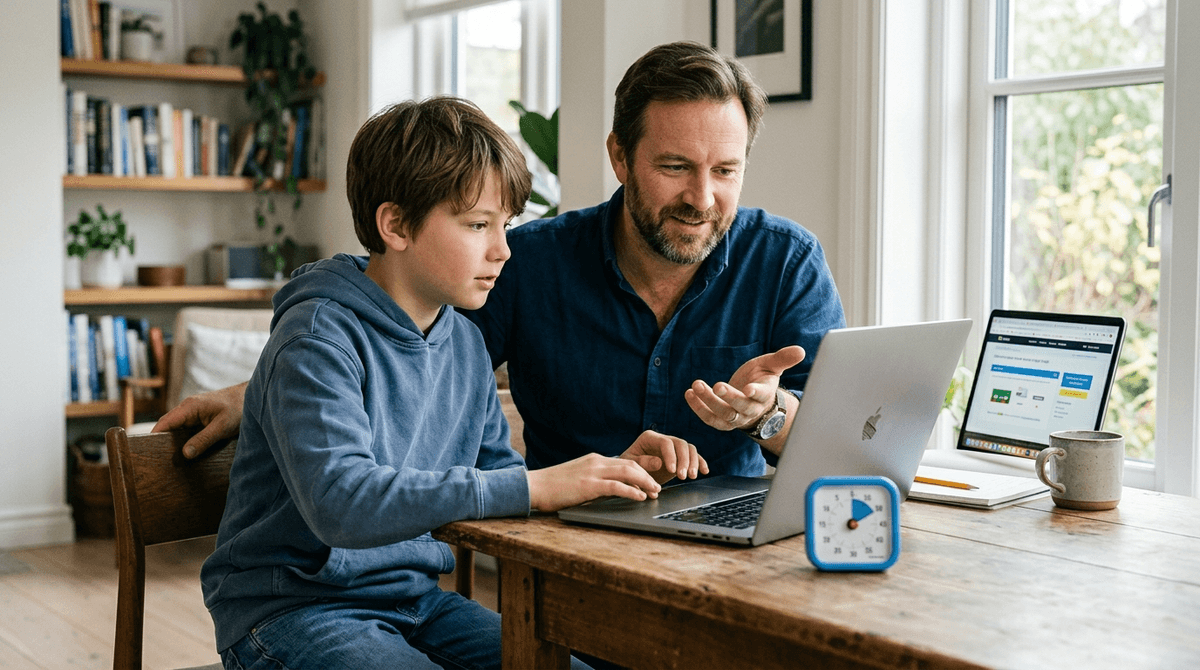

Unchecked screen use exacerbates behavioral and social challenges for children with ADHD or autism, but direct parental involvement can neutralize much of the impact. Simply sitting beside your child or enforcing predictable transitions changes how their nervous system processes digital media.
Active parenting buffers neurodivergent children from the worst impacts of high screen time, turning potentially dysregulating media into a manageable experience.
Managing screen time for a neurodivergent child does not require total digital deprivation. Shifting how your child consumes media—moving from solo, passive viewing to co-viewing and scheduled boundaries—preserves the utility of digital devices while preventing severe post-screen meltdowns and symptom flare-ups.
Neurodivergent children process rapid sensory inputs differently than neurotypical peers, making standard screen advice inadequate. High-frequency visual and audio cuts in modern media frequently overload the nervous systems of kids with Autism Spectrum Disorder (ASD) and trigger abrupt dopamine crashes in kids with Attention-Deficit/Hyperactivity Disorder (ADHD). Clinical reviewers wanted to determine whether structured parental interventions could offset these hardwired biological responses.
Excessive screen use—often exceeding two hours daily—directly correlates with increased hyperactivity, impulsivity, and social withdrawal in neurodivergent children.
- Sensory overload: Screens deliver intense sensory input that easily overwhelms children with ASD, causing them to retreat socially.
- Passive vs. active: Solo, continuous consumption causes far more behavioral disruption than interactive or shared screen use.
- Parental buffering: Co-viewing and strict digital schedules act as a protective barrier, reducing the severity of behavioral spikes.
The primary driver of post-screen dysregulation is often the unguided, solo nature of modern media consumption. When neurodivergent children watch devices alone, they lack external support to process rapid visual transitions and manage emotional reactions. A parent sitting nearby acts as an external prefrontal cortex, helping the child filter inputs before they trigger a stress response.
This synthesis reflects clinical consensus and observational data rather than a new controlled clinical trial. Much of the underlying research relies on parent-reported surveys, which carry inherent reporting bias. Furthermore, while high screen time correlates with worse symptoms, this review cannot prove causation—children with more severe baseline symptoms may simply be given screens more frequently as a calming tool.
- If your child experiences severe meltdowns when a device is turned off… establish a clear visual transition countdown to cushion the rapid dopamine drop that triggers emotional spikes.
- If your neurodivergent child consumes media alone… switch to active co-viewing by talking through the plot in real time to help your child process the sensory input.
- If screen time leaves your child visibly hyperactive or dysregulated… follow every screen session immediately with ten minutes of physical or tactile play to ground their nervous system.
You do not need to strip screens out of your household completely to protect your child's neurodevelopment. Stepping in as an active filter—talking through content and enforcing clear transition routines—protects your child's sensory balance without turning your home into a battleground.
Bukhari I, Bilal M (2026). Impact of screen time on ADHD and Autism in children and the role of parent-based interventions. JPMA. The Journal of the Pakistan Medical Association. doi:10.47391/JPMA.32685 — pubmed.ncbi.nlm.nih.gov