

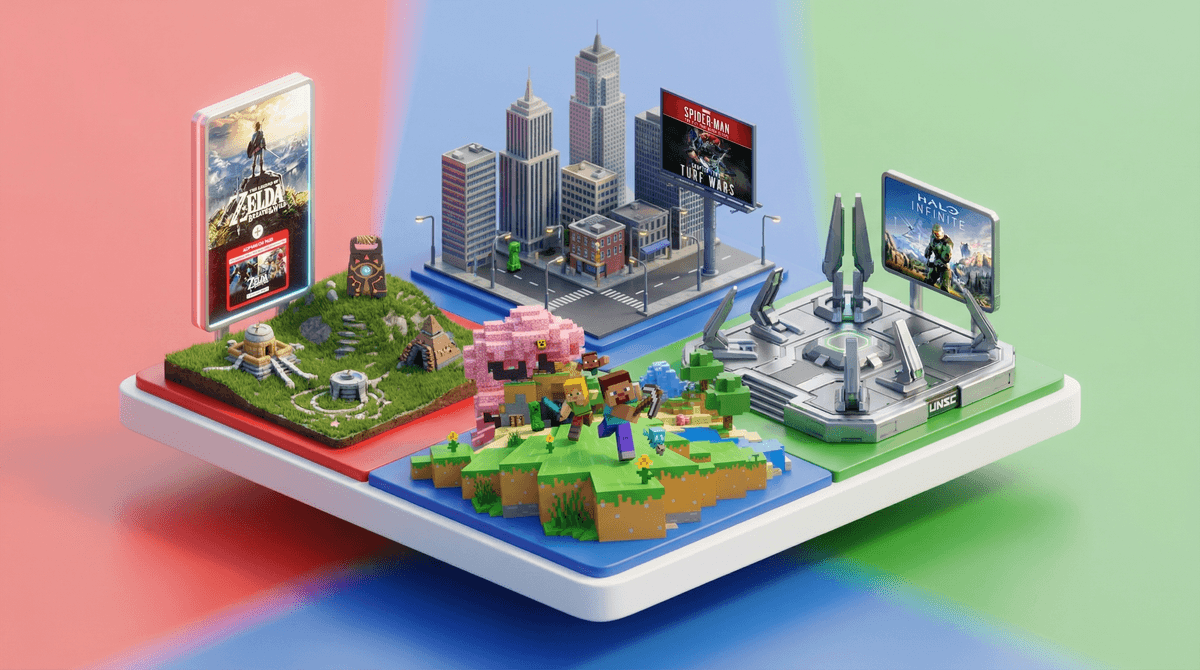
So you're ready to take the plunge on a gaming console. Maybe it's a birthday gift, maybe you're tired of your kid begging to play at their friend's house, or maybe you just want to understand what all the fuss is about. Whatever brought you here, let's cut through the marketing hype and talk real differences between the three major players: Nintendo Switch, PlayStation 5 (PS5), and Xbox Series X/S.
Here's the short version: These aren't really competing for the same spot in your home. The Switch is fundamentally different from the PS5 and Xbox, which are more similar to each other than most people realize. Think of it like comparing a Honda Civic to two different pickup trucks—they all have wheels, but they're built for different purposes.
Price: $299 (standard) or $199 (Switch Lite, handheld-only)
The Switch is the console that makes the most sense for most families with elementary and middle school kids. It's portable, so kids can play in the car or take it to grandma's house. It docks to your TV when you're home. And Nintendo's game library is absolutely stacked with age-appropriate titles that are actually good—The Legend of Zelda: Breath of the Wild, Mario Kart 8, Animal Crossing: New Horizons, Splatoon 3.
The good: Games are designed for all ages, not just "kid versions" of adult games. The parental controls app is genuinely useful—you can set time limits, restrict online features, and monitor playtime from your phone. No subscription required for most features (though online play needs Nintendo Switch Online at $20/year, which is cheaper than competitors).
The not-so-good: Graphics aren't as impressive as PS5/Xbox. Some games run at lower frame rates. The online voice chat system is clunky. And yes, your kids will still want Fortnite and Minecraft (both available on Switch, though they look better on other systems).
Best for: Ages 5-14, families who want to play together, parents who want more control over content, households where portability matters.
Price: $499 (with disc drive) or $449 (digital only)
The PS5 is Sony's bet on premium gaming experiences. We're talking stunning graphics, exclusive games like Spider-Man and Horizon Forbidden West, and a controller that actually makes you feel different textures through haptic feedback (it's wild, honestly).
The good: Best exclusive games for teens and adults. Doubles as a 4K Blu-ray player and streaming hub. PlayStation Plus subscription ($80/year) includes a solid library of free games. The PS5's parental controls let you restrict by age rating, set spending limits, and control communication features.
The not-so-good: Most of the marquee games are rated T (Teen, 13+) or M (Mature, 17+). It's expensive, and the games are expensive ($70 for new releases). The console is huge—like, comically large. And good luck finding one at retail price without some hunting.
Best for: Ages 13+, families who want a premium entertainment system, teens who are into story-driven single-player games, households where multiple people will use it for streaming.
Price: $499 (Series X) or $299 (Series S, digital-only with less storage)
Microsoft's strategy with Xbox is all about Game Pass, their Netflix-for-games subscription ($17/month for Game Pass Ultimate). You get access to hundreds of games, including day-one releases of Microsoft exclusives like Halo and Minecraft Legends.
The good: Game Pass is legitimately the best deal in gaming if your kids like variety. The Series S at $299 is the cheapest entry point for current-gen gaming. Xbox's parental controls are robust—screen time limits, content filters, purchase approvals all manageable from your phone. Cross-play with PC means kids can play with friends who don't have consoles.
The not-so-good: Fewer exclusive games than PlayStation. The Series S has less storage and can't play physical discs (which means you're locked into digital prices). Game Pass is a monthly commitment that adds up ($204/year).
Best for: Ages 10+, families who want variety without buying individual games, households with both console and PC gamers, parents who want strong parental controls.
Content and Age Appropriateness:
Social Features: This is where things get complicated. All three consoles have voice chat, friend systems, and ways for kids to interact with strangers online. Read more about managing online gaming safety if this is new territory for you.
Cost Beyond the Console:
- Switch: $60 games, $20/year online, occasional accessories
- PS5: $70 games, $80/year for online + free games, maybe an extra controller ($75)
- Xbox: $70 games OR $17/month Game Pass, extra controller ($65)
Over two years, assuming Game Pass for Xbox, you're looking at roughly similar total costs—but the spending pattern is different.
Here's the thing: your kid probably has specific games in mind. Ask them. Make a list. Then check which consoles have those games.
Popular cross-platform games (on all systems):
- Fortnite (free)
- Minecraft
- Rocket League (free)
- Fall Guys (free)
- Among Us
Switch exclusives kids love:
- Mario Kart 8
- Super Smash Bros. Ultimate
- Pokémon games
- The Legend of Zelda series
PS5/Xbox games teens want:
- Call of Duty (M-rated)
- FIFA/EA Sports FC
- Spider-Man (PS5 only)
- Halo (Xbox only)
Get a Switch if: Your kids are under 13, you want games the whole family can play, portability matters, or you want the most robust kid-friendly game library.
Get a PS5 if: Your kids are 13+, you want the best graphics and exclusive story games, you'll use it as a media center, and you're okay with the premium price.
Get an Xbox if: You want the best value through Game Pass, your kids like variety, you have a mixed household of console and PC gamers, or you want to start with the cheaper Series S.
Or honestly? If your kid is under 10 and you can swing it eventually, you might end up with a Switch now and a PS5/Xbox later. They serve different purposes. But if you're choosing one today, for most families with elementary and middle school kids, the Switch is the move.
- Ask your kid which specific games they want to play—that might make the decision for you
- Check what their friends have—gaming is social, and cross-platform play isn't universal yet
- Set up parental controls from day one—here's how for Switch, PS5, and Xbox
- Have the conversation about game ratings before you buy—decide together what content is okay for your family
And remember: no console is going to rot your kid's brain or turn them into a genius. It's just a tool. What matters is how you set boundaries, what games they play, and whether gaming is balanced with the rest of life. You've got this.