

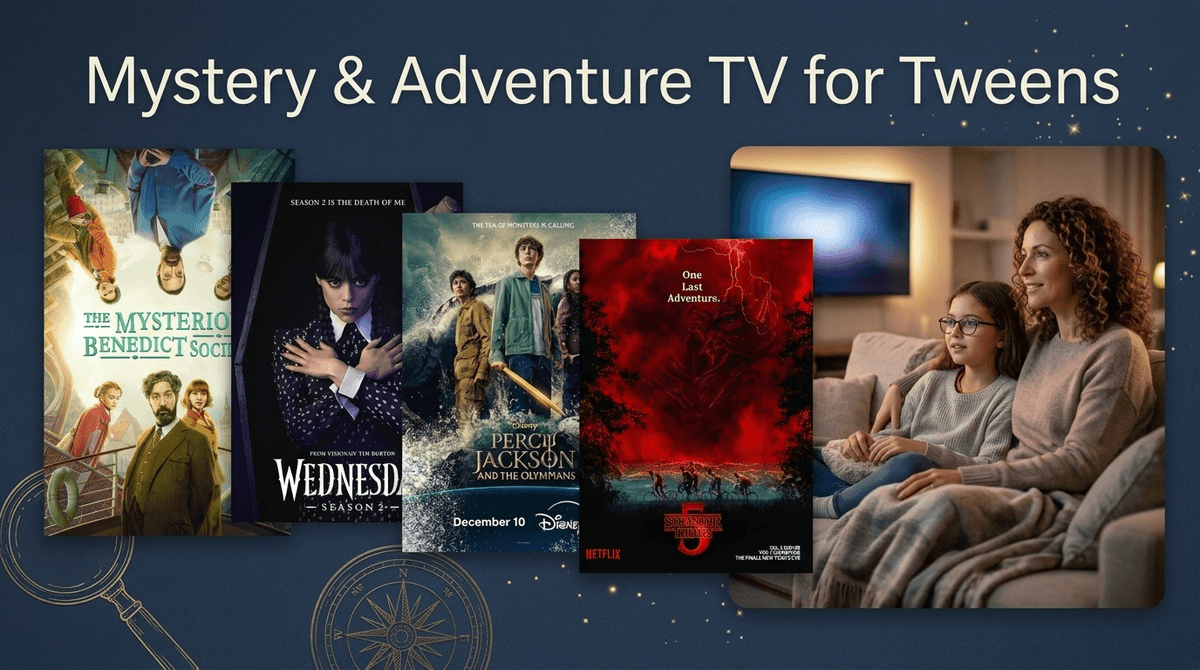
TL;DR: The Mystery & Adventure Cheat Sheet
If you’re looking to move past the "brain rot" of YouTube shorts and find something the whole family can actually enjoy without wanting to scroll through your phone the whole time, here are the top picks for tweens right now:
- Best for Puzzle Lovers: The Mysterious Benedict Society (Disney+) - Low on scares, high on "wait, I think I solved it."
- Best for Book Fans: Percy Jackson and the Olympians (Disney+) - Finally, a faithful adaptation that captures the "main character energy" tweens crave.
- Best for "Spooky" Tweens: Wednesday (Netflix) - High on "aura," dark humor, and a solid mystery that isn't too traumatizing.
- Best for Older Tweens (11+): Stranger Things (Netflix) - The ultimate adventure, but check the "scary" meter first.
- Best Hidden Gem: Lockwood & Co. (Netflix) - Ghost hunting with swords and zero adult supervision.
Ask our chatbot for a personalized watch list based on your kid's favorite books
There’s a specific window between ages 9 and 13 where kids stop wanting "lessons" in their TV shows and start wanting stakes. They are currently navigating the weirdest social transition of their lives—middle school—where every day feels like a high-stakes adventure (or a horror movie, depending on who they sat with at lunch).
Mystery and adventure shows mirror that internal chaos. When characters like Enola Holmes or the kids in Stranger Things solve a problem that the adults are too oblivious to see, it hits a very specific psychological "sweet spot." It’s about agency. In a world where we (rightfully) track their locations and manage their screen time, seeing a kid on screen outsmart a villain or navigate a literal underworld is the ultimate wish fulfillment.
Plus, let's be real: it's a great way to bond. It’s hard to have a deep conversation about a 15-second TikTok of someone doing a "Skibidi" dance in Ohio, but you can talk about who the mole is in The Mysterious Benedict Society.
This is the number one question I get at pickup: "Is Wednesday too scary for my 4th grader?"
The answer is almost always: it depends on their "scare-tolerance," but also on the type of scary. Most tweens can handle "spooky" (fog, ghosts, weird costumes) better than they can handle "dread" (psychological tension, things hiding under the bed, jump scares).
According to Screenwise community data, about 45% of parents of 10-year-olds feel comfortable with Wednesday, while that number jumps to nearly 80% once the kid hits 12.
If you're unsure, look for Adventure over Horror. Adventure shows usually focus on the solution and the journey, whereas horror focuses on the threat.
Ages 8+ This is the gold standard for "all-ages" mystery. It follows four gifted orphans recruited by a quirky benefactor to go undercover at a boarding school to stop a global "Emergency." It’s visually stunning, incredibly smart, and rewards kids for being observant. It’s basically the TV equivalent of an escape room.
- Why it’s safe: Very little violence, zero gore, and the "scary" elements are more about social engineering and mind control (which leads to great conversations about how social media algorithms work).
Ages 9+ If your kid has read the Percy Jackson books, they’ve probably already seen this three times. If they haven't, this is the perfect "entry-level" adventure. It deals with big themes—identity, abandonment, and bravery—but keeps it grounded in the friendship between Percy, Annabeth, and Grover.
- The Vibe: High-octane adventure with monsters, but it never feels hopeless. It’s the definition of "just right" for the tween demographic.
Ages 11+ This show is a cultural juggernaut. If your kid is talking about "deadpan vibes" or "aura points," they are likely channeling Wednesday Addams. It’s a classic "whodunnit" set at a supernatural boarding school.
- The Reality Check: There is some gore (it’s Tim Burton, after all) and a few jump scares. It’s definitely "edgier" than Disney+ fare. If your kid is sensitive to blood or "monster" visuals, maybe pre-screen the first episode.
- Parent Tip: Use this to talk about being an "outcast" and how Wednesday navigates social structures without losing her identity.
Ages 10+ This is the show I wish more people were talking about. In a world plagued by ghosts that only kids and teens can see/fight, three teens run their own ghost-hunting agency without adult supervision.
- Why it’s great: It treats tweens like adults. The stakes are real, the mystery is deep, and the world-building is top-tier. It's a bit spooky, but the focus is on the competence of the kids.
Check out our guide on the best "spooky but safe" shows for middle schoolers
Sometimes you don't want a "good" show; you want a show that fits the mood of the house.
For the "I'm Bored and Want to Solve Something" Mood:
- A Series of Unfortunate Events (Netflix) - Stylized, dark humor, and very meta. Great for kids who like Lemony Snicket books.
- The Hardy Boys (Hulu/Amazon) - A more modern, slightly grittier take on the classic mystery series.
For the "I Want to Feel Like a Hero" Mood:
- The Dragon Prince (Netflix) - Yes, it’s animated, but the adventure is epic and the writing is sophisticated enough for 12-year-olds.
- Renegade Nell (Disney+) - A historical adventure with a supernatural twist. Nell is a fantastic, gritty female lead who doesn't fit the "princess" mold.
For the "Everyone Else at School is Watching It" Mood:
- Stranger Things (Netflix) - This is the big one. If your tween is in 6th or 7th grade, the social pressure to watch this is real.
- Note: Season 1 is a solid "Adventure/Mystery." By Season 4, it is full-blown "Horror." If you have a younger tween, maybe stick to the first two seasons and re-evaluate.
Mystery shows are designed to be binged. The "cliffhanger" is a dopamine delivery system. You’ll hear "Just one more episode, I need to know who the killer is!" more often with this genre than any other.
Pro-tip: Instead of fighting the cliffhanger, use it. "We’ll watch the first 10 minutes of the next episode to see how they get out of the trap, then it’s lights out." It sounds counter-intuitive, but it lowers the "stress" of the cliffhanger and makes the transition to bed much easier.
Learn more about how binge-watching affects tween brain development
These shows aren't just entertainment; they're "practice" for real-life problem-solving. When you're watching together, try asking:
- "Who do you think is the most 'sus' right now?" (Using their lingo—suspicious—is a low-key way to show you're paying attention).
- "If you were in that situation, would you have told the adults or tried to fix it yourself?"
- "Why do you think the villain is doing this? Are they just 'evil' or is there a reason?"
This turns a passive screen time moment into a lesson in empathy and critical thinking without it feeling like a lecture.
Mystery and adventure shows are the perfect "bridge" content. They move kids away from the mindless scroll of YouTube and into long-form storytelling that requires focus and memory.
If you're looking for a place to start tonight, go with The Mysterious Benedict Society. It’s clever, it’s clean, and it’ll make your kid feel like the smartest person in the room—which, let’s be honest, is all a tween really wants.
- Audit your streaming settings: Make sure your Netflix parental controls are set so they don't accidentally wander from Enola Holmes into Squid Game.
- Check the "Scare Factor": Use the Screenwise chatbot to get a "scare breakdown" of any show before you hit play.
- Start a "Family Mystery Night": Pick one of the shows above and commit to watching one episode a week together. No phones allowed (for you either, sorry!).