

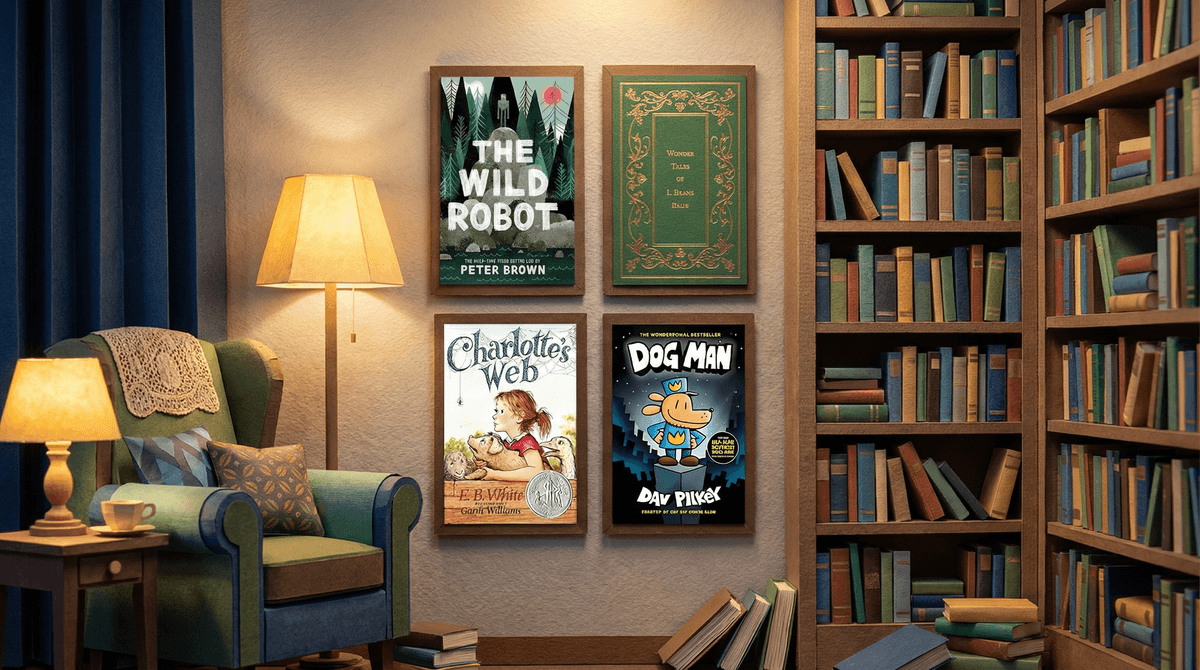
Must-Read Books for 3rd Grade: The 2024 Parent's Guide
TL;DR: Third grade is when kids either become readers or... don't. The sweet spot is 8-9 years old, chapter books are the gateway, and you need a mix of high-interest "junk food" reads (Dog Man, Diary of a Wimpy Kid) and genuinely great literature (Charlotte's Web, Wonder). Here's what actually works.
Third grade is when schools shift from "learning to read" to "reading to learn." Kids who aren't hooked on books by the end of this year often struggle to catch up—not because they can't read, but because they won't.
The competition is fierce: Roblox, YouTube, and Fortnite are engineered by teams of PhDs to hijack attention. Books? Books just sit there on the shelf, waiting to be chosen.
So yes, this matters. A lot.
Let's be honest: some kids would rather eat broccoli than read. For these kids, you need books that feel like cheating—so fun they don't realize they're reading.
Ages 7-10
Half comic, half chapter book, 100% bathroom humor. Dog Man is a police dog with a human body (or a human with a dog head? The science is unclear). Parents often worry these books are "too easy" or "not real reading," but here's the thing: a kid reading Dog Man is still reading. The vocabulary is stronger than you'd think, and Pilkey sneaks in themes about friendship, redemption, and doing the right thing between all the poop jokes.
Ages 8-12
The gateway drug of chapter books. Greg Heffley is selfish, whiny, and makes terrible decisions—which is exactly why kids love him. The diary format with cartoon illustrations makes these books feel manageable, and there are like 18 books in the series, so once a kid is hooked, you've got months of reading material. Fair warning: Greg is not a role model, but that's kind of the point.
Ages 7-9
A wolf, a snake, a shark, and a piranha try to become good guys. Heavily illustrated, fast-paced, genuinely funny. These books are perfect for kids transitioning from picture books to chapter books. The text is large, the chapters are short, and the jokes land. Plus, the underlying message about redemption and not judging by appearances is actually pretty solid.
Ages 7-10
The OG "trashy" book series that parents love to hate. But Pilkey is a genius—he gets that third-grade boys think underwear is the pinnacle of comedy, and he builds entire narratives around it. Bonus: these books celebrate creativity, friendship, and standing up to bullies. Yes, there's a character named Professor Poopypants. Your kid will be fine.
These are the books you can recommend to other parents without feeling defensive. They're well-written, award-winning, and—crucially—kids actually want to read them.
Ages 8-12
Auggie Pullman has a facial difference and is starting fifth grade at a mainstream school for the first time. This book is about kindness, empathy, and choosing courage over comfort. It's told from multiple perspectives, which helps kids understand that everyone has their own story.
Fair warning: this book will make your kid cry. It will also probably make you cry. It's been assigned reading in many schools, which sometimes makes kids resistant, but if you can get them to start it before it's homework, they'll devour it. The movie is also excellent, but read the book first.
Ages 7-10
A classic for a reason. Wilbur the pig and Charlotte the spider navigate friendship, mortality, and the meaning of life on a farm. White's prose is beautiful without being stuffy, and the themes are timeless. Some kids find it slow compared to modern books, but others fall completely in love.
This is one of those books where reading it aloud as a family can work magic—White's language is meant to be heard.
Ages 8-12
A robot named Roz wakes up on a remote island and has to learn to survive. It's part survival story, part meditation on what it means to be alive, part environmental fable. The writing is gorgeous, the story is gripping, and it works for both reluctant readers (it's a page-turner) and strong readers (there's real depth here).
There's a sequel (The Wild Robot Escapes) and a third book coming, plus a movie adaptation in the works. This is the rare book that appeals to kids who love nature AND kids who love robots.
Ages 8-12
A brilliant girl with terrible parents and a tyrannical headmistress discovers she has telekinetic powers. Dahl's books are dark, funny, and deeply satisfying—the bad guys get what's coming to them, and the weird kids win.
Matilda is probably Dahl's most beloved book, and for good reason. It's a love letter to reading, libraries, and kind teachers. Just be prepared for your kid to ask why they can't move things with their mind.
Ages 9-13
Thirteen-year-old Brian survives a plane crash and has to live alone in the Canadian wilderness with nothing but a hatchet. This book is intense—Brian makes mistakes, gets hurt, and has to figure out how to survive without any adults to help him.
It's perfect for kids who love survival stories, nature, and adventure. Some parents worry it's too scary, but most third graders can handle it, especially if they're strong readers. There are four sequels if your kid gets hooked.
Once a kid finds a series they love, they'll read every single book. These are the series that create lifelong readers.
Ages 9-14
Greek mythology meets modern middle school. Percy Jackson discovers he's the son of Poseidon and gets pulled into a world of gods, monsters, and quests. The first book (The Lightning Thief) is a perfect entry point.
Riordan's writing is fast-paced, funny, and sneakily educational—kids learn actual Greek mythology without realizing it. There are five books in the original series, plus multiple spinoff series (Roman mythology, Norse mythology, Egyptian mythology). Once a kid is hooked on Percy Jackson, you've got years of reading material.
Bonus: the new Disney+ show is actually good, but read the books first.
Ages 6-9
Jack and Annie travel through time via a magic tree house. These books are perfect for younger or struggling third graders—the chapters are short, the vocabulary is accessible, and there are over 30 books in the series.
Each book is set in a different time period or location (dinosaurs, ancient Egypt, the Titanic), so kids learn history while reading an adventure story. The books are formulaic, but that's actually helpful for building reading confidence.
Ages 9-14
Dragons. Politics. Prophecies. War. This series is basically Game of Thrones for kids, minus the inappropriate stuff. Each book is told from the perspective of a different dragon, and the world-building is incredibly rich.
These books are LONG (300+ pages), which can be intimidating, but kids who love them become obsessed. There are 15 books in the main series, plus graphic novel adaptations for kids who need more visual support. Fair warning: there's violence (dragons fighting dragons), but it's not gratuitous.
Ages 6-9
Junie B. is a kindergartener (later first grader) with a big personality and questionable grammar. These books are hilarious and perfect for younger third graders or kids who need shorter chapter books.
Some parents worry about Junie B.'s grammar and attitude, but most kids understand she's not always making good choices. The books are genuinely funny and help kids transition from picture books to chapter books.
Third grade is when kids start asking hard questions about fairness, identity, and how the world works. These books help start those conversations.
Ages 8-12
Mia Tang's family manages a motel in California, and Mia helps out at the front desk while navigating school, racism, and the challenges of being an immigrant kid. This book is funny, heartbreaking, and ultimately hopeful. It's also a great window into experiences many kids don't see in their own lives.
Ages 8-12
Based on a true story, Ivan is a gorilla who lives in a shopping mall. The book is told from Ivan's perspective and explores themes of captivity, friendship, and what it means to be free. It's beautiful, sad, and ultimately uplifting.
This book is perfect for animal-loving kids and works great as a read-aloud.
Ages 9-13
Castle "Ghost" Cranshaw is a natural runner who joins a track team and has to confront his past trauma and anger. Reynolds writes about Black boys with nuance and empathy, and his books are page-turners. This is the first in a four-book series, each about a different kid on the track team.
Third graders can range from reading at a first-grade level to a sixth-grade level. Here's the thing: reading level matters less than interest level.
A kid reading Dog Man "below their level" is better than a kid avoiding books entirely because you keep pushing Charlotte's Web before they're ready.
That said, if your kid is reading significantly below grade level, talk to their teacher. Third grade is when reading difficulties become more apparent, and early intervention makes a huge difference.
The goal isn't to create a third grader who only reads Newbery winners. The goal is to create a kid who chooses to read.
That means:
- Let them read "junk" if it keeps them reading
- Don't force books just because they're classics
- Series are your friend—momentum matters
- Comic books, graphic novels, and illustrated chapter books absolutely count
- Reading the same book 47 times is fine
- Audiobooks count (seriously, they do)
Build a home library with a mix of high-interest and high-quality books. Let your kid see you reading. Visit the library regularly. And when your kid finds a book they love, buy every book in the series.
Third grade is when readers are made. Make it count.
Next Steps: Not sure where to start? Check out how to build a home library for elementary schoolers or explore alternatives to screen time that actually work. And if you need help balancing reading time with Minecraft time, we can help with that too .
.