

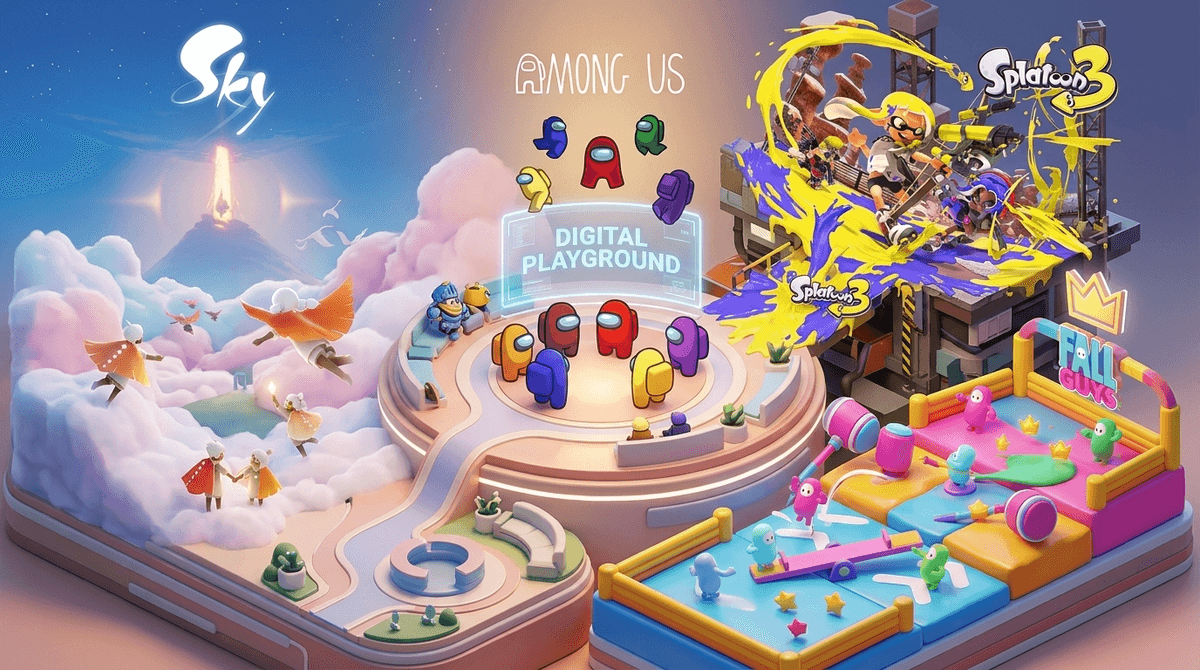
TL;DR: You want your kids to have the "social" part of gaming without the "listening to a 14-year-old in Ohio scream slurs" part. It’s possible. Our top picks for mic-free multiplayer:
- Best for Pure Vibes: Sky: Children of the Light
- Best for Competitive Spirits: Splatoon 3
- Best for Creative Collaboration: Minecraft
- Best for Chaos: Fall Guys
- Best for "Safe" Strategy: Among Us (Quick Chat mode)
We’ve all been there. You walk past the living room and hear a voice coming from the TV that definitely doesn't belong to your child. It’s usually some kid halfway across the country complaining about "lag" or using "Skibidi" in a way that makes your brain leak out of your ears.
Voice chat is the Wild West of modern parenting. On one hand, gaming is the new "hanging out at the mall." On the other hand, toxic lobbies are a breeding ground for bullying, inappropriate language, and the kind of "brain rot" content we’re all trying to moderate.
The good news? Some of the best multiplayer experiences today either don’t have native voice chat or have built-in systems that make the mic completely unnecessary. You can give your kids the thrill of playing with others without the stress of stranger danger or toxic chatter.
Communication in games used to mean a headset and a prayer. But game designers have realized that voice chat is often... well, terrible. It’s exclusionary, it’s often toxic, and for younger kids, it’s a massive privacy risk.
Enter "Non-Verbal Communication." Many modern games use "pings," emotes, or physical gestures to let players work together. It turns out you don't need to hear someone's voice to know they want to team up to build a castle or take down a boss. In fact, it’s often a more "pure" form of play.
Get the pros and cons of voice chat in gaming
Ages 7+ If you want a game that feels like a warm hug, this is it. Created by the same people who made Journey, Sky is a "social adventure." You fly through beautiful realms, but here’s the kicker: you communicate through musical chirps and gestures. You can hold hands with other players to fly together, but you can’t actually type or talk to them unless you go through a multi-step process to become "friends." It’s the ultimate "peaceful" multiplayer experience.
Ages 10+ Nintendo is famously (and sometimes frustratingly) protective when it comes to online safety. In Splatoon 3, there is no native voice chat in the game itself. If kids want to talk, they have to use a separate phone app (which you can just... not set up). Players communicate using simple "This way!" or "Booyah!" pings. It’s fast-paced, competitive, and entirely salt-free.
Ages 6+ This is a masterclass in "passive" multiplayer. When your child plays online, they see "ghosts" of other real players running through the level with them. They can’t talk, but they can place "standees" to help each other out or share power-ups. It feels like you’re part of a community without any of the pressure of direct interaction.
Ages 8+ Think Wipeout but with jellybeans. It’s a massive obstacle course race. While there is a party chat feature for friends, the main gameplay has no public voice chat. Kids just run, jump, and occasionally get knocked off a platform by a giant swinging hammer. It’s pure, chaotic fun where the only communication is a "woo-hoo" sound effect.
Ages 10+ Wait, isn't Among Us all about talking? Yes, but the "Quick Chat" feature is a lifesaver. If you set your child’s account to under 13 (or just enforce it), they can only use a pre-set wheel of phrases like "I saw Blue in the MedBay." It removes the ability for strangers to type inappropriate things while keeping the "whodunnit" mystery alive.
You can't talk about multiplayer without Minecraft and Roblox. Both are incredible for entrepreneurship and creativity, but they handle chat differently.
Ages 8+ Standard Minecraft doesn't have built-in voice chat (though many kids use Discord on the side). If your child is playing on a private "Realm" with just school friends, it’s one of the best digital playgrounds out there. If they are on massive public servers like Hypixel, text chat can get spicy, but you can disable it entirely in the settings. Check out our guide on Minecraft safety settings
Ages 10+
Roblox is a bit of a minefield. It does have a "Spatial Voice" feature now, but it requires age verification (ID upload). For most kids, communication is limited to text chat, which has heavy filtering (lots of "####" when they try to say something the system doesn't like). You can—and probably should—set their account to "No Chat" or "Friends Only" in the privacy settings.
Is Roblox actually teaching my kid to be an entrepreneur?
When deciding if a game is right for your kid, look past the ESRB rating. A "10+" rating doesn't account for the 19-year-old on the other end of a headset.
- Under 8: Stick to "Passive" multiplayer like Super Mario Bros. Wonder or local "couch co-op" games like Untitled Goose Game.
- Ages 9-12: This is the "ping" sweet spot. Games like Splatoon 3 or Rocket League (with chat disabled) allow them to feel the competitive rush without the exposure.
- Ages 13+: This is usually when the social pressure to use Discord or voice chat hits. At this stage, it’s less about blocking and more about training.
Find the best "first" online games for 2nd graders
Most consoles have "System Level" controls that are way more effective than individual game settings.
- Nintendo Switch: Use the Nintendo Switch Parental Controls app. You can disable "Communication with Others" entirely.
- PlayStation/Xbox: You can set "Communication and Multiplayer" to "Friends Only" or "Off." This prevents anyone not on their approved friend list from talking to them.
- The "Headset Rule": A simple household rule? No headsets. If the game audio is coming through the TV, you can hear what’s being said. If they’re playing a game that "requires" a mic to be good? Maybe that’s a game they wait a few years for.
If you do allow some level of chat, you’re going to hear weird stuff. Your kid might tell you a game is "so Ohio" or mention "Skibidi."
Don't panic. Most of this is just the current "slang of the week" from YouTube and TikTok. It’s usually harmless, albeit annoying. The real red flag isn't the slang; it’s the behavior. If your kid is getting angry, throwing controllers, or sounding like a different person when they’re "with the guys" online, that’s your cue to pull the plug on the mic.
Read our guide to understanding Gen Alpha slang
Online gaming doesn't have to be a choice between "Total Isolation" and "Toxic Lobbies." There is a massive middle ground of games designed to be played together in silence.
By steering your kids toward games with non-verbal communication, you’re letting them build those teamwork and strategy skills without the side of verbal abuse. It’s a win-win. They get to play with their friends, and you don’t have to worry about who’s on the other end of the connection.
- Check the settings: Pick one game your kid plays and see if you can toggle chat to "Friends Only."
- Try a "Vibe" game: Download Sky: Children of the Light and play it with them for 20 minutes. You’ll see why it’s a game-changer.
- Talk about it: Ask your kid, "Do people ever say mean things in the chat?" You might be surprised by how much they actually dislike the noise, too.