

Look, representation matters. And when it comes to disability representation in film, we've come a long way from the "inspiration porn" trope where disabled characters exist solely to make able-bodied people feel good about themselves. These days, there are genuinely great films featuring characters with disabilities who are complex, funny, flawed, and real — not just symbols or teaching moments.
We're talking about movies where characters who are blind, deaf, autistic, use wheelchairs, have Down syndrome, or live with other disabilities are actually characters — not plot devices. They have their own stories, agency, and personalities beyond their disability.
For kids growing up, seeing disability represented on screen (whether they're disabled themselves or not) shapes how they understand difference, accessibility, and what it means to be human. And honestly? Some of these movies are just really, really good.
If your child has a disability: Seeing themselves reflected on screen can be genuinely powerful. It's the difference between growing up thinking you're the only one versus seeing someone like you be the hero, the friend, the love interest, the funny one. Representation tells kids they belong in the story.
If your child doesn't have a disability: These movies build empathy and normalize disability as part of human diversity. They counter the "othering" that happens when kids never see disabled people as full human beings in their media diet. Plus, statistically, your kid will have classmates, friends, family members, or eventually coworkers with disabilities — this is basic cultural literacy.
The thing is, not all disability representation is created equal. Some movies get it beautifully right. Others... well, they try. And some are straight-up cringeworthy in ways that can actually reinforce harmful stereotypes.
Green flags:
- Actually cast disabled actors in disabled roles (this is huge)
- The character has a life beyond their disability
- The story doesn't revolve around being "cured" or "overcoming" disability
- Shows both challenges and joy — disability isn't all tragedy
- Includes authentic details (like how deaf people actually communicate, not Hollywood's version)
Red flags:
- Non-disabled actors playing disabled characters (looking at you, Music)
- The "magical disability" trope where being disabled gives you superpowers
- Inspiration porn — the disabled character exists to teach able-bodied people life lessons
- The disability is "fixed" by the end as the happy ending
- Harmful stereotypes (autistic people as savants, blind people as mystical, etc.)
Elementary Age (5-10)
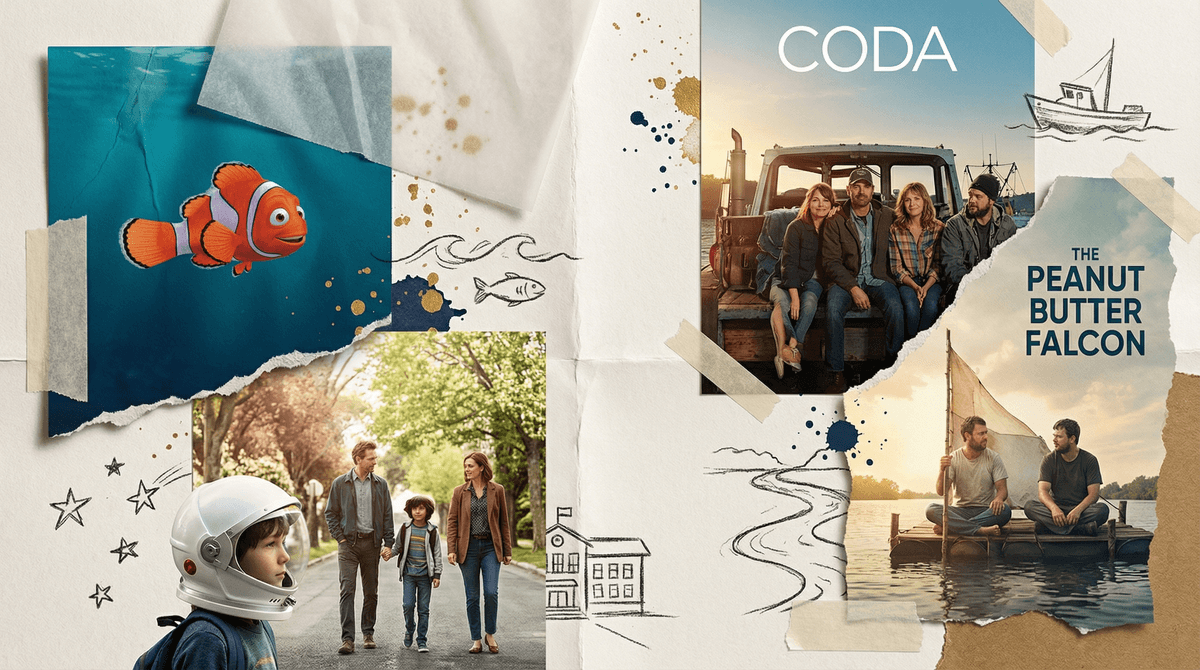
Finding Nemo — Nemo has a "lucky fin" (a smaller, weaker fin from birth), and the movie doesn't make a huge deal about it. It's just part of who he is. His dad's overprotectiveness is more about his own anxiety than Nemo's actual capabilities. Ages 5+.
Luca — While not explicitly about disability, many viewers (especially those with social anxiety or who feel "different") see their experiences reflected in Luca's story about hiding who you are. Ages 6+.
CODA — This one's technically PG-13 for language and some mature themes, but it's a beautiful film about a hearing girl in a deaf family. The deaf characters are played by deaf actors, and the movie treats sign language as a full, rich language (not a limitation). Best for ages 12+ due to some sexual references and language, but the representation is chef's kiss.
Middle Grade (8-13)
Wonder — Based on the beloved book, this follows Auggie, a boy with facial differences starting mainstream school. It's emotional (bring tissues), but it's also funny and real about both the cruelty and kindness of kids. Ages 8+.
A Quiet Place — Okay, this is a horror movie, so not for everyone. But the deaf character Regan (played by deaf actress Millicent Simmonds) is smart, capable, and ultimately saves everyone. Her deafness is integrated into the plot in clever ways without being the point of the story. Ages 13+ if your kid can handle intense suspense.
The Peanut Butter Falcon — An adventure story featuring Zack Gottsagen, an actor with Down syndrome, as the lead. It's a buddy movie that's genuinely fun and doesn't treat its protagonist as a charity case. PG-13 for some language and thematic elements, ages 11+.
Teens (13+)
CODA — Mentioned above, but really shines for teen viewers who can appreciate the family dynamics and coming-of-age elements.
Everything Everywhere All at Once — Features a character who uses a wheelchair, played by Stephanie Hsu, in a multiverse adventure. The wheelchair is just... there. She's not defined by it. Ages 14+ (it's rated R for language and some violence, but it's more weird than graphic).
Sound of Metal — About a drummer who loses his hearing and must rebuild his identity. It's a mature, honest look at disability and identity. R-rated for language and some drug use, but appropriate for older teens (16+) who can handle heavy emotional themes.
The "nothing about us without us" principle: In disability advocacy, there's a saying: "Nothing about us without us." When you're choosing movies, look for films where disabled people were involved in the creation — as actors, writers, consultants, directors. The difference shows.
Your kid might ask questions: Good! That's the point. If they ask "Why does that person talk different?" or "How do they do that without seeing?" — answer honestly and matter-of-factly. Disability isn't shameful or secret.
Watch together: Especially for younger kids, these movies can spark great conversations. Pause and talk about what they're noticing, what questions they have, how characters are being treated.
Books too: Many of these movies are based on books. Wonder by R.J. Palacio, for example, is fantastic and includes perspectives from multiple characters. Reading the book first or after can deepen the experience.
Good disability representation in movies isn't about making your kid feel grateful for what they have (ugh, no). It's about expanding their understanding of what's normal, what's possible, and who gets to be the hero.
The best movies featuring disabled characters are just... good movies. The disability is part of the character, not the entire character. And increasingly, Hollywood is getting this right — especially when disabled actors, writers, and directors are in the room.
Start with what fits your kid's age and interests. If they love adventure, try The Peanut Butter Falcon. If they're into animation, Finding Nemo is a classic. If they're ready for something emotional, Wonder will wreck you both (in a good way).
And hey, if you want to dig deeper into any of these titles or find more recommendations, explore movies with disability representation or check out individual guides for the films that catch your eye.