

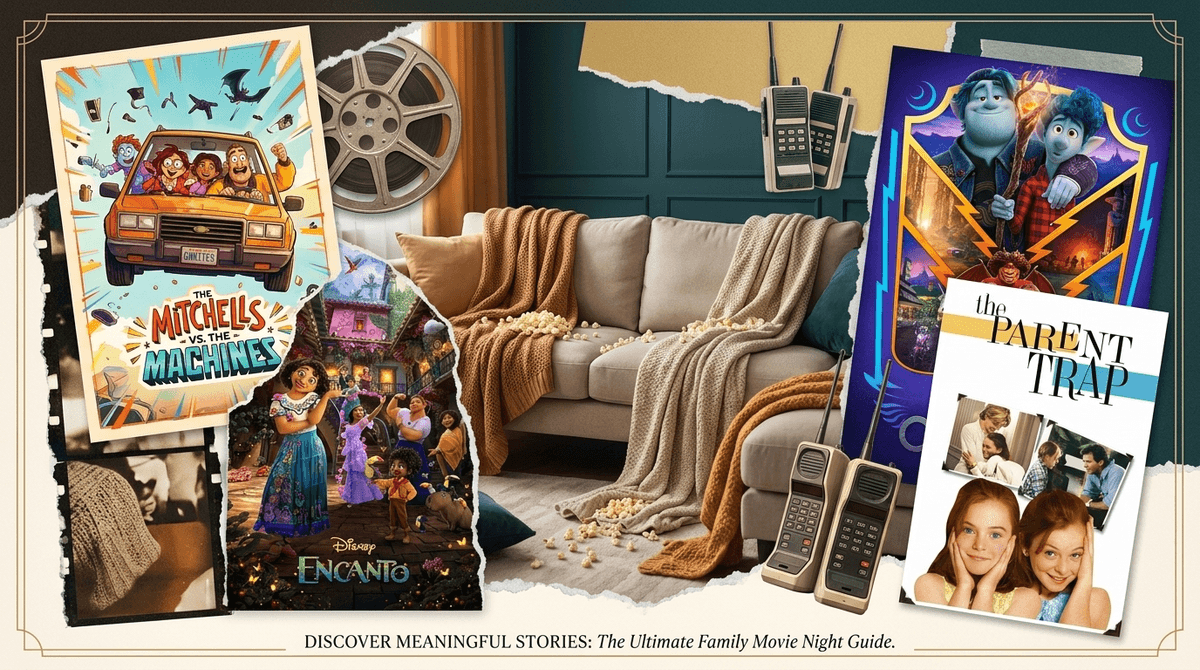
TL;DR: The Short List If you’re looking for a Friday night flick that does more than just distract them for 90 minutes, these are our top picks for navigating the "I love you / I want to throw your iPad out the window" sibling vibe:
- Best for Sibling Rivalry & Competition: The Parent Trap
- Best for Opposites Attracting: The Mitchells vs. The Machines
- Best for Sibling Grief & Support: Onward
- Best for Breaking Out of Sibling Roles: Encanto
- Best for "The Accidental Parent" Dynamic: Lilo & Stitch
One minute they’re huddled together over a single Nintendo Switch, working in perfect harmony to build a house in Minecraft. The next, someone has "accidentally" deleted a pixelated wall, and the screams echoing through the house make it sound like the world is ending.
Sibling dynamics are weird. They are the only people who will defend you to the death against a schoolyard bully and then turn around and tell you your breath smells like "Ohio" just to watch you crumble.
As parents, we spend a lot of time refereeing. We’re the UN peacekeepers of the living room. But sometimes, the best way to get them to see each other’s perspective isn't another lecture about "using your words"—it's sitting them down in front of a story that mirrors their own chaos.
Movies have a way of showing kids that their feelings—the jealousy, the loyalty, the annoyance—are actually universal. Here is our Screenwise-approved list of movies that explore sibling dynamics without being total "brain rot."
Research consistently shows that sibling relationships are the longest-lasting connections most people will ever have. It's the first "peer" relationship where kids learn to negotiate, share, and handle conflict. In the digital age, this has shifted. Now, siblings aren't just fighting over the remote; they’re fighting over who gets the "good" iPad, why one kid gets Discord while the other is stuck on YouTube Kids, and who’s hogging the bandwidth for Fortnite.
Watching movies that depict these struggles helps normalize the friction. It gives them a shared language to talk about their own "roles" in the family.
See advice on managing screen time fairness between siblings
Ages 7+ This movie is a masterpiece for modern families. It captures the exact moment a sibling relationship starts to shift: when the older sibling (Katie) is ready to leave for college and the younger sibling (Aaron) is terrified of being left behind.
- The Dynamic: Katie is the creative, tech-savvy "main character," while Aaron is the dinosaur-obsessed, slightly awkward younger brother.
- Why it works: It shows how siblings often "get" each other in ways parents don't. When the parents are clueless about Katie's filmmaking, Aaron is her biggest fan. It’s a great way to talk about supporting each other’s weird hobbies, whether that’s making YouTube videos or obsessing over prehistoric facts.
Ages 5+ If you haven't heard "We Don't Talk About Bruno" 4,000 times, do you even have kids? But beyond the catchy songs, Encanto is the gold standard for "Sibling Roles."
- The Dynamic: You have the "Perfect Child" (Isabela), the "Strong One" (Luisa), and the "Left Out One" (Mirabel).
- Why it works: This movie is a conversation starter about the pressure siblings feel to fit into a certain box. Ask your kids: "Do you ever feel like you have to be the 'smart one' or the 'helpful one'?" It helps them realize that their siblings are often struggling with expectations just as much as they are.
Ages 7+ This is the ultimate "brother" movie, but it resonates for any pair. It follows Ian and Barley on a quest to spend one more day with their late father.
- The Dynamic: Ian is the "responsible" but insecure younger brother; Barley is the "screw-up" older brother who is actually deeply knowledgeable and protective.
- Why it works: It flips the script. Ian spends the whole movie looking for a father figure, only to realize that his older brother has been filling that role the entire time. It’s a tear-jerker, but it’s a powerful look at how siblings step up when things get hard.
Ages 6+ Yes, the Lindsay Lohan version. It’s a classic for a reason.
- The Dynamic: Hallie and Annie start as bitter rivals at camp and end up as inseparable allies.
- Why it works: It highlights the "us vs. the world" energy that siblings can tap into. When they stop competing and start collaborating (even if it's to manipulate their parents—sorry!), they become an unstoppable team. It’s a great way to talk about how much more they can get done when they stop fighting each other.
Ages 6+ This movie doesn't pull punches about how hard it is when a sibling has to become a caregiver. Nani is trying to raise her younger sister Lilo after their parents pass away.
- The Dynamic: The "Parent-ified" older sister and the "Difficult" younger sister.
- Why it works: It’s messy. They scream at each other. Lilo bites Nani. It’s real. But it also features the most honest quote about family: "Ohana means family. Family means nobody gets left behind or forgotten." It’s a great look at the sacrifices older siblings often make.
Ages 4+ We have to mention it. Frozen shifted the Disney narrative from "Prince Charming saves the girl" to "The sister saves the girl."
- The Dynamic: The sister who shuts everyone out (Elsa) and the sister who tries too hard to connect (Anna).
- Why it works: It addresses the "walls" siblings build between each other, especially as they enter the teen years and start wanting more privacy or having different interests.
Learn more about how sibling dynamics play out in online games like Roblox
When picking a movie to address sibling issues, keep the ages in mind.
- Preschool/Early Elementary: Stick to Bluey (technically a show, but the "mini-movies" or longer episodes like The Sign are perfect) or Frozen. They need clear, emotional beats.
- Middle Grade (8-12): This is the sweet spot for The Mitchells vs. The Machines and Spy Kids. They are starting to value their independence but still deeply need that sibling bond.
- Teens: You can go a bit heavier with something like Little Women (2019). It explores the long-term evolution of sisters from childhood playmates to adult friends (and rivals).
One thing these movies often miss is the digital divide. In 2026, sibling rivalry is often fueled by "tech envy."
- The "Fairness" Trap: If your 12-year-old is playing Hades and your 7-year-old is told they can only play Toca Boca World, that's a recipe for disaster.
- The Solution: Use these movies to talk about privilege and responsibility. Just like Elsa had to learn to control her powers, older siblings have to learn to handle their digital "powers" (more screen time, social media access) with maturity.
Don't pause the movie to give a lecture—that's the fastest way to make them hate the movie and you. Instead, wait for the credits or talk about it the next day in the car. Try these:
- "Which character in that movie are you most like? Am I the dad from The Mitchells vs. The Machines who doesn't know how to use a phone?"
- "Do you think it was fair that Mirabel didn't get a gift in Encanto? Does it ever feel like [Sibling Name] gets more 'gifts' or perks than you do?"
- "What’s one thing we could do as a 'team' like the twins in The Parent Trap?"
Sibling dynamics are a marathon, not a sprint. There will be seasons of "brain rot" arguments and seasons of deep loyalty. Movies are just a tool to help them see the finish line—a relationship where they actually like each other as adults.
If you’re struggling with constant bickering over the Xbox or who gets to use the ChatGPT account for homework help, remember that even the Mitchells had to fight off a robot apocalypse before they finally got along. You're doing fine.
- Schedule a "Sibling Choice" Movie Night: Let them pick a movie from this list together. If they can’t agree, use a random spinner app or flip a coin—don’t let the fight start before the movie does.
- Check the WISE scores: Before you hit play, check the Screenwise Media Reviews to make sure the content fits your family's specific boundaries.
- Take the Survey: If your kids' digital habits are causing more friction than fun, take the Screenwise survey to get a personalized plan for your family’s digital wellness.
Check out our guide on the best co-op games for siblings to play together