

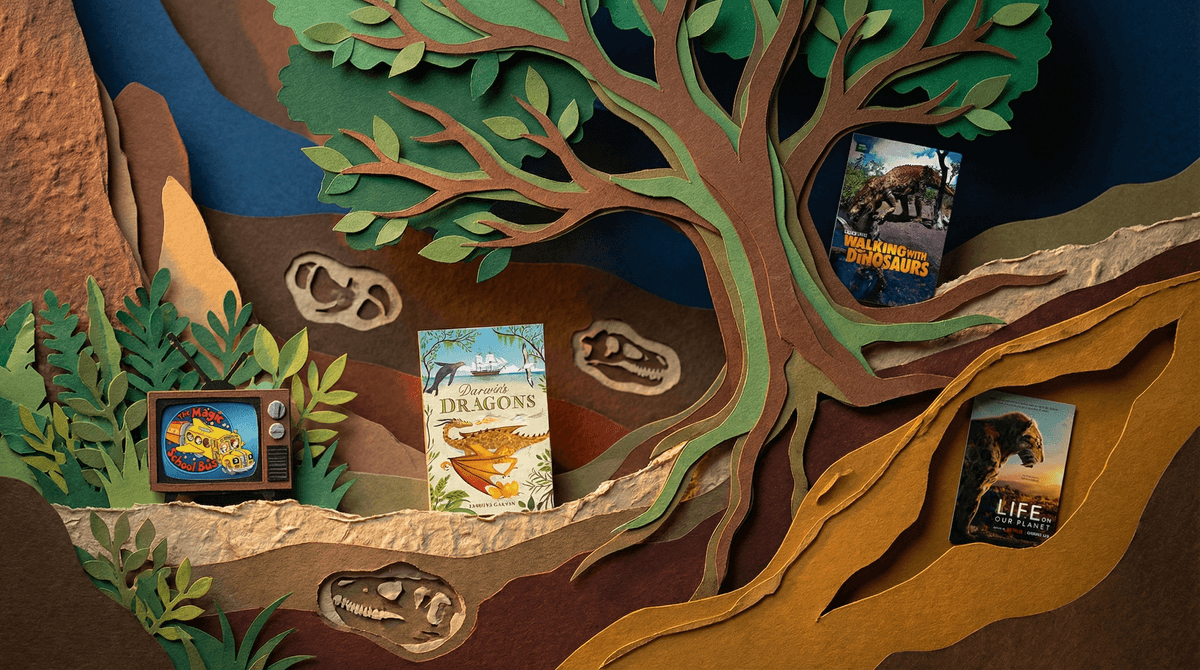
Evolution content spans everything from David Attenborough documentaries explaining natural selection to Pokémon showing Charmander "evolving" into Charizard. It includes Walking with Dinosaurs, The Magic School Bus episodes on adaptation, Darwin's Dragons by Lindsay Galvin, and even Octonauts episodes that touch on species diversity.
Here's the thing: evolution shows up everywhere in kids' media, but it's rarely labeled as such. Your kid might be watching Wild Kratts learn about animal adaptations on PBS Kids without anyone saying the word "evolution" once. Or they're deep into Spore, literally guiding creatures through evolutionary stages, treating it like any other game mechanic.
With 80% of families in our community using streaming services like Netflix, Disney+, or Amazon Prime, and 42% of kids watching YouTube solo, your children are encountering science content constantly—often without you in the room to provide context.
Evolution sits at this interesting intersection of science education and family values. For some families, it's straightforward science. For others, it requires thoughtful conversation about how scientific explanations and faith traditions can coexist.
The challenge? Kids don't encounter evolution as a controversial topic—they encounter it as dinosaurs being cool. They're watching Jurassic World: Camp Cretaceous on Netflix (available to 80% of kids in our community) or playing ARK: Survival Evolved, and suddenly you're fielding questions about how long ago dinosaurs lived or why some animals went extinct.
The other piece? Not all "evolution" content is scientifically accurate. Pokémon's version is basically metamorphosis with extra steps. Digimon calls it "digivolution." These aren't teaching real evolutionary biology—but they're using the language, which can create confusion.
Ages 4-7: At this age, focus on observation and adaptation without the heavy terminology. Octonauts, Wild Kratts, and Dinosaur Train introduce concepts like "animals are different because they live in different places" without diving into mechanisms. Books like Our Family Tree by Lisa Westberg Peters use simple language about shared ancestors.
Ages 8-11: This is when kids can grasp natural selection as a concept. The Magic School Bus has episodes on adaptation. Life on Our Planet on Netflix presents evolution as Earth's story. Charles and Emma by Deborah Heiligman tells Darwin's story as human narrative, not just science. With 50% of families in our community watching Disney+ together, National Geographic content becomes accessible for co-viewing.
Ages 12+: Teens can handle nuance. Cosmos: Possible Worlds, Your Inner Fish, and The Gene by Siddhartha Mukherjee explore evolution within broader scientific contexts. They're also encountering evolution in Spore, Ancestors: The Humankind Odyssey, and even Minecraft mods about prehistoric life .
.
The "just entertainment" trap: Kids absorb information from media whether we intend it or not. When 38% of kids are watching YouTube supervised and 42% are watching solo, they're getting science explanations from CrashCourse, SciShow Kids, or random creators with varying accuracy.
You don't need to be an expert: You need to be present and curious. "That's interesting—how do they think that works?" opens better conversations than lectures. If your family has faith traditions that approach origins differently, you can say "scientists explain it this way, and our family also believes..." Kids can hold multiple frameworks.
Gaming presents evolution differently: In Pokémon, evolution is individual and instant. In Spore, you're directing it. Real evolution is population-level and takes generations. If your kid plays these games (and statistically, many do), clarifying the difference prevents misconceptions.
Co-viewing is your friend: With 50% of families watching Disney+ together, use that time. Pause Life on Our Planet to ask questions. Make it interactive, not interrogative.
Evolution content isn't going anywhere—it's baked into nature documentaries, dinosaur shows, and even video games your kids already play. The question isn't whether they'll encounter it, but whether you'll be part of the conversation when they do.
You get to decide what framework your family uses to understand origins and science. But ignoring evolution content entirely means missing chances to teach critical thinking, scientific literacy, and how to hold complex ideas together.
Start where you are: If you're already watching Bluey together (and who isn't?), try adding Wild Kratts or Octonauts to the rotation. Notice what questions come up naturally.
Check what they're already watching: With 80% of kids having access to Netflix or similar services, pull up their watch history. Are they into dinosaurs? Space? Animals? Find evolution content that matches their existing interests.
Use Screenwise to dig deeper: Not sure if a specific show handles evolution well? See age-appropriateness and scientific accuracy for evolution content. Want to know what other families are watching? We've got community data on that too.
The goal isn't perfect scientific literacy by age 10. It's raising kids who ask good questions, think critically, and know they can talk to you about what they're learning—wherever they're learning it.