

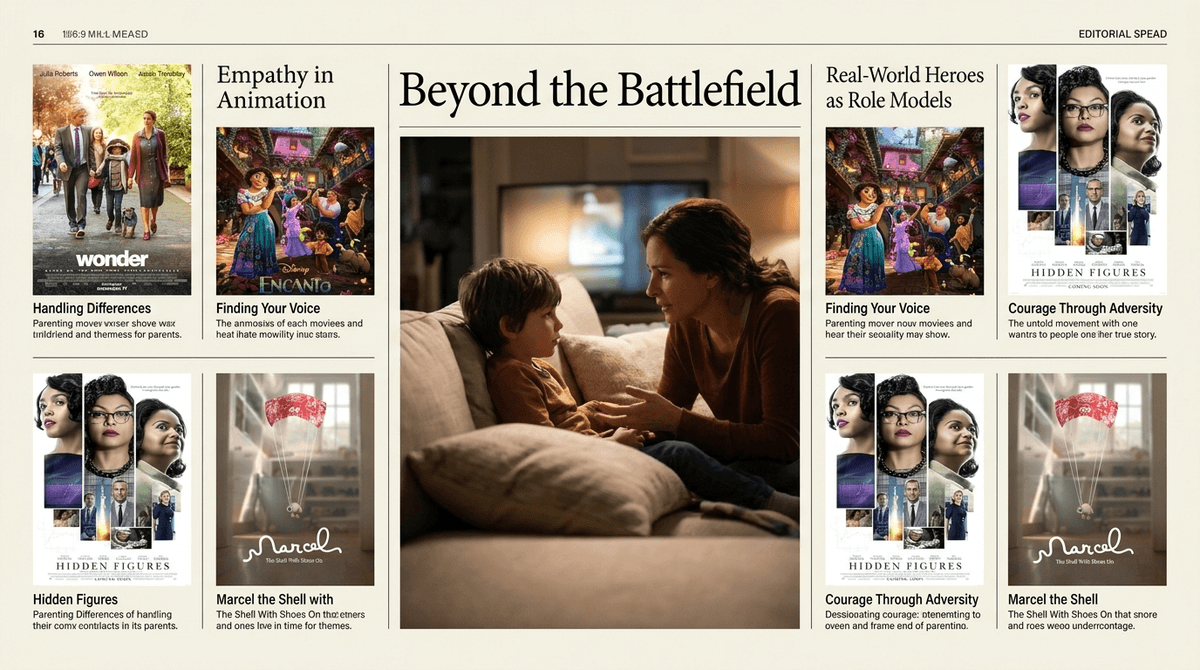
TL;DR: Top Picks for Courage (Minus the Combat)
If you're looking for a Friday night movie that doesn't involve a superhero leveling a city block, start here:
- Best for Preschool/Early Elementary: Marcel the Shell with Shoes On — a tiny shell shows massive heart in a big world.
- Best for Tweens: Wonder — the ultimate lesson in the guts it takes to be kind when it’s hard.
- Best for Family Night: Encanto — because standing up to your own family’s expectations is the hardest battle of all.
- Best for History/Inspiration: Hidden Figures — intellectual courage that literally changed the world.
- Best for Resilience: Akeelah and the Bee — overcoming the fear of your own potential.
Check out our full list of non-violent movies for kids
Most "bravery" narratives in kids' media follow a predictable script: the hero gets a sword (or a blaster, or a superpower), faces a physical threat, and wins by being stronger or faster. But in the real world—the one our kids actually live in—courage looks a lot less like a Marvel fight scene and a lot more like sitting next to the lonely kid at lunch or admitting you made a mistake.
When we only show kids "battlefield courage," we accidentally teach them that bravery is something that only happens in extreme, high-stakes conflicts. We want to pivot the screen time toward stories where the "boss fight" is internal.
It takes a specific kind of "main character energy" to stick to your guns when the world is telling you to fit in. These movies skip the physical brawls and focus on the internal strength required to be authentic.
Set in a tough mining town, Billy trades boxing gloves for ballet shoes. This is a masterclass in the courage to defy gender norms and community expectations. It’s not just about dancing; it’s about the grit it takes to pursue a passion when everyone you love thinks you’re "weird" for it.
- Ages: 11+ (due to some language and mature themes).
This Studio Ghibli classic is a vibe. Kiki is a young witch moving to a new city, and her "enemy" isn't a monster—it's burnout and self-doubt. Watching her lose her magic because she loses her confidence, and then finding the courage to try again, is a huge lesson for kids who struggle with perfectionism.
- Ages: 5+
While it's a "sea monster" story, the real plot is about the fear of being "found out" for who you really are. Luca and Alberto’s journey is a beautiful metaphor for the courage it takes to step out of your comfort zone (and the ocean) to find where you belong.
- Ages: 6+
Standing up to a villain is easy when you have a lightsaber. Standing up to a system or a crowd when you’re "just a kid" is the real-life skill we want to foster.
This movie is a powerhouse for showing intellectual courage. Katherine Johnson and her colleagues didn't use fists; they used math and sheer persistence to break through racial and gender barriers at NASA. It’s a great way to talk about how being the smartest person in the room sometimes requires the most bravery.
- Ages: 10+
If you haven’t seen this yet, grab the tissues. Based on the Wonder book, it follows Auggie, a boy with facial differences entering a mainstream school. The courage here is shared: it’s Auggie’s courage to show up, and his classmates’ courage to choose kindness over the "cool" thing to do.
- Ages: 8+
The true story of the six-year-old who integrated an all-white school in New Orleans. There is no clearer example of courage than a small child walking through a screaming crowd just to go to class. It’s a heavy watch, but an essential one for understanding the history of civil rights.
- Ages: 8+
We talk a lot about "digital wellness" and "brain rot," but a big part of wellness is emotional literacy. These movies show that being brave often means being vulnerable.
The most courageous thing Riley does in this movie isn't winning a hockey game—it's admitting to her parents that she’s sad and misses her old life. Teaching kids that "Sadness" is a necessary part of the journey is a total game-changer.
- Ages: 6+
Mirabel doesn't have a "gift," but her bravery lies in her willingness to see the cracks in her family's perfect facade. It takes massive guts to tell an authority figure (even a beloved Abuela) that the way things are being done is actually hurting people.
- Ages: 5+
Don't let the "cute" factor fool you. Marcel is a tiny shell dealing with loss, loneliness, and the terrifying prospect of the unknown. His bravery is quiet, persistent, and deeply relatable. It’s a "slow" movie, which is a great antidote to the high-stimulation Skibidi Toilet style content that kids are often bombarded with.
- Ages: 7+
Let’s be real: a lot of modern animation is basically "brain rot" disguised as entertainment. It’s loud, it’s fast, and the conflict is always resolved with a "big boom." When kids consume a steady diet of that, their threshold for boredom drops, and their understanding of conflict resolution becomes... well, violent.
By intentionally choosing movies where the conflict is resolved through empathy, communication, or persistence, you’re helping rewire their expectations. You're showing them that "winning" isn't about defeating someone else; it's about mastering yourself.
In our community data, we see a direct correlation between families who prioritize high-quality, narrative-driven media and those who report fewer issues with "screen-induced" aggression. It’s not that Minecraft or Roblox are "bad" (they’re actually great for creativity), but they need to be balanced with stories that have actual emotional stakes.
- Ages 4-7: Focus on "bravery in the everyday." Movies like My Neighbor Totoro or Finding Nemo (yes, there's a shark, but the core is a father's courage) are perfect.
- Ages 8-12: This is the prime time for social courage. Tweens are obsessed with "fitting in," so stories like Wonder or Akeelah and the Bee hit home.
- Ages 13+: Teens can handle the complexity of moral courage. The Truman Show or The Hate U Give offer deep dives into standing up against a system.
Don't make it a lecture—nobody likes a "teachable moment" after a long day of school. Instead, try these "low-key" conversation starters:
- "Who do you think was braver: the person who fought the monster, or the person who told the truth even when they were scared?"
- "What was the hardest thing [Character Name] had to do? Why was it hard?"
- "Have you ever felt like [Character Name] when they were [trying something new/standing up for a friend]?"
- "If you were in that situation, would you have done the same thing?"
Check out our guide on how to have better conversations about media with your kids
Courage is a muscle. If we only show our kids one way to flex it (violence), that’s the only tool they’ll develop. By broadening their "media diet" to include movies about emotional, social, and intellectual courage, we’re giving them a much more useful toolkit for the real world.
Next time you’re scrolling through Netflix or Disney+, skip the "action" tab and look for the "drama" or "inspiring" categories. Your kids might complain for five minutes that there are no explosions, but the conversations you’ll have afterward are worth it.
Find movies for a 10-year-old who loves science but hates violence