

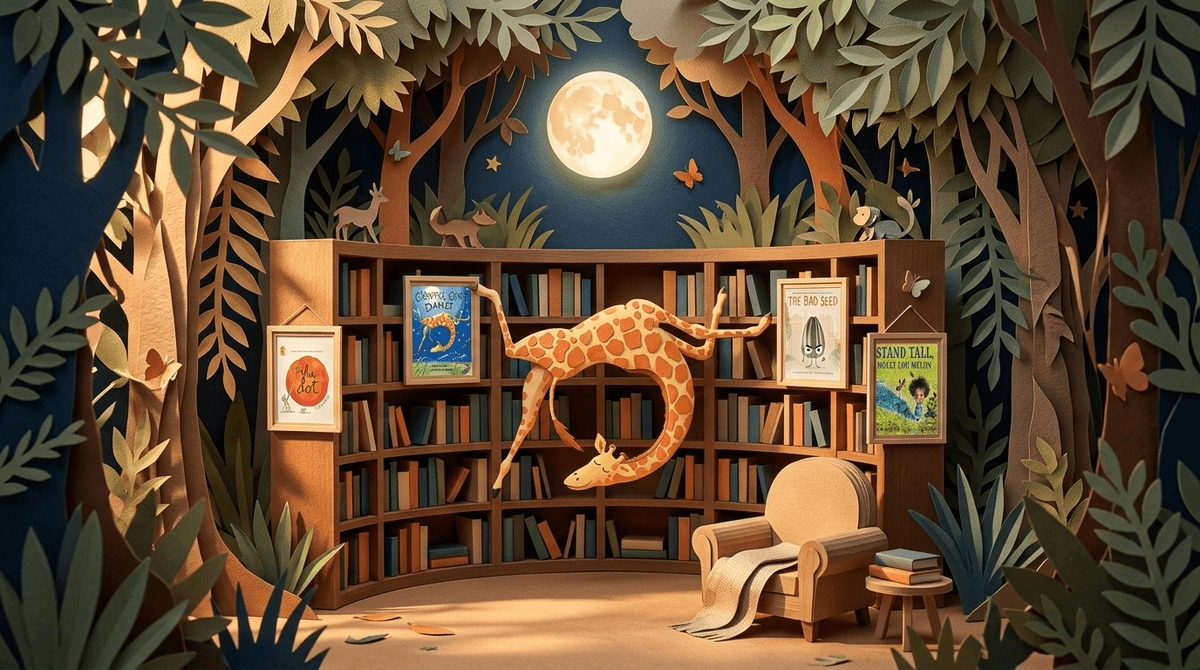
Beyond Gerald: More Books Like Giraffes Can't Dance for Confident Kids
Help your child find their own rhythm with these picture book picks that celebrate individuality, resilience, and standing out in the jungle.
If your kid has worn out your copy of Giraffes Can't Dance — spine cracked, pages soft from a hundred reads — you already know what a perfect little book it is. Gerald the giraffe, awkward and earnest and ultimately triumphant, hits something deep for kids (and honestly, for adults too). The good news: there's a whole shelf of picture books that do the same thing, and some of them are just as good.
TL;DR: The best books like Giraffes Can't Dance share a core DNA: an underdog character, a moment of doubt, and a genuinely earned victory that doesn't feel cheap. Top picks include The Bad Guys, The Most Magnificent Thing, Beautiful Oops!, Enemy Pie, and The Dot by Peter H. Reynolds — all books that celebrate trying, failing, and finding your own weird wonderful way through.
Before we get to the list, it's worth naming what actually makes Gerald's story land so hard. It's not just "be yourself" messaging — that's in a thousand books. What Giraffes Can't Dance does is:
- Shows the specific sting of public humiliation (the other animals laughing)
- Gives Gerald a real moment of despair, not just a quick sad face
- Offers a gentle outside voice (the cricket) that helps him find his own way
- Delivers a payoff that the kid earns, not one handed to them
So when you're looking for similar books, you want that arc. Not just "everyone is special" as a thesis statement, but a story that actually takes the hard feelings seriously before getting to the good stuff.
Ages 4–8
Vashti thinks she can't draw. Her teacher asks her to just make a mark and see where it takes her. What follows is one of the most quietly powerful picture books ever made about creative confidence. Reynolds is a genius at this — his art style is loose and imperfect in exactly the right way. If your kid has ever said "I can't do it" before even trying, this one's basically a prescription.
Ages 4–8
A little girl decides to make the most magnificent thing. It does not go well — at first. She tries, fails, tries again, gets furious, takes a walk, and eventually figures it out. What's great about this book is it doesn't skip the anger. The protagonist genuinely loses it, which is refreshing and real. Great for kids who are perfectionists or who get frustrated and quit.
Ages 3–7
This one's interactive — torn pages, flaps, textures — and the whole premise is that every mistake is an opportunity. A rip becomes a crocodile mouth. A spill becomes a landscape. It's short and tactile and genuinely delightful. Perfect for younger kids who are still in that stage of crying over a crayon mark in the wrong place.
Ages 5–9
A boy asks his dad to help him get rid of his enemy. Dad agrees — but says they have to spend the whole day with him first. What unfolds is a story about assumptions, friendship, and how enemies are sometimes made, not born. This one's a little different from Gerald's story — it's less about individual confidence and more about social courage and giving people a chance. But the emotional intelligence it builds is in the same neighborhood.
Ages 5–9
Unhei is a new student from Korea, and her name is hard for classmates to pronounce. She considers picking an American name to fit in. This book handles the specific loneliness of being different in a way that's tender without being saccharine. Great for kids who are navigating being "the new kid" or feeling like they don't quite fit.
Ages 4–8
Reynolds again — because honestly the man has a whole catalog of these and they're all good. Ramon loves to draw until his brother laughs at his picture of a vase. His little sister saves him by showing him her collection of his drawings — labeled things like "vase-ish." The concept of "ish" — close enough, good enough, your own version — is one of the most useful ideas you can give a kid. Pair it with The Dot for a double feature.
Ages 4–8
A child has a problem that follows them everywhere. The more they avoid it, the bigger it gets. When they finally face it — well, you can guess. The visual metaphor here is really well executed, and the message isn't "problems go away" but "problems can become opportunities." More sophisticated than it looks.
Ages 3–7
A boy with a pet elephant tries to attend the local pet club — but the sign says no elephants. Instead of getting sad and going home, he starts his own club. Inclusion, belonging, making your own space when you're not welcome in someone else's — this one punches above its weight for a picture book.
Ages 4–8
Okay this one's a little different — the protagonist isn't trying to fit in, he's a self-described bad seed who decides to change. But the humor is great, the art is perfect, and the message that you can decide to be different (without it being easy or instant) is genuinely valuable. Kids who feel labeled — as the troublemaker, the wild one — often really connect with this one. The whole Jory John "Food Group" series is worth exploring.
Ages 4–8
Molly Lou is small, has buck teeth, and a voice like a bullfrog. Her grandma has given her enough confidence to power a small city. When a bully at her new school tries to knock her down, she just... doesn't let him. This book is pure confidence energy, and the grandma character is one of the best in picture book literature. No contest.
There are a LOT of picture books with this general message, and honestly, some of them are kind of lazy about it. The ones on this list earn it. But if you're browsing at the library or bookstore, the test I'd apply is: does the character actually struggle? If the kid on the cover looks mildly inconvenienced and then immediately triumphant, it's probably not going to hit the way Gerald does. The good ones sit in the hard feelings for a minute before the resolution.
Get picture book recommendations
These books are conversation starters, not just bedtime fillers. A few questions worth asking after you read:
- "Has there ever been something you thought you couldn't do, and then you could?"
- "What would you do if someone laughed at you for trying something?"
- "Is there something you've been wanting to try but you're scared to?"
- "Who's your cricket?" (the character who believes in Gerald) — this one is gold
Get more ideas for talking to kids about resilience and confidence
Q: What age is Giraffes Can't Dance appropriate for?
Giraffes Can't Dance works best for ages 3–7, though plenty of kids (and parents) love it well past that. The emotional content — embarrassment, self-doubt, finding your own path — is simple enough for preschoolers but resonant enough that older kids still connect with it.
Q: What are some books like Giraffes Can't Dance for slightly older kids?
Once kids age out of picture books, the same themes show up in early chapter books. The One and Only Ivan, Freak the Mighty, and Wonder by R.J. Palacio all carry similar DNA — outsider characters, real emotional stakes, and earned resolution.
Q: Are there books like Giraffes Can't Dance that focus on creative confidence specifically?
Yes — The Dot and Ish by Peter H. Reynolds are the gold standard here. Both are specifically about artistic self-doubt and finding your own creative voice. Beautiful Oops! is great for younger kids who are still in the "I ruined it" stage.
Q: What's a good book like Giraffes Can't Dance for a kid dealing with bullying?
Stand Tall, Molly Lou Melon and The Name Jar both address being mocked or excluded directly, without being heavy-handed about it. They're both warm and funny while taking the situation seriously.
Q: Is there a series like Giraffes Can't Dance we can keep reading?
The Jory John series (Bad Seed, Good Egg, Cool Bean, etc.) has that same mix of humor and heart across a bunch of books. Peter H. Reynolds also has a loose trilogy — The Dot, Ish, and Sky Color — that works really well together.
Gerald the giraffe found his dance. Your kid's version of that story might be in any one of these books. The ones that last aren't the ones that say "you're special" on every page — they're the ones that show a character actually going through it, doubting themselves, and coming out the other side. That's what kids need to see modeled, over and over, at every age.