

TL;DR: The "Organic Kale" of Gaming
If you’re tired of the flashing lights, "Skibidi" memes, and the constant "Mom, can I have 1,000 Robux?" requests, Monument Valley is your new best friend. It’s a stunning, silent, and deeply smart puzzle game that feels more like an interactive art museum than a "video game." There are no ads, no chat rooms, and no predatory loot boxes. Just beautiful architecture and brain-bending puzzles.
Quick Links:
- Best for ages 7+ (though younger kids can play with help)
- The original: Monument Valley
- The sequel: [Monument Valley 2](https://screenwiseapp.com/media/monument-valley-2-game
- The newest release: Monument Valley 3 (available via Netflix Games)
- Explore more cozy games for kids
We’ve all been there. You hand over the iPad so you can have ten minutes of peace to finish a coffee or a work email, and within thirty seconds, the house is filled with the chaotic sounds of Roblox obbys or some high-pitched YouTuber screaming about a "secret" in Minecraft.
It’s overstimulating for them, and let’s be honest, it’s grating for us.
But then there’s Monument Valley.
I call this the "Zen" app because it’s one of the few pieces of digital media that actually lowers the heart rate of everyone in the room. If most mobile games are the equivalent of a bag of Sour Patch Kids—pure sugar, bright colors, and an inevitable crash—Monument Valley is a perfectly plated, locally sourced meal. It’s nourishing, it’s beautiful, and it actually leaves your kid smarter than when they started.
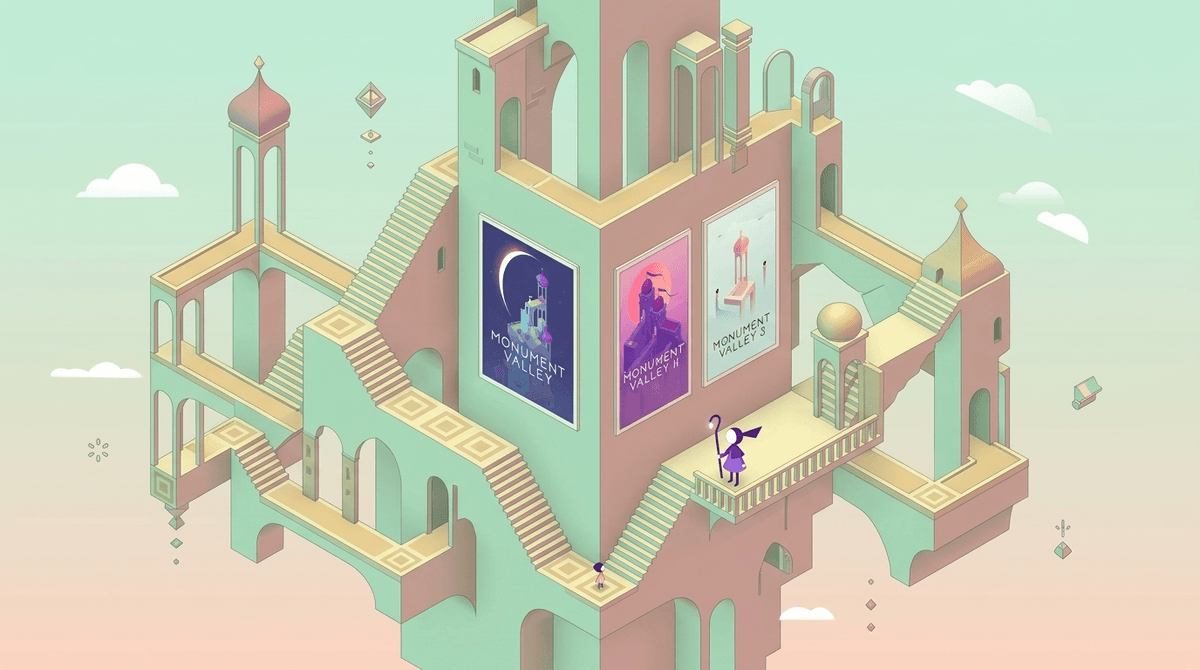
At its core, Monument Valley is a puzzle game inspired by the "impossible geometry" of M.C. Escher. You play as Princess Ida, a silent protagonist who needs to navigate through a series of "monuments" (levels).
The catch? The world doesn't follow the laws of physics. You have to twist, slide, and rotate the environment to create paths that shouldn't exist. A staircase might look like it leads nowhere, but if you rotate a pillar 90 degrees, suddenly it connects to a balcony on the other side of the screen.
It’s a game about perspective—literally.
Kids are used to games that demand their attention with timers, lives, and flashing "BUY NOW" buttons. Monument Valley does the opposite.
- The "Aha!" Moment: There is a specific kind of dopamine hit that comes from solving a spatial puzzle. When a kid finally figures out how to make two disconnected platforms meet, they feel like a genius. It builds genuine confidence.
- No Pressure: There is no "dying" in Monument Valley. There are no enemies that reset your progress (the "Crow People" just block your path and squawk at you). This makes it perfect for kids who get easily frustrated by traditional gaming.
- It’s Visually Stunning: Even if they don’t have the words for "minimalist aesthetic" or "pastel color palettes," kids respond to the beauty of this game. It feels special. It feels like they’re playing a storybook.
We talk a lot about digital wellness, and usually, that conversation is focused on limiting things. "Don't spend too much time on TikTok." "Watch out for the YouTube rabbit hole."
But part of being an intentional parent is also curating the good stuff.
Monument Valley is the gold standard for "Good Screen Time." It requires deep focus and patience. You can’t "button mash" your way through it. You have to sit, look, think, and experiment. In a world of 15-second TikToks, an app that asks a child to sit still and contemplate a puzzle for five minutes is a massive win for their attention span.
The OG. It’s relatively short (you can beat it in a few hours), but every single level is a masterpiece. If your kid is new to puzzle games, start here. It’s a one-time purchase, which we love. No subscriptions, no "gems," no BS.
[Monument Valley 2](https://screenwiseapp.com/media/monument-valley-2-game
This one actually has a bit of a narrative. It follows a mother and child, which makes it a beautiful one to play with your kid. The puzzles are slightly more complex, and the themes of growing up and independence are surprisingly touching for a mobile app.
The newest entry. Here’s the "No-BS" take: It’s great, but it’s currently a Netflix exclusive. That means you need a Netflix subscription to play it. If you already have one, it’s "free" in the App Store under the Netflix Games banner. It introduces sailing and more expansive worlds. It’s gorgeous, but the Netflix gatekeeping is a bit of a bummer if you’re trying to move away from big streaming platforms.
Ages 4-6: They will love the colors and the sounds. They can probably do the first few levels, but they’ll likely get stuck when the "impossible geometry" kicks in. This is a great "on my lap" game where you help them figure out the rotations.
Ages 7-10: This is the sweet spot. They are old enough to grasp the logic of the puzzles but young enough to still be enchanted by the world-building. It’s a great alternative to the high-stress environment of Fortnite.
Ages 11+: Even older kids (and adults) find this game satisfying. It’s often used as a "de-stressor" app. If you have a middle schooler who is stressed about tests, suggest they play a level of Monument Valley before bed instead of scrolling Instagram.
If I could give this app a "Safety Score," it would be an 11/10.
- Data Privacy: The developers (Ustwo Games) are known for being ethical. They aren't harvesting your kid's data to sell to advertisers.
- Social: There is zero social interaction. No chat, no friends list, no strangers.
- In-App Purchases: In the first two games, there are occasionally small "expansion packs" for a couple of dollars, but they are clearly marked and not predatory. There is no "virtual currency."
Look, I’m not going to tell you this game will keep them busy for weeks. It won't.
The biggest "complaint" about Monument Valley is that it’s short. You are paying $4 or $5 for a few hours of gameplay. In a world where Coolmath Games is free and Roblox is an endless pit of content, some parents feel like they aren't getting their money's worth.
I disagree. You are paying for quality. You are paying for an experience that doesn't turn your kid into a screen-zombie. You are paying for art. I’d rather pay $5 for two hours of Monument Valley than have my kid play a "free" game that’s designed to manipulate their dopamine receptors and show them an ad every 30 seconds.
Use this game as a bridge to other conversations.
- Art: Look up M.C. Escher together after they play. Show them "Relativity" (the famous stairs drawing). They’ll immediately see the connection.
- Perspective: Talk about how sometimes in life, a problem looks impossible until you change how you’re looking at it. It’s a literal lesson in the game that applies to real life.
- Design: Ask them, "How do you think they made that look like it connected?" It’s a great lead-in to books about game design.
Monument Valley is a rare gem. It’s a quiet, thoughtful, and intellectually stimulating experience in a digital landscape that is usually anything but. If you’re looking for a way to reset your family’s digital habits, this is the perfect place to start.
Buy it, download it, and maybe even play it yourself after the kids go to bed. You might find you needed that "Zen" moment just as much as they did.
Next Steps:
- Download Monument Valley on your phone or tablet.
- If your kids like this style, check out Gris or [Townscaper](https://screenwiseapp.com/media/townscaper-game for similar "low-stress" vibes.
- Get more puzzle game recommendations
