

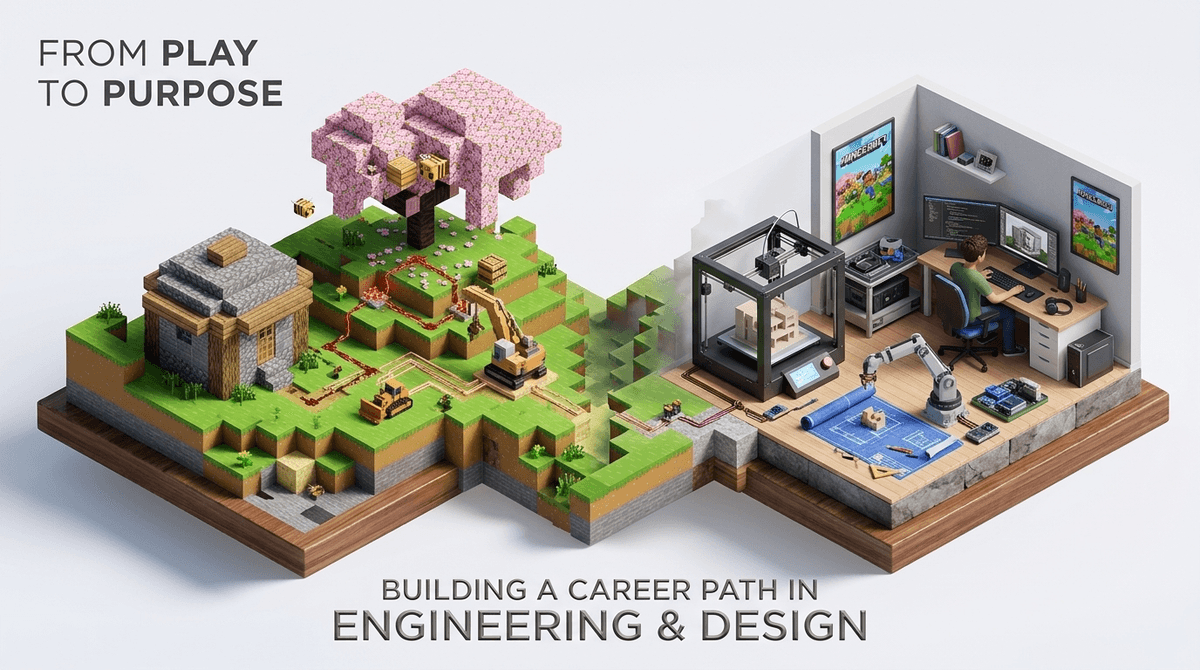
TL;DR: Minecraft is more than just a survival game; it’s a sandbox for real-world skills. If your kid is obsessed, they’re likely already practicing the basics of coding, architecture, and electrical engineering. You can bridge the gap from screen time to "skill time" by introducing tools like Scratch, Tinkercad, and Arduino.
We’ve all been there: you’re trying to get them to put the tablet down for dinner, and they’re shouting about "diamonds" or "creepers" or how a "griefer" just ruined their base. It’s easy to write off Minecraft as just another time-sink, but for a huge percentage of kids (nearly 70% of kids aged 6-12 have played it), it’s actually their first exposure to complex systems.
When we talk about Minecraft as a gateway, we’re talking about the "low floor, high ceiling" effect. The game is easy to start (the floor), but the possibilities for mastery (the ceiling) are practically infinite. It doesn't take long before a kid moves from "I built a dirt hut" to "I want to automate my farm using complex logic gates." That transition is where the magic happens.
Kids love Minecraft because it’s one of the few places in their lives where they have total agency. In the real world, they’re told when to wake up, what to eat, and what to study. In Minecraft, they are the architects, the engineers, and the mayors.
This matters because that sense of autonomy is the strongest driver of learning. When a kid wants to build a working elevator in their digital castle, they aren't "studying physics"—they're solving a problem they actually care about. That’s the spark that leads to a lifelong hobby.
If your child is obsessed with Redstone, they are already learning the fundamentals of electrical engineering and Boolean logic. Redstone is essentially the "wiring" of Minecraft. It allows players to build powered machines, from simple doors to fully functional 8-bit computers inside the game.
For the kid who loves building traps or complex machines, Mark Rober is the gold standard. His videos explain engineering principles with the same high-energy enthusiasm found in gaming videos, but with real-world applications.
Find engineering-focused YouTube channels
If they can handle Redstone repeaters and comparators, they can handle an Arduino kit. This is a physical microcontroller that lets kids program real lights, motors, and sensors. It’s the "Redstone of the real world."
Eventually, "vanilla" Minecraft isn't enough. Kids start wanting to add new items, change the physics, or create their own game rules. This is called modding, and it is the single most common entry point for modern software engineers.
For younger kids (ages 8-11) who want to "make games," Scratch is the perfect next step. It uses block-based coding that feels very similar to the logic used in Minecraft. Read our guide on how to get started with Scratch
For older kids (12+), you can actually use Minecraft to teach Python. There are several books and online courses that allow kids to write code that builds massive structures instantly within their game world. It turns "boring" syntax into a superpower.
Not every kid is a "logic" kid. Some are "aesthetic" kids. They spend hundreds of hours in Creative Mode meticulously detailing a Gothic cathedral or a futuristic cyberpunk city. This isn't "just playing"—it's spatial reasoning, color theory, and architectural history.
Tinkercad is a free, browser-based 3D design tool. It feels remarkably like Minecraft because you build with shapes, but the end result can be exported to a 3D printer. It’s the bridge between a digital "build" and a physical object.
If your child cares more about interior design and floor plans than fighting mobs, The Sims 4 is a natural progression. The "Build Mode" in The Sims is incredibly deep and allows for much more nuanced architectural expression than blocks.
If your kid is running a private server for their friends, they are essentially acting as a junior IT administrator and community manager. They are dealing with server uptime, "whitelisting" players, resolving interpersonal conflicts (the dreaded "he stole my stuff!" drama), and setting digital boundaries.
Most Minecraft communities eventually migrate to Discord. While this requires a conversation about safety (see below), learning how to manage a Discord server—setting up roles, permissions, and bots—is a legitimate technical skill used in almost every modern workplace. Check out our guide on setting up Discord safely for your family
While Minecraft is generally rated E for Everyone (or 10+ depending on the version), the "gateway" hobbies have different maturity requirements:
The biggest risk in Minecraft isn't the game itself—it's the people. Public servers can be a mixed bag. While many have strict filters, "griefing" (intentionally destroying someone else's work) can lead to real-world tears and frustration.
Also, be aware of the "YouTube Rabbit Hole." Many kids learn how to build in Minecraft by watching creators. While DanTDM is generally safe, other creators can be loud, obnoxious, or use "soft" profanity.
Learn more about the best Minecraft YouTubers for kids
If you want to turn Minecraft into a gateway hobby, you have to stop treating it like a "distraction" and start treating it like a "project."
Instead of saying "Time to get off that game," try:
- "Can you show me how that Redstone circuit works?"
- "That building looks incredible. Did you base that on a real style of architecture?"
- "I saw a video of someone making a 3D-printed version of their Minecraft house. Do you think we could try that on Tinkercad?"
When you validate their digital work, they are much more likely to listen when you suggest a related real-world hobby.
Minecraft is the "Greatest Hits" of digital education. It’s a math tool, a logic puzzle, a social club, and an art studio all rolled into one. If your kid is "stuck" in the game, don't just pull them out—lean in and see which direction they're pointing. They might just be digging their way toward a career.
- Identify the "Type": Observe your kid for 20 minutes. Are they building (Architect), wiring (Engineer), or playing with friends (Social)?
- Introduce One Tool: Based on their type, download Scratch or open Tinkercad this weekend.
- Set "Project" Goals: Instead of just "screen time," offer "project time" where they can stay on longer if they are working on a specific complex build or learning a mod.