

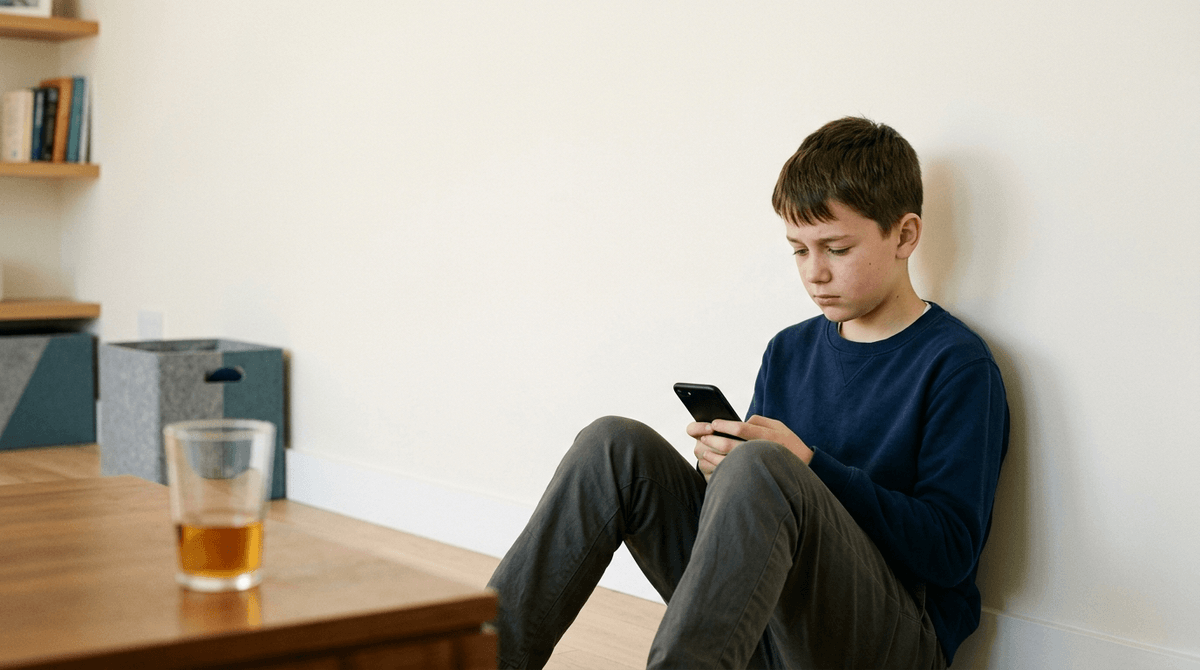

Middle schoolers who experiment with alcohol are significantly more likely to end up targeted by cyberbullies two years down the road. The link isn't just about party culture—it is heavily driven by underlying feelings of loneliness and anxiety.
Early alcohol use predicts a sharp rise in a child's risk of being cyberbullied two years later, with anxious and lonely kids—especially boys—facing the highest risk.
Substance use in middle school is rarely just about experimentation; it often signals that a child is struggling to fit in digitally and emotionally. If your child is drinking or showing an interest in alcohol, treating it solely as a discipline issue misses the bigger picture. You may be seeing the early warning signs of social isolation that leave kids vulnerable to online harassment.
Addressing a child's underlying anxiety and loneliness is just as critical as stopping the drinking itself. Protecting their emotional health directly impacts their physical safety and digital well-being.
Researchers wanted to understand why substance use and digital harassment so frequently overlap during the early teen years. While previous studies tracked drinking and bullying separately, few followed kids over time to pinpoint whether emotional distress acts as the bridge connecting the two.
Kids who reported drinking alcohol at around age 12 faced a 45% higher risk of being cyberbullied two years later.
- Boys face higher odds: Drinking among boys was linked to a 63% increase in their chances of being targeted online compared to non-drinkers.
- Frequency amplifies risk: Frequent drinkers—those consuming alcohol 3 to 30 days a month—were nearly two and a half times as likely to be targeted by cyberbullies.
- Emotional distress is key: Feelings of loneliness and nervousness explained roughly one-fifth of the link between early drinking and future online victimization.
- Later starters had higher risk: Counterintuitively, kids who started drinking at age 11 or older showed a stronger link to future cyberbullying than those who tried it even younger.
Alcohol does not directly cause a child's phone to blow up with hateful messages. Instead, early drinking often marks a child as socially out-of-step with their peers or signals an attempt to self-medicate for hidden anxiety and loneliness. Bullies frequently target kids who appear vulnerable or socially isolated, making internal distress the hidden link between drinking and digital harassment.
This study followed nearly 2,000 middle schoolers in Ningbo, China. While the two-year longitudinal design is strong, cultural norms around youth drinking, parental supervision, and social media platforms vary across the globe. Additionally, because the study relied on self-reported surveys, some adolescents may have underreported their drinking or brushed off harassment due to social stigma.
- If you discover your middle schooler has tried alcohol... ...look past the immediate discipline and evaluate their emotional state for underlying loneliness or anxiety.
- If your son is showing interest in drinking... ...pay close attention to his online social circle, as middle school boys who drink face a 63% higher risk of being targeted online.
- If your child seems frequently anxious or isolated... ...proactively build off-screen social connections and check in on their digital lives before those feelings translate into risky coping behaviors.
Early drinking is a distress signal, not just a behavioral breach. Focusing on your middle schooler's emotional health and helping them navigate anxiety is one of the most effective ways to protect them from becoming a target online.
Xiao X, Luo Y, Wang J et al. (2026). Loneliness and nervousness mediate the association between alcohol use and cyberbullying victimization among school-aged adolescents: a two-year longitudinal study. BMC psychology. doi:10.1186/s40359-026-05054-8 — pubmed.ncbi.nlm.nih.gov