

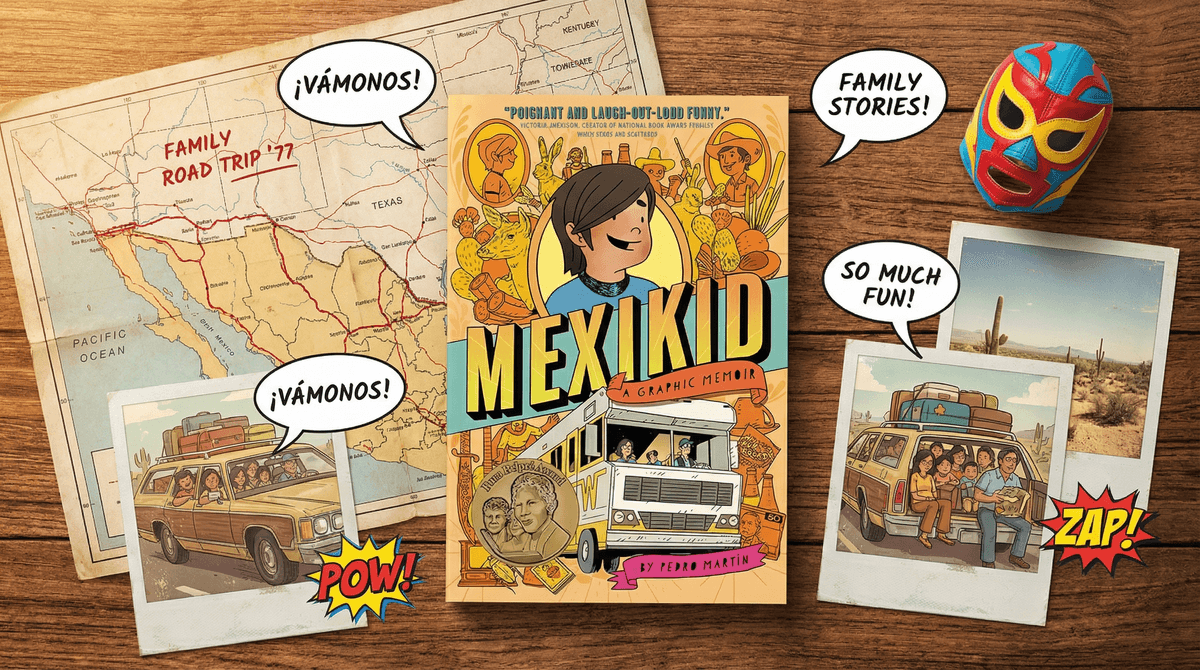
Mexikid: The Road-Trip Memoir About Superheroes and Identity
TL;DR: Pedro Martín's Mexikid is a gorgeous graphic novel memoir about a 1970s family road trip from California to Mexico that's funny, honest, and deeply moving. Perfect for ages 8-13, it tackles identity, belonging, family dynamics, and what it means to grow up between two cultures—all wrapped in superhero mythology and laugh-out-loud moments. If your kid loved Raina Telgemeier's work or New Kid by Jerry Craft, this belongs on your shelf.
This isn't just another "road trip goes wrong" story. Mexikid is Pedro Martín's actual childhood memory of his family's chaotic journey from Sacramento to a tiny village in Mexico to pick up his abuelito (grandfather) and bring him back to the U.S.
The setup sounds simple enough, but Martín weaves in so much more: his obsession with Mexican wrestling superheroes (luchadores), the tension of being "too Mexican" for some kids and "too American" for others, sibling dynamics in a big family, and the bittersweet reality of aging grandparents who don't want to leave their home.
What elevates this book is Martín's artistic skill and emotional honesty. The illustrations are vibrant and expressive, moving seamlessly between comedic exaggeration (a packed station wagon that looks ready to explode) and tender moments (young Pedro watching his grandfather say goodbye to his village). The superhero framing device—where Pedro imagines himself and his family as luchadores—gives kids a familiar entry point into heavier themes.
It's genuinely funny. The humor lands for middle-grade readers because it comes from real family chaos: fighting over car space, dad's questionable driving decisions, the horror of shared motel rooms, and the universal experience of parents embarrassing you in public. Pedro's internal monologue is sarcastic and self-aware in a way that feels authentic to that age.
The superhero angle hooks reluctant readers. For kids who might not naturally gravitate toward memoir or "serious" topics, the luchador framing makes it feel like an adventure story. Pedro's imagination transforms boring or uncomfortable moments into epic wrestling matches, which is exactly how many kids process difficult situations.
It validates the "in-between" feeling. For kids growing up in immigrant families or between cultures, seeing Pedro struggle with Spanish pronunciation, feel embarrassed by his family's differences, and then slowly come to appreciate his heritage is powerful. For kids who don't share that experience, it's an accessible window into what their classmates might be navigating.
Age range: 8-13 is the sweet spot. The book deals with some mature themes (death, aging, cultural discrimination) but handles them age-appropriately. Younger kids might need help with context about immigration and family separation. Older middle schoolers will appreciate the nuance.
It's a real memoir with real complexity. This isn't a sanitized version of growing up Mexican-American in the 1970s. Pedro experiences racism from other kids, feels shame about his family's poverty, and witnesses his parents' stress about money and documentation. These moments aren't graphic or traumatic, but they're honest. That's actually what makes the book valuable—it doesn't shy away from reality while still being hopeful.
The Spanish is accessible. Martín includes Spanish words and phrases throughout but provides enough context that non-Spanish speakers can follow along. It's actually a great opportunity for kids to pick up some vocabulary naturally. If your kid is learning Spanish, even better—they'll feel proud catching words they recognize.
It's won major awards for good reason. Newbery Honor, Pura Belpré Award, and a stack of other recognition. This isn't just "good for a graphic novel"—it's excellent literature, period.
This book opens up so many natural discussion points:
About identity: "Pedro feels like he's not Mexican enough or American enough. Have you ever felt like you didn't quite fit in somewhere?" This works for kids across all backgrounds—the feeling of being "in-between" isn't limited to cultural identity.
About family legends: Pedro's family has stories about his grandfather being a luchador. "What are the stories our family tells about grandparents or great-grandparents? How do those stories shape how we see ourselves?" This guide about family storytelling has more ideas.
About aging and change: The grandfather doesn't want to leave his home, even though staying might not be safe. "Why do you think it was so hard for him to leave? What would you miss most if you had to move somewhere completely new?"
About superhero mythology: "Why do you think Pedro imagines his family as wrestlers? What would your family's superhero identities be?" This is a fun, low-pressure way into talking about how we use stories to process hard things.
If your kid connects with Mexikid, here's what to queue up next:
More graphic novel memoirs: American Born Chinese by Gene Luen Yang explores similar themes of cultural identity through mythology. El Deafo by Cece Bell uses a superhero framing to talk about growing up deaf.
Road trip stories: Pam Muñoz Ryan's Esperanza Rising isn't a graphic novel but shares themes of Mexican heritage and family migration. For something lighter, One Crazy Summer by Rita Williams-Garcia has that same mix of humor and heart.
Luchador culture: If the wrestling aspect hooked them, Niño Wrestles the World by Yuyi Morales is perfect for younger siblings, and you can explore documentaries about lucha libre together.
More Pedro Martín: He has other books including a follow-up called Mexikid: A Graphic Memoir—wait, that's this one. But seriously, keep an eye out for his future work.
Let's address this directly: Should only Mexican-American kids read this book? Absolutely not. Should Mexican-American kids see themselves in books? Absolutely yes.
The beauty of Mexikid is that it's both a specific cultural story AND a universal family story. Every kid will recognize something—the embarrassment of parents, the complexity of family loyalty, the desire to be seen as special, the confusion of growing up.
For kids from Mexican or Latinx families, seeing their culture centered as normal and valuable (not exotic or "other") matters enormously. For kids from other backgrounds, reading widely about different experiences builds empathy and cultural literacy. This is exactly the kind of book that should be on classroom and library shelves everywhere.
Mild language: A few instances of "hell" and "damn" in realistic family contexts. Nothing beyond what you'd hear in a PG movie.
Cultural stereotypes: The book actually addresses stereotypes head-on, showing how Pedro encounters racist assumptions and how that makes him feel. It's handled thoughtfully as a teaching moment, not gratuitously.
Death and aging: Pedro's grandfather is elderly and frail. The book doesn't show death but deals with mortality and saying goodbye. It's gentle but real.
Poverty and class: The family's financial struggles are visible—the packed car, the cheap motels, the stress about money. This is presented matter-of-factly, not as something shameful.
Mexikid is that rare book that works on multiple levels: it's entertaining enough to hook reluctant readers, literary enough to win awards, and emotionally resonant enough to stick with kids long after they finish.
The graphic novel format makes it accessible to a wide range of reading levels, and the superhero framing gives kids a way to engage with heavier themes without feeling lectured. Most importantly, it tells a specific, personal story with such warmth and humor that it becomes universal.
If you're looking for books that expand your kid's worldview while still being genuinely fun to read, Mexikid delivers. Bonus: it's a great family read-aloud if you have kids at different reading levels.
Where to get it: Your local library almost certainly has it (it's been a hot title since release). If you're buying, support your local bookstore or grab it wherever you usually shop. The paperback is around $13, hardcover around $22.
And if your kid finishes it and wants more graphic novels about identity and belonging, we've got you covered.