

TL;DR
Kids use multiple online identities (Finstas, alts, and burners) to separate their "curated" public lives from their "messy" private ones, explore niche interests, or gain privacy from parents and recruiters. While often harmless—like a Roblox account dedicated solely to trolling—they can also be used to bypass parental controls or hide bullying.
Quick Resources:
If you grew up in the era of one MySpace page and maybe a stray AIM screen name, the idea of having five different versions of yourself online might feel like a lot of work. But for kids today, it's the standard operating procedure.
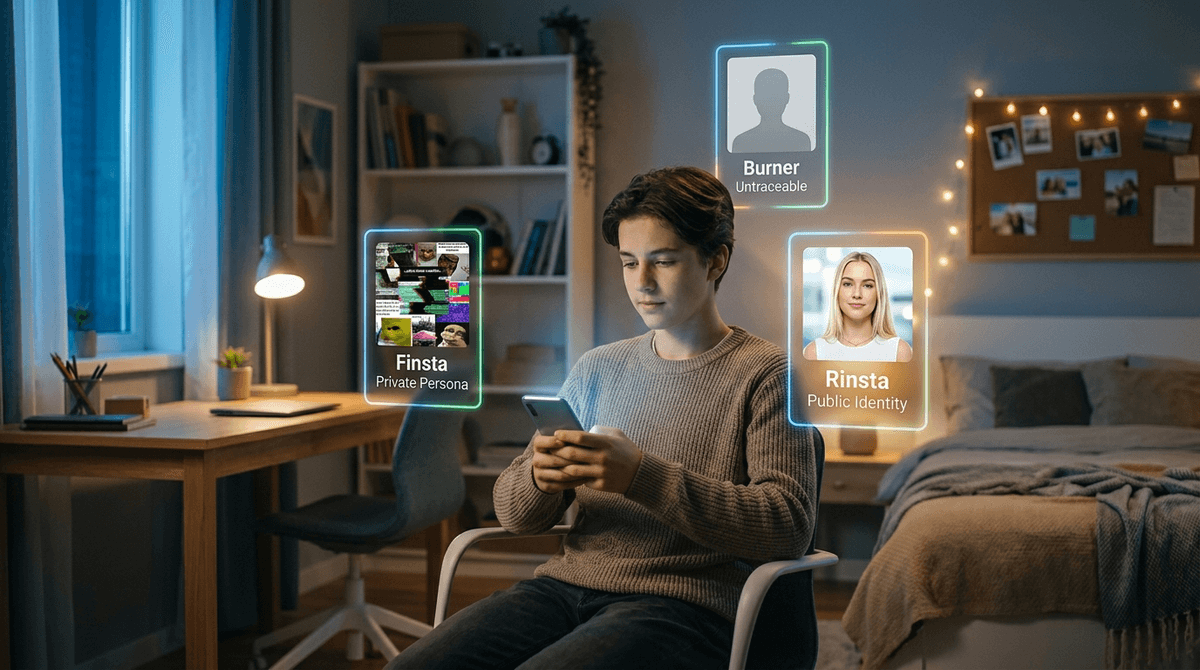
- Finsta: Short for "Fake Insta." Ironically, the Finsta is usually the "real" one. Their main account (the "Rinsta") is the polished, high-gloss version where they look like they’re living their best life for the benefit of college recruiters and distant aunts. The Finsta is private, has maybe 15 followers, and is where the "ugly" selfies, inside jokes, and vent sessions live.
- Alt (Alternative Account): This is common in gaming and fandoms. A kid might have their main Fortnite account where they play seriously, and an "alt" where they experiment with new strategies or just mess around without tanking their stats. On TikTok, an alt might be dedicated entirely to a specific hobby, like anime edits or sourdough baking, away from their main social circle.
- Burner: These are temporary accounts or phone numbers (often created via apps like Google Voice or TextNow). Burners are the red flag of the group. They are designed to be disposable and anonymous, often used to sign up for platforms without a real email or to bypass a ban.
Get a list of apps kids use to hide photos and accounts
It’s easy to assume that if a kid is hiding an account, they’re doing something "bad." Sometimes that's true, but more often, it’s about context collapse.
In the physical world, kids act differently at Sunday dinner than they do in the locker room. Online, those worlds collide. A "Finsta" or an "Alt" is just their way of recreating those boundaries. They want a space where they can be "Ohio" (slang for weird/cringe) without it being pinned to their permanent record.
The Pressure of the "Grid"
On apps like Instagram, there is massive social pressure to maintain a specific aesthetic. If a kid posts a blurry photo of a cool bug they found on their main feed, it "ruins the grid." An alt account provides a low-stakes outlet for the mundane parts of life that don't fit the "influencer" vibe.
Niche Interests
If your kid is obsessed with Minecraft redstone builds but their school friends think it’s "for babies," they’ll create an alt account to engage with that community. It’s about finding their "people" without facing social suicide at school.
Privacy from the "Algorithm"
Kids are surprisingly savvy about how their data is tracked. Some create alts just to see different content. If their main YouTube feed is nothing but MrBeast, they might start an alt to explore different creators without "messing up" their recommendations.
Discord is the king of multiple identities. Because it’s server-based, a kid can have a different nickname and persona in every group they join. It’s very easy to toggle between accounts here, making it the primary place for "alt" culture. Check out our guide to Discord safety
The app makes it incredibly easy to switch between accounts with a long-press on the profile icon. Most teens have at least two: the "Professional/Public" one and the "Private/Spam" one.
While Snapchat doesn't encourage "alts" in the same way, their "My Eyes Only" feature acts as a hidden identity within the main account. It’s a password-protected folder for photos that don't show up in the main gallery.
Learn more about Snapchat's 'My Eyes Only' feature
In the gaming world, "smurfing" (an experienced player using a new account to play against beginners) is common. Kids will often have a "main" account with all their expensive skins and a "burner" for when they want to act out or troll without risking their primary account getting banned.
While having a "spam" account for memes is generally fine, there are three areas where multiple identities become a genuine safety risk:
- Anonymity Breeds Cruelty: When kids feel they are untraceable, they are more likely to engage in cyberbullying. If your kid has a "burner" account they won't show you, it’s often because they’re using it to say things they wouldn't say under their own name.
- Bypassing Parental Controls: If you’ve blocked TikTok on their phone, a tech-savvy kid might use a burner email to log in via a browser or an old tablet you forgot about.
- The "Secret Life" Escalation: There is a slippery slope between "I want a private place for my art" and "I have a secret identity where I talk to strangers."
Interestingly, apps like BeReal were designed to fight this "multiple identity" trend by forcing users to post one unedited photo a day. However, even here, kids have found ways to "curate" the reality. It's a good app to discuss the concept of authenticity with your kids.
The goal isn't to ban alt accounts—that’s a losing battle. The goal is to ensure that integrity follows them across every account they own.
The "One Persona" Rule
You can tell your kids: "I don't care if you have an account for your Pokemon obsession and an account for school friends. But the rules of how you treat people apply to both. If you wouldn't say it on your main account, don't say it on your alt."
The Transparency Policy
A good middle ground for many Screenwise families is the "Follow Back" rule. You don't necessarily need to scroll through their Finsta every day, but you should know it exists, and you (or a trusted adult) should be one of the few followers. If they refuse to let you follow an account, that’s a conversation about why that space needs to be a total secret.
Questions to Ask:
- "I heard people are using 'spam' accounts for memes lately. Do you have one, or do you just post everything to your main?"
- "Why do you think people feel the need to have a Finsta? Is the pressure to look perfect on your main account actually that high?"
- "If someone was being mean to you from a burner account, how would you handle that?"
Multiple identities are the digital version of "code-switching." It’s how kids navigate a world where their every move is potentially recorded and archived forever.
An alt account isn't a lie; it's a boundary.
As long as those boundaries aren't being used to hide risky behavior or hurt others, they can actually be a healthy way for kids to explore different facets of their personality. Just make sure they know that "anonymous" is a myth—nothing online is truly untraceable, and their digital footprint is being built one alt-account at a time.
Next Steps:
- Audit the devices: Check the "switch account" settings on Instagram and TikTok together.
- Discuss the "Rinsta" pressure: Talk about the mental health toll of maintaining a "perfect" online image.
- Review the Burner list: Check for apps like TextNow or Google Voice on their phone.
Check out our full guide on social media privacy settings
See how to know if your kid has a secret social media account