

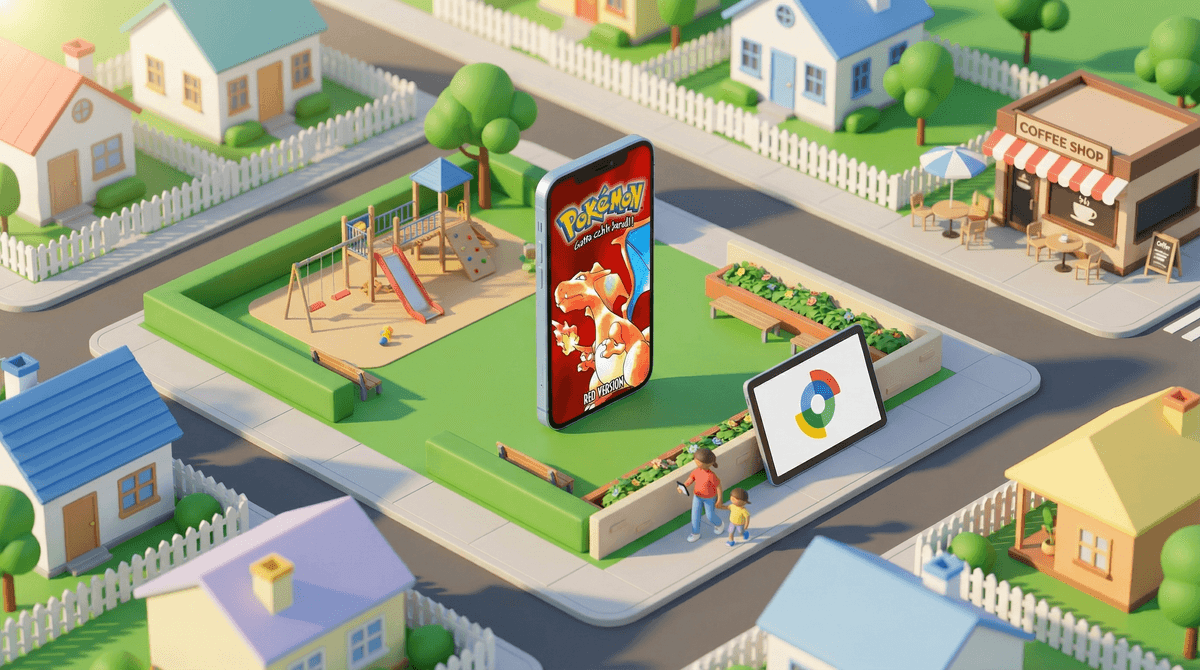
If you somehow missed the summer of 2016 when every sidewalk, park, and parking lot was suddenly filled with people staring at their phones and swiping at invisible creatures, here's the deal: Pokémon GO is an augmented reality (AR) game that overlays digital Pokémon onto the real world through your phone's camera. Kids (and let's be real, plenty of adults) walk around their actual neighborhoods, parks, and towns to catch Pokémon, battle at gyms, and collect items from PokéStops—all tied to real geographic locations.
The game uses GPS to track where players are, and it literally requires you to move around in the physical world to play. A Pikachu might appear in your driveway. A rare Dragonite could be at the coffee shop three blocks away. And that gym battle? It's happening at the actual playground down the street.
It's genuinely clever game design. It gets kids moving, encourages exploration, and has a built-in social component. But it also means your kid is broadcasting their location, potentially interacting with strangers, and navigating real-world risks while staring at a screen.
Even though the initial craze has cooled, Pokémon GO remains wildly popular—especially with the 8-14 crowd. Here's why:
It's Pokémon. The franchise has multi-generational staying power. If you collected cards in the '90s, your kid is probably into it now through the games, shows, or cards themselves.
It gets them outside. In a digital landscape full of sedentary screen time, this game actually requires movement. Kids love the treasure hunt aspect of finding rare Pokémon in different locations.
Social connection. Raid battles require teaming up with other players (often strangers), and there's a whole community culture around sharing spawn locations and strategies. For some kids, it's their entry into local gaming communities.
It's legitimately fun. The core loop of catching, collecting, and battling is satisfying. Special events keep things fresh. And the AR camera feature where you can pose Pokémon in your living room is genuinely delightful.
Let's talk about what makes this game different—and potentially more concerning—than most screen time.
Location Tracking
Pokémon GO requires constant access to your child's location. The game knows where they are at all times when it's open. And unlike passive location sharing with family, this data is going to Niantic (the game developer) and potentially being used in ways you might not expect. Location data is incredibly valuable and often shared or sold , and while Niantic's privacy policy has improved over the years, it's still something to understand.
Stranger Danger (But Make It 2025)
Here's where it gets tricky. Raid battles and community events are designed to bring players together at specific locations at specific times. Sometimes that's great—families playing together at a park. Sometimes it's your 10-year-old meeting up with a group of teenagers or adults they don't know because there's a rare Pokémon spawning behind the library.
The game has a social component where players can add friends, see each other on the map, and send gifts. While you can't directly message in-game (thank goodness), kids often coordinate through Discord, Instagram, or other platforms to plan meetups.
Distracted Walking (and Worse)
The game literally requires you to stare at your phone while moving through the world. Kids have walked into traffic, tripped over curbs, wandered into dangerous areas, and gotten lost—all while hunting Pokémon. The game does have warnings about staying aware of your surroundings, but we all know how effective those are when there's a Charizard nearby.
Lures and Predatory Behavior
One feature of the game is "Lure Modules" that attract Pokémon to a specific PokéStop for 30 minutes. Anyone can drop a lure, and it benefits all nearby players. This has been used by businesses (cute!) and community organizers (great!)... but also by people with bad intentions trying to lure kids to isolated locations. It's rare, but it has happened.
Ages 8-10: Play Together
At this age, Pokémon GO should be a parent-and-kid activity, full stop. You're walking together, you're controlling the account, and you're teaching them how to navigate both the game and the real world safely.
- Keep the account on your phone or a shared device
- You choose where you go and when
- Disable social features entirely (you can turn off friend requests and nearby player visibility)
- Use it as an excuse to explore your neighborhood together—it's actually a great bonding activity
Ages 11-13: Supervised Independence
This is the age where many kids want to play with friends, and that can be okay with the right boundaries.
- Set up parental controls through Niantic Kids (yes, they exist, and you should use them)
- Require they only play in approved areas—your neighborhood, the local park, places you know well
- Establish a buddy system: they play with a friend or sibling, never alone
- Set time limits (the game will absolutely drain hours if you let it)
- Review their friend list regularly and keep it limited to people they know IRL
- Use a family location sharing app (like Life360 or Apple's Find My) so you can see where they are
- Have a clear rule: no going anywhere new or unfamiliar without permission, even if a rare Pokémon appears
Ages 14+: Monitored Freedom
Older teens can handle more independence, but they still need guardrails.
- They should understand how location data works and what they're sharing
- Discuss the risks of meeting up with strangers from online communities
- Encourage them to play in groups and in public spaces
- Make sure they understand that lures can be used to attract people, not just Pokémon
- Keep communication open—if they want to go to a raid or community event, they should tell you where and when
The game is free, but... Like most free games, Pokémon GO makes money through in-app purchases. PokéCoins can be bought with real money and used for items, storage upgrades, and raid passes. Set up purchase restrictions on your device or prepare for some surprise charges.
Battery drain is real. This game will murder your phone battery. If your kid is out playing for more than 30 minutes, they need a portable charger or they'll come home with a dead phone (and no way for you to reach them).
Weather and safety matter. The game encourages playing in all conditions, but use common sense. Extreme heat, storms, icy sidewalks—sometimes it's just not worth it for a digital creature.
Community Day events are a thing. Once a month, Niantic hosts special events with rare spawns and bonuses. These draw huge crowds to parks and downtown areas. If your kid wants to go, scope it out first or go with them. These events can be great fun, but they're also where the stranger-danger risk is highest.
It's not just for kids. You'll see plenty of adults playing, which is mostly harmless but means your kid will be interacting in spaces with grown-ups. That's not inherently bad, but it's worth being aware of.
Pokémon GO isn't inherently dangerous, but it does require a different kind of parenting than passive screen time. You're not just monitoring what they're watching—you're managing where they're going, who they might encounter, and how they're navigating the real world while distracted by a screen.
The good news: This game genuinely gets kids moving, can be a fantastic family activity, and teaches some real-world navigation skills. It's also way more wholesome than a lot of what's out there.
The reality: You need to set clear boundaries, use the available parental controls, and stay involved—especially with younger kids. This isn't a "hand them the iPad and walk away" situation.
- Download the game yourself and play for 20 minutes so you understand how it works
- Set up a Niantic Kids account if your child is under 13 (it's required and gives you actual controls)
- Walk through your neighborhood together and identify safe play zones
- Establish clear rules about where they can go, who they can play with, and what to do if something feels off
- Check in regularly on their friend list and play habits
And hey, if you end up getting weirdly into catching Pokémon yourself, you're not alone. There are worse ways to spend a Saturday morning than walking around the park with your kid hunting for a shiny Eevee.
Want to learn more about location-based apps and privacy? Or looking for other active games that get kids moving?