

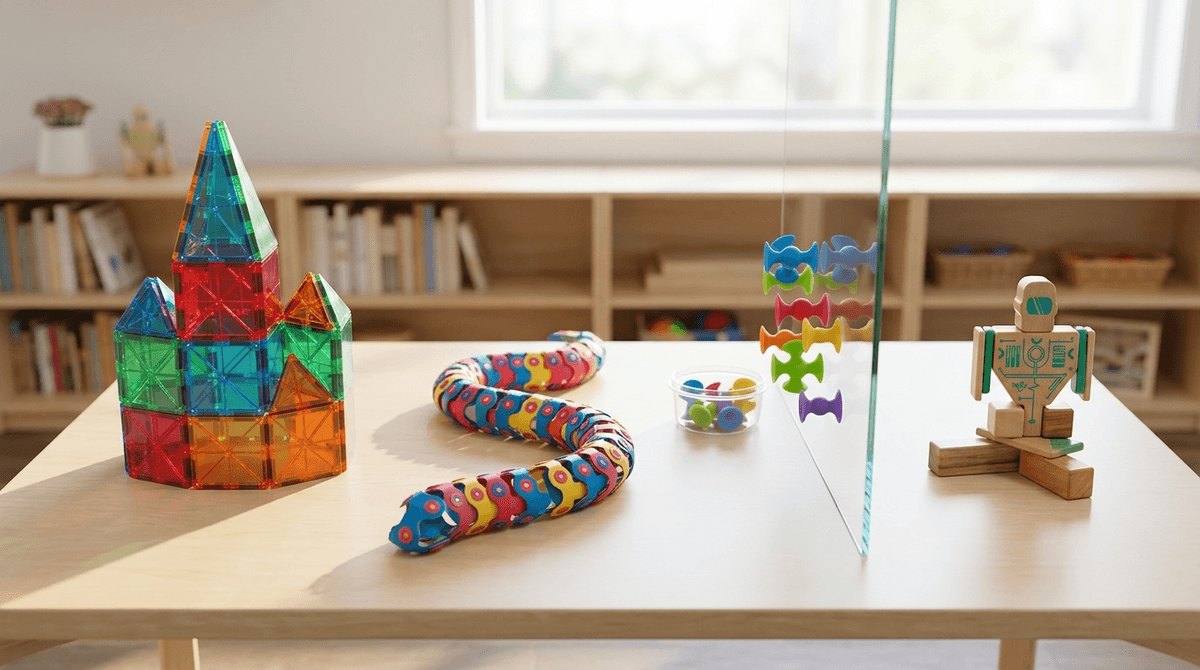
LEGO is the undisputed heavyweight champion of the toy box, but in a classroom or a high-traffic living room, it’s also a liability. If you’ve ever spent twenty minutes hunting for a single translucent 1x1 slope or heard the soul-crushing rattle of a $500 kit being inhaled by a vacuum, you know the "LEGO tax" is real. You want the spatial reasoning and the "aha!" moments of engineering without the microscopic debris field. The good news: the STEM market has finally figured out that "high engagement" shouldn't mean "permanent floor hazard," and the best alternatives right now use magnets, suction, and clever geometry to keep the play contained.
For a classroom that doesn't require a shop-vac, skip the tiny bricks and go for Clixo for portability or Squigz for sensory, vertical play. These kits prioritize magnetic or suction connections that stay in large chunks, making cleanup a 30-second task instead of a 20-minute ordeal. They hit the same STEM notes as LEGO—spatial reasoning and iterative design—without the "stepping on a brick" trauma.
The biggest innovation in low-mess building isn't just making the pieces bigger; it’s making them smarter. These kits use internal magnets so there’s no "right side up," which lowers the frustration floor for younger kids while keeping the ceiling high for older ones.
Clixo is the "cool younger sibling" of the building world. It’s essentially magnetic paper—flexible, reinforced synthetic paper shapes with powerful magnets at the corners. Because the pieces are flat and flexible, they don’t take up space, and they don’t hurt when you step on them. Kids can build 3D creatures, wearable "armor," or abstract sculptures. The cleanup move here is the "snake"—you just click them all together in a long line and drop them in a bag.
If you want the "silent classroom" vibe, Tegu is the answer. They’re heirloom-quality wooden blocks with magnets hidden inside. You get the tactile satisfaction of wood without the "tower of doom" crashing noise, because the magnets provide just enough structural integrity to keep things standing. They are expensive, but they are indestructible and incredibly easy to sort.
One of the best ways to keep a classroom clean is to get the toys off the floor entirely. These kits turn windows, whiteboards, and desks into the building surface.
Squigz are "suction construction." They’re silicone pieces that stick to each other and any non-porous surface (windows, lockers, tabletops). They are the ultimate sensory building toy—the "pop" sound they make when pulled apart is addictive. From a STEM perspective, they’re great for learning about tension and suction. From a cleanup perspective, they’re a dream: they’re chunky, they don't have "bits," and they can be washed in a sink if they get sticky.
You’ve likely seen these, but they stay on the list for a reason. They are the standard for open-ended magnetic play. While they can technically "shatter" into a pile of tiles, the pieces are large enough that a kid can clear a whole floor in under a minute. If you’re choosing between brands, Connetix generally has stronger magnets, which allows for taller, more ambitious builds that don't collapse as easily.
Sometimes the mess happens because the pieces are too small to be seen. The fix? Go big.
Standard Plus-Plus pieces are great, but they’re basically LEGO-adjacent when it comes to the vacuum factor. The "BIG" version is designed for preschoolers but is weirdly popular through elementary school because of how fast you can build something substantial. They have a unique "one shape, endless possibilities" geometry that forces kids to think about interlocking patterns rather than just stacking.
Strawbees uses plastic connectors and standard straws to build massive, lightweight structures. It’s a masterclass in structural engineering—kids learn very quickly why triangles are stronger than squares. While it looks like it could be messy, it’s actually very contained because the "mess" is just a handful of straws. When the project is over, you pull the connectors out and the straws can be bundled with a rubber band.
The mistake most people make with these kits is treating them as "quiet time" filler. To turn them into actual STEM engines, give them a constraint.
- The Bridge Challenge: Using only Clixo or Strawbees, build a structure that can span a 12-inch gap and hold a stapler.
- The Vertical Build: Use Squigz to see who can build the longest horizontal branch off a window before gravity wins.
- The Negative Space Test: Ask them to build a "cage" for a specific stuffed animal using Magna-Tiles, focusing on using the fewest tiles possible.
If your kid is outgrowing simple builds, don't reach for a screen—raise the bar on the physical kit. Hand them a real engineering brief: a Strawbees tower that has to hold a book, a Clixo creature with a working hinge, a Magna-Tiles dome with no flat roof. Constraints are what turn "stacking" into "engineering," and they scale a long way before a kid ages out.
The "magnetic" label isn't just about ease of use—it's a safety thing. In a classroom setting, you want kits where the magnets are ultrasonically welded inside the plastic (like Magna-Tiles or Tegu). Cheaper knock-offs can sometimes crack, and loose magnets are a serious ingestion hazard. Stick to the name brands for high-traffic environments; the durability is what you're actually paying for.
Q: What is the best LEGO alternative for a classroom? Magna-Tiles are the gold standard for versatility, but if you want something truly unique and low-profile, Clixo is the winner. It takes up 90% less space and offers more creative flexibility for older kids.
Q: Are magnetic tiles better than LEGO for STEM learning? They aren't "better," they just teach different things. LEGO is about following complex instructions and fine motor precision; magnetic tiles and Tegu are about 3D spatial awareness and understanding magnetic polarity/balance.
Q: What are the best low-mess STEM toys for 5-year-olds? Squigz are perfect for this age. They are virtually indestructible, impossible to lose in a rug, and provide the tactile feedback that 5-year-olds crave without the frustration of precise clicking.
Q: How do I keep building kits organized in a classroom? The "one-bin" rule is the move. Don't try to sort by color or sub-shape—that's where the cleanup time explodes. Use clear, latching bins for each type of kit (the "Clixo Bin," the "Squigz Bin"). If it doesn't fit in the bin, the build stays up or gets recycled.
You don't have to ban building toys to keep your sanity (or your vacuum). By switching the "connection method" from friction-fit plastic to magnets and suction, you drop the cleanup time to almost zero while keeping the "brain-on" part of the play.
