

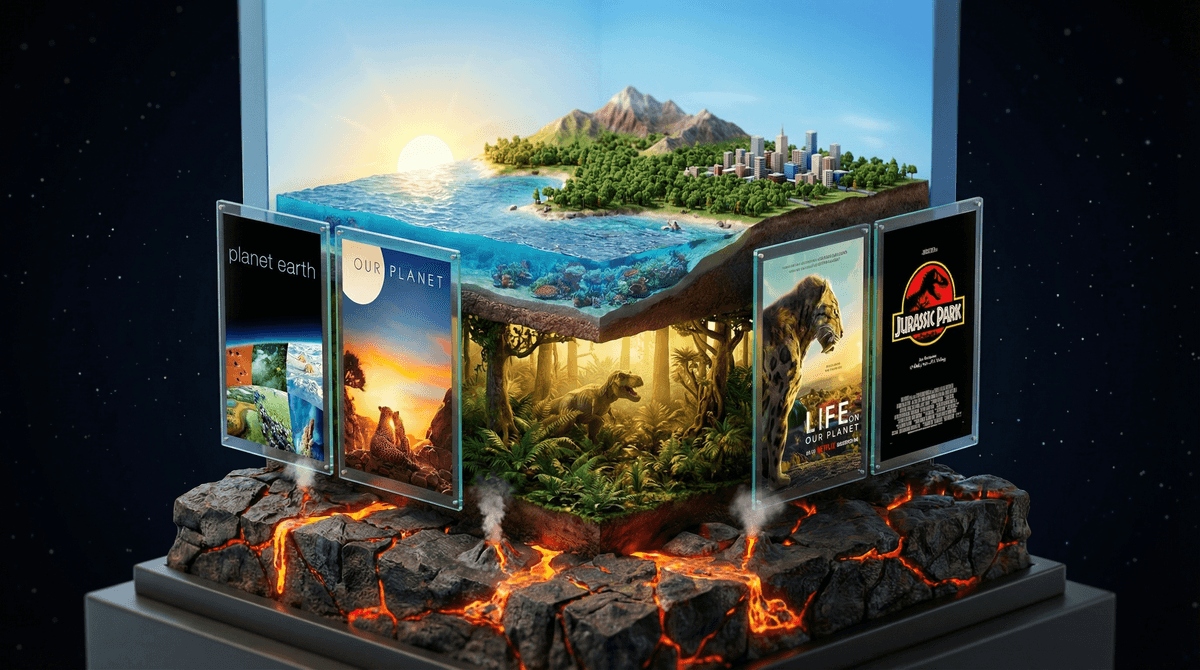
Life on Our Planet is Netflix's 2023 nature documentary series that takes viewers on a 4-billion-year journey through Earth's history. Narrated by Morgan Freeman and produced by the team behind Planet Earth and Our Planet, it's eight episodes of absolutely stunning visuals showing how life evolved, survived mass extinctions, and eventually led to... us.
Here's what makes it different from other nature docs: it doesn't just show you beautiful animals doing beautiful things. It shows you creatures that haven't existed for millions of years—dinosaurs, giant sea scorpions, saber-toothed cats—brought to life with the same CGI technology used in movies, seamlessly blended with footage of modern animals and landscapes. It's like Jurassic Park met Planet Earth and decided to teach a biology class.
According to our community data, about 40% of families use Netflix regularly for kids' content, with another 40% letting kids watch occasionally. If you're in that 80%, this is one of those shows worth adding to the rotation.
Let's be honest: kids love dinosaurs and giant prehistoric creatures. Always have, always will. But Life on Our Planet delivers more than just the T-Rex content they're expecting.
The show moves fast enough to hold attention spans (each episode is about 50 minutes), and the visuals are genuinely jaw-dropping. We're talking cinematic quality that makes you forget you're watching something educational. The CGI creatures move through real landscapes, hunting, fighting, and struggling to survive in ways that feel visceral and real.
There's also something compelling about the extinction narrative. Kids are fascinated by the idea that the world used to be completely different—that entire species dominated the planet and then vanished. It's dramatic, it's a little scary, and it makes them think about change in ways that abstract climate conversations sometimes don't.
Age appropriateness: Netflix rates this TV-PG, and I'd say that's about right for ages 8+, though it depends on your kid. There's predator-prey violence throughout—animals hunting, killing, and eating other animals. It's nature documentary violence, not gratuitous, but it's there. Younger kids who are sensitive to animals being hurt might find some scenes upsetting.
The series also covers all five major mass extinction events, which means you're going to see a lot of death. Asteroid impacts, volcanic eruptions, climate catastrophes that wipe out most life on Earth. For kids who get anxious about existential threats, this might hit differently than you expect.
The climate conversation: The final episode brings us to modern times and addresses human impact on the planet. It's not preachy, but it's direct about climate change, habitat destruction, and current extinction rates. Depending on your family's values and how you approach these topics, you might want to watch this episode first to decide if you want to preview it with your kids or use it as a conversation starter.
Educational value: This is legitimately good science content. The evolutionary concepts are accurate (though simplified), the timeline is clear, and it does a nice job explaining how life adapts to changing conditions. If your kids are studying evolution, geology, or earth science, this is a fantastic supplement. Learn more about how documentaries compare to traditional educational content .
.
Given that families in our community average 4.2 hours of screen time daily (4 hours on weekdays, 5 on weekends), this could be a great way to make some of that time more intentional.
Co-viewing is key here. Not because the content is inappropriate, but because the conversations that come out of this show are where the real value lives. When you watch together, you can:
- Pause and discuss: "Why do you think that animal evolved that way?" "What would happen if that species survived instead?"
- Connect to current events: When you see ancient climate change, you can talk about modern climate patterns without it feeling like a lecture
- Process the scary parts: Mass extinctions are heavy. Being there to answer questions and provide context helps kids process big concepts
- Encourage curiosity: This show raises more questions than it answers, which is perfect for sending kids down research rabbit holes about specific creatures or time periods
One episode at a time works better than binge-watching. These aren't light entertainment—they're dense with information and big concepts. Give kids time to absorb and think between episodes.
After watching, try these:
- "Which extinction event do you think was scariest for the animals living through it?"
- "If you could bring back one extinct species, which would it be and why?"
- "What do you think future Earth will look like if we don't change how we treat the planet?"
- "How do you think humans are different from other animals that have lived on Earth?"
These aren't gotcha questions—they're genuine invitations to think critically about what they've seen.
Life on Our Planet is one of those rare pieces of content that's both entertaining and genuinely educational. It's visually spectacular enough to compete with the flashiest content kids consume, but it's teaching them about evolution, extinction, adaptation, and climate science in the process.
Is it going to single-handedly make your kid a climate activist or paleontologist? Probably not. But it might spark an interest in science, generate meaningful family conversations, and give them a bigger-picture understanding of how life on Earth works—and how fragile it can be.
For families trying to be more intentional about screen time, this is exactly the kind of content worth prioritizing. Not because it's "educational" in a eat-your-vegetables way, but because it's the rare show that kids actually want to watch that also expands their understanding of the world.
- Preview episode 8 if you're unsure about the climate content
- Watch one episode together this week and see how your kids respond
- Follow up with books or documentaries about specific creatures or time periods that caught their interest
- Compare with other nature series like Our Planet or Blue Planet to see what resonates most with your family
Want to explore more high-quality documentary content for kids? Check out our guides on nature documentaries and educational Netflix shows.