

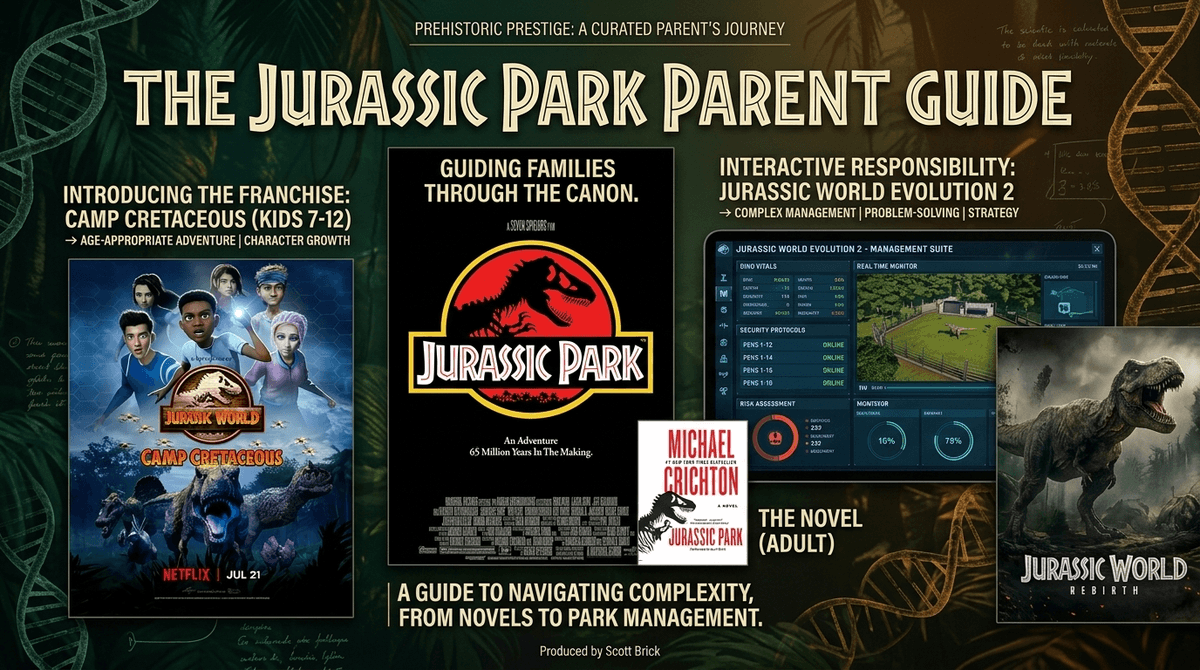
TL;DR: If your kid is currently obsessed with dinosaurs, you're likely navigating a path from the "safe" animated world of Netflix to the high-stakes, teeth-gnashing intensity of the 2025 film Jurassic World: Rebirth. For the 7-and-under crowd, stick to LEGO Jurassic World and Camp Cretaceous. For the middle-schoolers ready for actual stakes, Chaos Theory is the sweet spot. If they’re asking for the movies, start with the 1993 Jurassic Park—it’s still the gold standard for a reason.
Check out our full breakdown of the Jurassic timeline for parents
We’ve come a long way since Steven Spielberg made us all terrified of a ripple in a cup of water. What started as a cautionary tale about "playing God" with DNA has ballooned into a massive "Transmedia Universe." That’s just a fancy way of saying your kid can watch the shows, play the games, collect the plastic toys, and then beg you to take them to the newest blockbuster.
The franchise currently lives in three distinct "buckets":
- The Legacy: The original 90s trilogy.
- The World Era: The Chris Pratt movies and the Netflix animated series.
- The Rebirth: The 2025 soft-reboot starring Scarlett Johansson that’s promising a "grittier" return to the franchise's roots.
In a world of Skibidi Toilet and nonsensical YouTube shorts that feel like a fever dream, Jurassic Park is actually a breath of fresh air. It’s "prehistoric prestige" media.
Kids are naturally drawn to the scale and power of dinosaurs—it’s a phase most of them hit around age four and some never leave. But Jurassic Park adds layers of ethics, science, and survival that actually challenge a kid’s brain. It’s one of the few franchises that successfully bridges the gap between "cool monsters" and "complex themes" like corporate greed and ecological responsibility.
Depending on your kid's age and "scare-tolerance," here is how to navigate the prehistoric landscape.
Best for: Ages 7-10 This is the ultimate gateway drug. It follows a group of teens stranded on Isla Nublar. While there are plenty of "dinosaur chases," the show focuses heavily on friendship and problem-solving. It’s animated, but don't let that fool you—it can get intense, but nobody actually gets eaten on screen. Read our guide on Camp Cretaceous safety
Best for: Ages 10-13 This is the direct sequel to Camp Cretaceous, and it’s significantly "older." The characters are young adults now, the conspiracy plot is deeper, and the tone is more "thriller" than "adventure." If your kid thinks they’re too cool for "cartoons," show them this. It’s excellent storytelling that respects the audience’s intelligence.
Best for: Ages 12+ (Anticipated) The buzz around Rebirth is that it’s moving away from the "superhero" feel of the recent Chris Pratt movies and going back to being a scary survival movie. Expect more tension, more jump scares, and a more mature tone. This isn't going to be a "take the kindergartner" kind of flick.
Best for: Ages 10+ If your kid is into Roblox or Minecraft, this is a massive step up. It’s a park management simulator. They have to manage genomes, build enclosures, and deal with disasters. It’s basically a biology and business ethics lesson disguised as a video game. It's high-quality, complex, and requires actual strategy.
Best for: Ages 6-9 The safest way to experience the "scary" movie plots. LEGO games take the edge off the violence with slapstick humor. If you want them to know the story of the original movies without the trauma of seeing a guy get eaten off a toilet, this is your winner.
The biggest hurdle with Jurassic Park isn't "inappropriate content" in the traditional sense (drugs, sex, etc.). It’s intensity.
- Ages 5-7: Stick to the LEGO Jurassic World specials or the Jurassic World: Camp Cretaceous series with a parent nearby. Avoid the live-action movies; the sound design alone (the roars and screams) is designed to trigger a fight-or-flight response.
- Ages 8-12: This is the prime demographic. They can usually handle the "thrill" of the original Jurassic Park. However, be wary of Jurassic World: Fallen Kingdom—it has some "haunted house" vibes that are surprisingly dark.
- Ages 13+: They’re ready for the full cinematic experience, including the upcoming Rebirth. This is also a great age to introduce them to the original Jurassic Park book by Michael Crichton, which is much more of a "techno-thriller" and way more cynical than the movies.
One of the coolest things about this franchise is that it’s not just about "monsters." It’s a perfect springboard for real-world conversations. If your kid is obsessed, use that momentum to talk about:
- De-extinction: Scientists are actually talking about bringing back the Woolly Mammoth. Is that a good idea? (Hint: Dr. Ian Malcolm would say no).
- Genetic Engineering: We’re already editing genes with CRISPR. Where do we draw the line?
- Corporate Responsibility: In almost every movie, the "bad guy" isn't the T-Rex; it's the guy trying to monetize the T-Rex.
Jurassic Park is one of the "good ones." It’s a franchise that has largely maintained a level of quality and intellectual curiosity that many other "toy-commercial" franchises have lost.
Yes, it’s loud. Yes, there are dinosaurs eating people. But it also encourages kids to think about science, consequences, and the natural world. If your kid is transitioning from the "cute" dinosaurs of their toddler years to the "scary" dinosaurs of the Jurassic era, it’s a sign they’re ready for more complex storytelling.
Next Steps:
- If they've only seen the cartoons, have a family movie night with the original 1993 Jurassic Park.
- If they want to play the games, look into Jurassic World Evolution 2 for a "smart" gaming experience.
- Keep an eye on the trailers for Jurassic World: Rebirth—if it looks too intense for your specific kid, you might want to pre-screen it in 2026.