

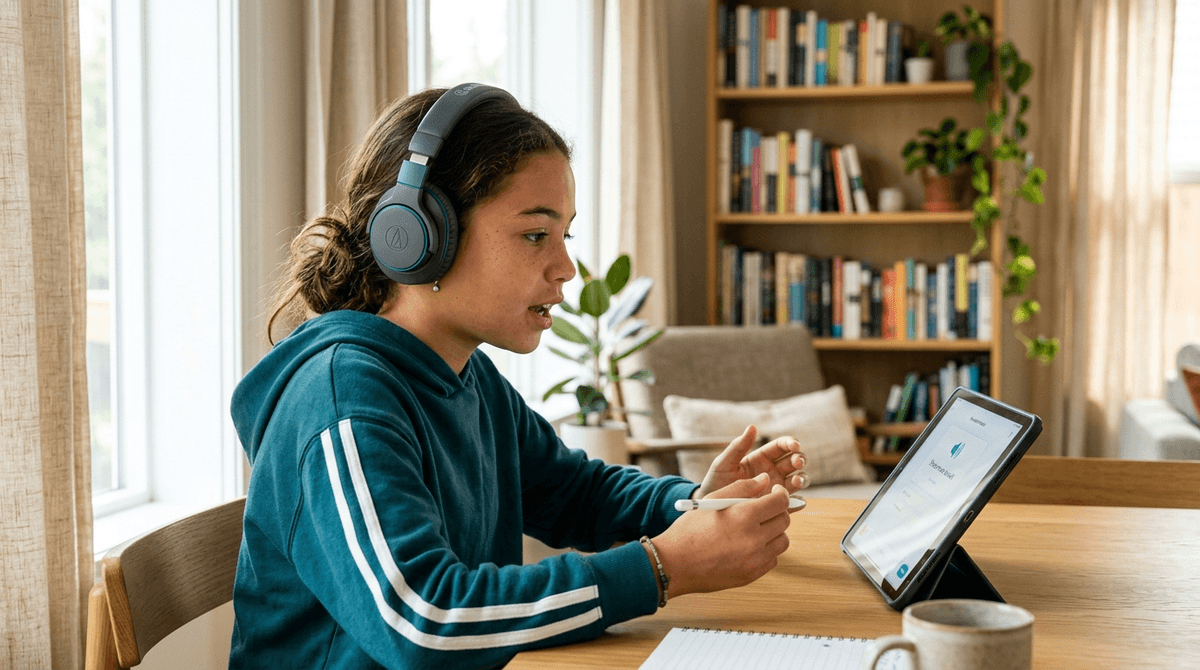

Practicing a second language through an interactive speaking game sharpens how quickly a child's brain registers basic musical tones and everyday sounds. The auditory benefits spill far beyond vocabulary drills into general sound processing after just a few total hours of play.
Interactive language games that require kids to speak aloud retune the brain's sound-processing hardware, speeding up auditory responses to non-speech tones after just three total hours of gameplay.
Most screen-time debates treat educational apps as passive digital flashcards. If an app requires active vocal imitation, it functions more like music lessons or speech therapy than passive screen time.
For parents deciding between silent vocabulary apps and tools that listen to your child speak, the brain treats speaking aloud as a whole-system sensory tune-up. Interactive voice practice alters basic auditory pathways that passive listening simply leaves untouched.
Auditory processing forms the backbone of reading, musical ability, and following directions in a noisy classroom. Researchers wanted to see whether training the mouth and ear to master foreign vowel sounds could transfer to raw sound perception, sharpening how the brain hears basic pitch changes outside of language.
Children who practiced speaking in a game-based English program showed rapid shifts in brain processing speed:
- Brain reaction times accelerated: Neural response time to pitch changes dropped from 216 milliseconds down to 174 milliseconds over four to five weeks.
- The benefit crossed domains: The children practiced spoken English words, but their brains became faster at tracking raw musical tones that had nothing to do with speech.
- More screen time did not mean bigger gains: Children who logged extra practice hours showed no greater neural improvement than those who played roughly three hours total, suggesting the brain's auditory network recalibrates early in the training process.
Speech production creates a tight feedback loop. When a child speaks aloud and waits for an app to judge their pronunciation, their brain must listen intensely to its own output and self-correct. That intense motor-auditory workout is likely driving the neural change, not the foreign language itself.
Treat these findings with caution before overhauling your child's screen routine.
The study examined only 37 Finnish nine-year-olds, with just 15 children in the initial treatment group. Crucially, the researchers measured brain waves (EEG) while the kids rested; they did not run behavioral tests to see if the children actually heard, sang, or performed better in daily life. A faster electrical signal in the auditory cortex does not guarantee your child will suddenly follow verbal directions better or excel at an instrument.
- If you are selecting a language app for an elementary schooler: Choose programs that use speech recognition and require vocal repetition over silent matching games.
- If you struggle to fit app practice into a busy week: Cap practice sessions at 10 to 15 minutes a few times a week, since neural changes surfaced after just three total hours of play.
- If your child struggles with pitch discrimination or auditory processing: Consider voice-interactive speech games as a light, supplementary exercise, but do not replace proven speech or music interventions based on preliminary brain-wave data alone.
Voice-driven language apps provide a fast, measurable workout for a child's auditory cortex, but wait for real-world listening tests before buying into claims that screen-based games transform broader hearing skills.
Ylinen S, Junttila K, Smolander AR et al. (2026). Game-Based Foreign-Language Speech Rehearsal Improves Pitch Processing Beyond Speech Domain. The European journal of neuroscience. doi:10.1111/ejn.70603 — pubmed.ncbi.nlm.nih.gov