

TL;DR
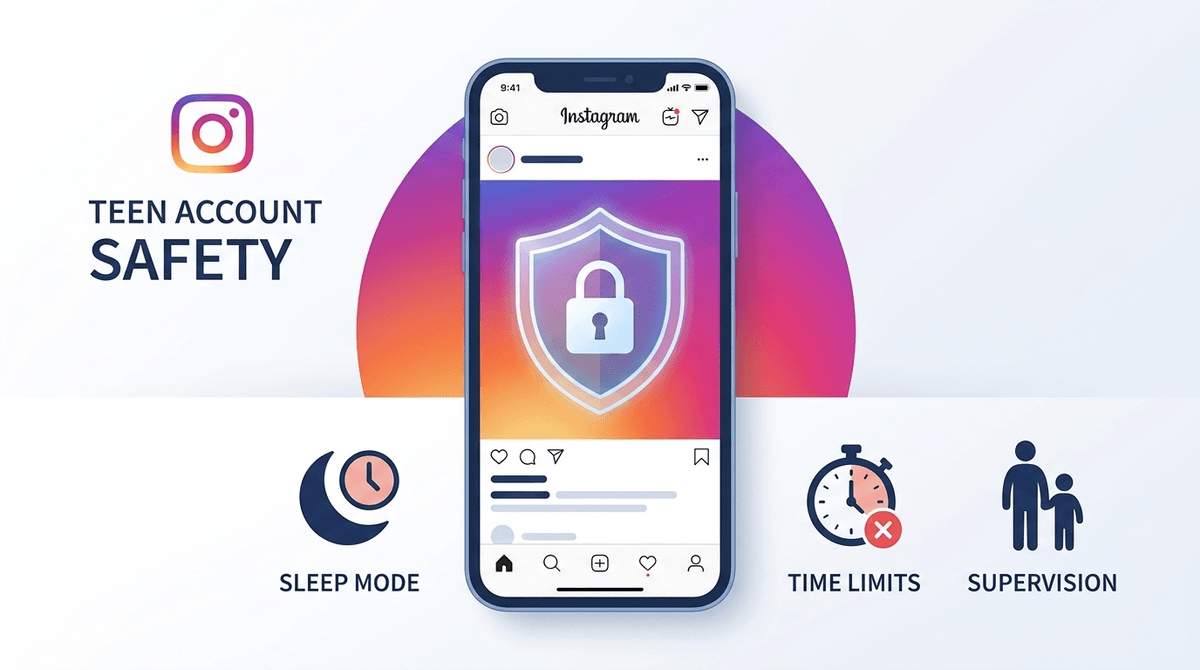
- Automatic "Teen Accounts": Every user under 18 is now automatically funneled into a restricted account type with "training wheels" settings.
- Default Privacy: For those under 16, accounts are private by default, and they can only be messaged by people they already follow.
- Sleep Mode & Time Limits: Notifications are muted from 10 PM to 7 AM, and the app nudges kids to close it after 60 minutes.
- Parental "Lock": Teens under 16 cannot change these safety settings without a parent’s explicit digital permission.
- Learn more: How to set up Instagram Supervision | Is Instagram safe for middle schoolers?
If you feel like Instagram has been in the news every other week for the last few years, you’re not imagining it. Between Senate hearings and growing concerns about the "anxious generation," Meta was under massive pressure to do more than just offer a "Parental Supervision" toggle that most kids (and let’s be honest, many parents) ignored.
The 2025 "Teen Accounts" update is the biggest change to the platform since its inception. It’s no longer about asking parents to opt-in to safety; it’s about Meta forcing the safety settings on by default and making it a hurdle to turn them off. It’s basically the digital equivalent of graduated licensing for teen drivers.
Instagram remains the "town square" for social life. While younger kids are still obsessed with Roblox and TikTok, Instagram is where the "social resume" lives once they hit middle school. It's where the sports photos, the "Ohio" memes, and the group chats happen.
The problem has always been that a 13-year-old was essentially using the same app as a 35-year-old. This update changes that by creating a distinct, walled-off experience for minors.
The Big Five: Features of the New Teen Account
- Private Accounts by Default: For anyone under 16 (and new users under 18), the account starts as private. This means they have to manually approve every follower. No "lurking" from strangers.
- Messaging Restrictions: This is a big one. Teens can only be messaged by people they already follow. This effectively kills the "random DM" from a bot or a stranger.
- Sensitive Content Limits: Instagram is cranking the "Sensitive Content Control" to its most restrictive setting. This limits the appearance of "edgy" content in Explore and Reels—think stuff that isn't quite a violation of rules but isn't exactly "wholesome" either.
- Hidden Words: The anti-bullying "Hidden Words" feature is automatically turned on. It filters out comments and DM requests that contain offensive words or phrases.
- Sleep Mode & Nudges: Between 10 PM and 7 AM, "Sleep Mode" kicks in. Notifications are silenced, and any DM sent to them gets an auto-reply saying the teen is offline. They also get a "Daily Limit" nudge after 60 minutes of use.
In the world of digital wellness, "default" is everything. Most parents are too busy to hunt through sixteen sub-menus to find a privacy toggle. By making these settings the baseline, Meta is acknowledging that the burden of safety shouldn't rest solely on a parent's shoulders at 9 PM on a Tuesday.
For kids under 16, these settings are locked. If a 14-year-old wants to make their account public or turn off Sleep Mode, they have to set up "Supervision" and get a parent to approve the change within their own app.
Does this actually stop "Brain Rot"?
We talk a lot about "brain rot"—that mindless, infinite scroll of low-quality content that leaves kids feeling like zombies. While "Teen Accounts" don't magically make the content better, the Sleep Mode and 60-minute nudges are designed to break the dopamine loop. It forces a moment of "Oh, I've been on this for an hour." It’s not a total fix, but it’s a speed bump in a world that usually feels like a 10-lane highway.
Let's be real: kids are smart. If they don't want to be in a "Teen Account," they’ll just try to lie about their age.
Meta is countering this with two things:
- AI Age Prediction: They are using AI to look at "signals" (like what kind of content a user interacts with or how they write) to see if a user who says they are 20 is actually 14.
- ID/Video Selfie Verification: If a teen tries to change their age from 15 to 18, Instagram now requires a video selfie or an ID upload.
However, the "Finsta" (fake Instagram) is still a thing. Many kids have a "Real" account that parents see and a "Spam" account for their friends. If your kid is using Instagram, it’s worth checking if they have multiple logins.
Learn more about the "Finsta" phenomenon and what to look for
While these updates are a massive step forward, they aren't a "set it and forget it" solution.
- The "Follower" Loophole: If a teen follows a "bad actor" (or a "cool" older kid who posts inappropriate stuff), that person can still DM them. The messaging restriction only blocks strangers.
- The Content Filter isn't Perfect: AI-based sensitive content filters are good, but they miss things. A Reel that is technically "clean" but promotes toxic beauty standards or "hustle culture" might still get through.
- Mental Health: A private account doesn't stop the "Fear Of Missing Out" (FOMO). Seeing a group of friends at a party via their Stories can still hurt, even if the account is private.
If your teen is suddenly moved into a "Teen Account," they might be annoyed. They might feel like they're being "babied." Here’s how to frame the conversation:
- "It's not just you." Remind them that this is a global change for everyone under 18. They aren't being singled out by you; the platform itself is changing the rules.
- The "Training Wheels" Metaphor. Compare it to a learner's permit. You don't give a 16-year-old the keys to a Ferrari and say "good luck" on the interstate. You start with restrictions and earn more freedom as you show you can handle the responsibility.
- Focus on the Sleep Mode. Instead of focusing on "privacy," focus on the "Sleep Mode" as a tool for better sleep and less stress. "I love that your phone won't be buzzing at 11 PM while you're trying to rest."
If you’re looking to diversify your teen's digital diet away from the constant scroll of Instagram, consider these higher-quality options:
Ages 12+. Pinterest is a great alternative because it’s about interests rather than influence. It’s less about "look at me" and more about "look at this cool room decor/art project/recipe." It generally has a much lower "toxicity" vibe than Instagram.
Ages 13+. While it's still social media, BeReal only allows one post a day at a random time. It eliminates the "curated perfection" of Instagram and doesn't have an infinite feed to get lost in.
Ages 10+. If they have "scroll itch," redirect them to something productive. Duolingo uses the same gamification tricks as social media (streaks, leaderboards, notifications) but actually teaches a skill.
Ages 14+. For the teen who loves movies, Letterboxd is a social network for film reviews. It’s a great way to engage with a community around a specific hobby without the pressure of "aesthetic" photos.
Instagram's "Teen Accounts" are a win for parents. It’s the first time a major social media company has moved away from the "growth at all costs" model to implement meaningful, default safety barriers for minors.
Is it perfect? No. Will kids find ways around it? Some will. But for the vast majority of families, it provides a much-needed safety net. Your job as a parent has shifted from "How do I lock this down?" to "How do I help my teen navigate these boundaries until they’re ready for the full version?"
- Check the app: Open your teen’s Instagram and see if the "Teen Account" banner has appeared.
- Set up Supervision: Even with the new defaults, setting up Instagram Supervision allows you to see who they follow and how much time they spend on the app.
- Talk about it: Use the "training wheels" conversation to explain why these settings exist.
Get a script to talk to your teen about social media privacy