

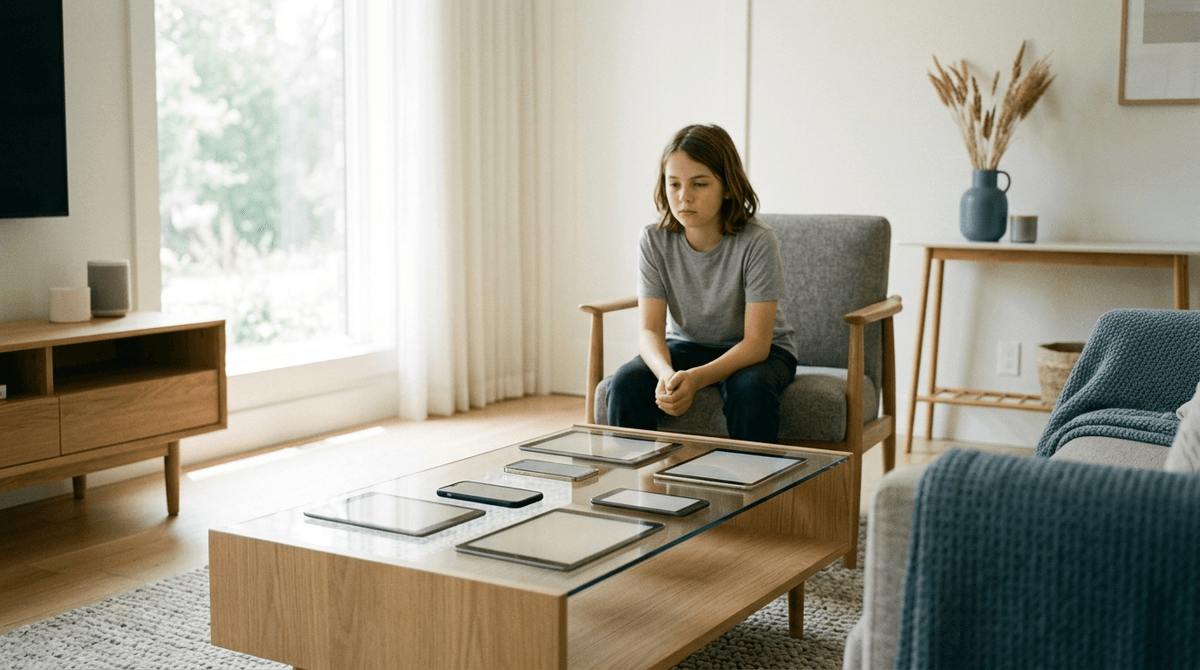

Toddlers diagnosed with autism spectrum disorder spend over six hours a day in front of screens on average—nearly four times as much as their neurotypical peers—and begin watching digital media months earlier.
Early and heavy screen use correlates directly with an autism diagnosis and higher symptom severity, with four out of five diagnosed children exposed to digital devices before their first birthday.
Pediatric guidance has long advised zero screen time before age two, but real-world enforcement often slips when an overwhelmed caregiver needs a quick soothe. When an infant is irritable, overstimulated, or difficult to calm, a glowing screen becomes an irresistible digital pacifier.
This research indicates that early digital immersion carries serious developmental stakes. While screens do not necessarily trigger autism on their own, massive exposure during critical neurological windows is linked to more severe social and communication deficits.
Smartphones and tablets have saturated households across the globe, reaching cribs in high-income and developing nations alike. Clinicians launched this study to determine whether the surge of infant screen use outside Western contexts mirrors patterns seen globally—and whether daily screen dosage actively tracks with diagnostic severity.
The developmental divide between children on the autism spectrum and their neurotypical peers opened up early in infancy:
- Infant exposure: Four in five children with autism were exposed to screens before age one, compared to fewer than half of the control group.
- Daily dosage: Children diagnosed with autism averaged 6.26 hours of daily screen time, compared to 1.72 hours among neurotypical children.
- Starting age: Children on the spectrum started regular screen exposure at 13.7 months old on average, nearly four and a half months earlier than peers (18.1 months).
- Symptom severity: Longer viewing hours and earlier start dates correlated significantly with higher symptom severity on standard diagnostic evaluations.
The causal arrow likely points in both directions, but neither direction favors screen use.
Infants with underlying neurodivergent wiring are often fascinated by predictable visual loops, flashing lights, and digital stimulation, making them far more willing to sit quietly before a phone. Caregivers—exhausted by an infant who resists traditional soothing—naturally lean into whatever calms them down.
Yet six daily hours in front of a screen systematically displaces real-world interactions. Developing brains require live facial mimicry, joint attention, and back-and-forth vocalizations to build social neural networks. Even if digital media does not cause autism, heavy use isolates an already vulnerable child from the social stimulation they need most.
This was an observational, case-control study conducted at a single hospital in Dhaka, meaning it establishes a correlation, not direct causation.
The dataset relied on parental interviews, which are vulnerable to memory lapses and retrospective reporting bias. Additionally, the statistical association between screen hours and symptom severity was moderate (r ≈ 0.30)—meaningful, but a clear reminder that screen exposure is only one component of a multifactorial developmental outcome.
- If your baby is under 18 months old… ban digital media from their daily environment entirely, reserving screens exclusively for interactive family video calls.
- If you notice your infant fixates heavily on screens instead of human faces… remove the device immediately and counter that preference with high-contact, interactive play like peek-a-boo and vocal turn-taking.
- If your toddler is showing early communication delays… audit your home's background media habits and eliminate ambient television during waking hours.
- If you relied on devices during your child's first year… drop the parenting guilt and focus on flooding their daily routine with shared floor play and eye contact right now.
Do not use a phone or tablet to calm an infant; the developmental cost of displaced human interaction is far too high. Keeping screens out of an infant's first year gives their social brain the clearest possible runway to connect with the physical world.
Hossain MM, Siddika A, Parvin J et al. (2026). The Correlation between Exposure to Screen Time and Severity of Autism Spectrum Disorder in Children in Bangladesh: A Case-Control Study. Mymensingh medical journal : MMJ. — pubmed.ncbi.nlm.nih.gov