

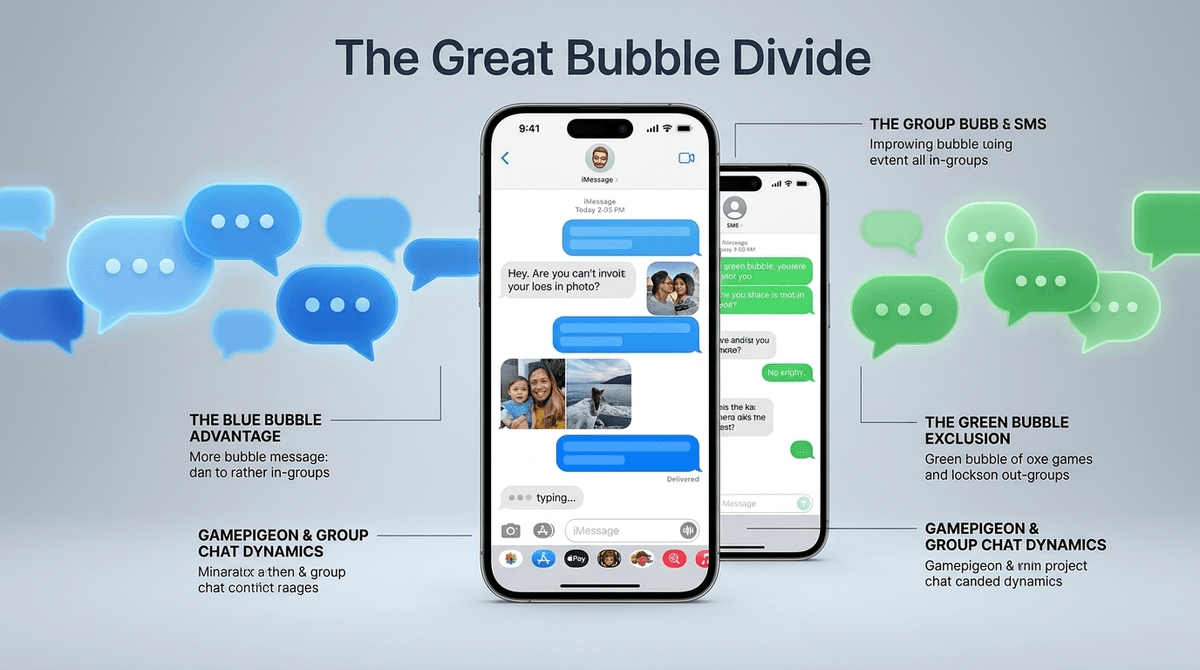
TL;DR: For kids, the "green bubble" isn't just a different color—it’s a social signal that you’re the one "breaking" the group chat. While Apple’s recent adoption of RCS (Rich Communication Services) makes texting between iPhones and Androids much less glitchy, the color divide remains. If your kid is begging for an iPhone, it’s likely less about the camera and more about the fear of being the "out-group" in the class chat.
Quick Links for the Group Chat Era:
If you’ve ever been in a group text where one person has an Android and everyone else has an iPhone, you’ve seen it: the blue bubbles turn green. But for your middle schooler, this isn't just a UI change. Historically, "going green" meant the chat lost its best features. Photos became pixelated, videos looked like they were filmed on a potato, "typing" indicators disappeared, and you couldn't "heart" a message without everyone getting a weird text that says "John liked 'See you at 5.'"
In the ecosystem of a 7th-grade social circle, the person with the Android was the person who "ruined" the chat. This created a massive amount of peer pressure for parents to buy iPhones, even if a cheaper Android was a better fit for the family budget or the child's responsibility level. It’s a classic "in-group/out-group" dynamic engineered by Apple’s software design.

We might think it’s ridiculous to care about the color of a text box, but to a kid, digital space is their primary social space.
- Exclusion: When a group of kids wants to start a chat, they often check if everyone has an iPhone. If one kid doesn't, they might literally be left out of the main thread to keep the "blue bubble" features (like high-res photo sharing and games via GamePigeon) intact.
- The "Broke" Stigma: In the weird, judgmental world of teens, Androids are often unfairly associated with being "cheap" or "off-brand," regardless of whether the Android phone actually costs $1,200. It’s the digital equivalent of wearing the wrong brand of sneakers in the 90s.
- Functionality over Fashion: It’s not just about being "cool." It’s frustrating when you can't see who is typing or when a video of a school project arrives so blurry you can't read the text. That frustration often gets directed at the person with the green bubble, not at Apple's restrictive software.
You might have heard that Apple finally "fixed" this. With the release of iOS 18, Apple added support for RCS (Rich Communication Services). This is a big deal, but it’s not a total fix for the social divide.
What’s better now:
- High-res media: You can finally send a clear video from an iPhone to an Android.
- Read receipts and typing dots: You can see when your Android-using friend is replying.
- Better group chats: Adding or removing people from a cross-platform chat is much smoother.
What stayed the same:
- The Bubbles are still Green: Apple made sure that even with better tech, the visual distinction remains. If you have an Android, you are still a "green bubble."
- Encryption: While iMessage-to-iMessage is end-to-end encrypted, RCS on iPhone isn't quite at the same security level yet (though it's better than old-school SMS).
If you want to opt out of the bubble wars entirely, many families and friend groups move to "platform-agnostic" apps. These apps treat every user the same, regardless of their phone hardware.
This is the gold standard globally. It doesn't care if you're on a $2,000 iPhone or a $100 Android. Everyone gets the same features, the same encryption, and—most importantly—the same color bubbles. It’s a great way to keep family chats functional without the "green bubble" drama.
If your kid plays Minecraft or Roblox, they are likely already on Discord. It’s more of a community hub than a simple texting app. It’s great for groups, but it requires a bit more parental oversight due to its "server" structure. Read our full guide to Discord safety
For better or worse, many teens use Snap as their primary "texting" app. Since it's all based on photos and videos within the app, there is zero bubble discrimination. However, it comes with its own set of "brain rot" concerns like Snap Streaks and the Snap Map. Check out the guide on Snapchat parental controls
When it’s time for that first phone, the "green vs. blue" debate will inevitably come up. Here’s how to handle it without feeling like you’re just caving to a marketing gimmick:
- Acknowledge the social reality: Don't just tell them "it doesn't matter." To them, it does. Acknowledge that being left out of group chats sucks.
- The "Eco-System" Talk: Explain that Apple uses these colors to keep people buying expensive phones. It’s a lesson in "vendor lock-in" and marketing.
- Check the Community Norms: Use Screenwise to see what other parents in your school district are doing. If 95% of the kids in your kid's grade are on iPhones, giving them an Android is an intentional choice that will require some coaching on how to handle the "green bubble" comments.
- Focus on the "Why": Is the child asking for an iPhone because they want to use Procreate Pocket to draw, or just because they’re afraid of the green bubble?
Ages 10-12 (The Entry Phase)
This is when the pressure starts. If you choose an Android or a "kid-safe" phone like a Gabb or Bark Phone, be prepared for them to feel a bit "othered" in digital spaces. This is a good time to introduce WhatsApp for family chats to show that there are other ways to communicate.
Ages 13-15 (The Peak Pressure)
Middle school is the "Ohio" of social dynamics—everything is weird and high-stakes. If they have an Android, they might start using Instagram DMs as their primary way to talk to friends to avoid the iMessage stigma. Monitor these third-party apps, as they often have fewer parental controls than native texting.
Ages 16+ (The Pragmatic Phase)
By high school, many kids realize that a phone is just a tool. However, the "Blue Bubble" still reigns supreme for dating and organizing sports teams. If they’re still on an Android, they’ve likely developed a thick skin or a "tech-savvy" identity to counter the "green bubble" jokes.
The "Green Bubble" problem is a masterpiece of social engineering by Apple. By making the experience of texting an Android user slightly worse, they've turned "blue" into a status symbol.
As a parent, you don't have to "solve" this by spending $800 on a new iPhone. But you should understand that when your kid complains about their green bubbles, they aren't just being spoiled—they're navigating a digital social hierarchy that was designed to make them feel exactly that way.
Next Steps:
- Check your family's stats: Use the Screenwise survey to see how your kid's tech usage compares to their peers.
- Update your devices: If you have an iPhone, make sure you're on iOS 18 so your texts to Android-using family members are at least using RCS for better quality.
- Talk about it: Ask your kid, "Do people in your grade actually care about green bubbles?" You might be surprised by how much—or how little—it actually matters in their specific circle.