

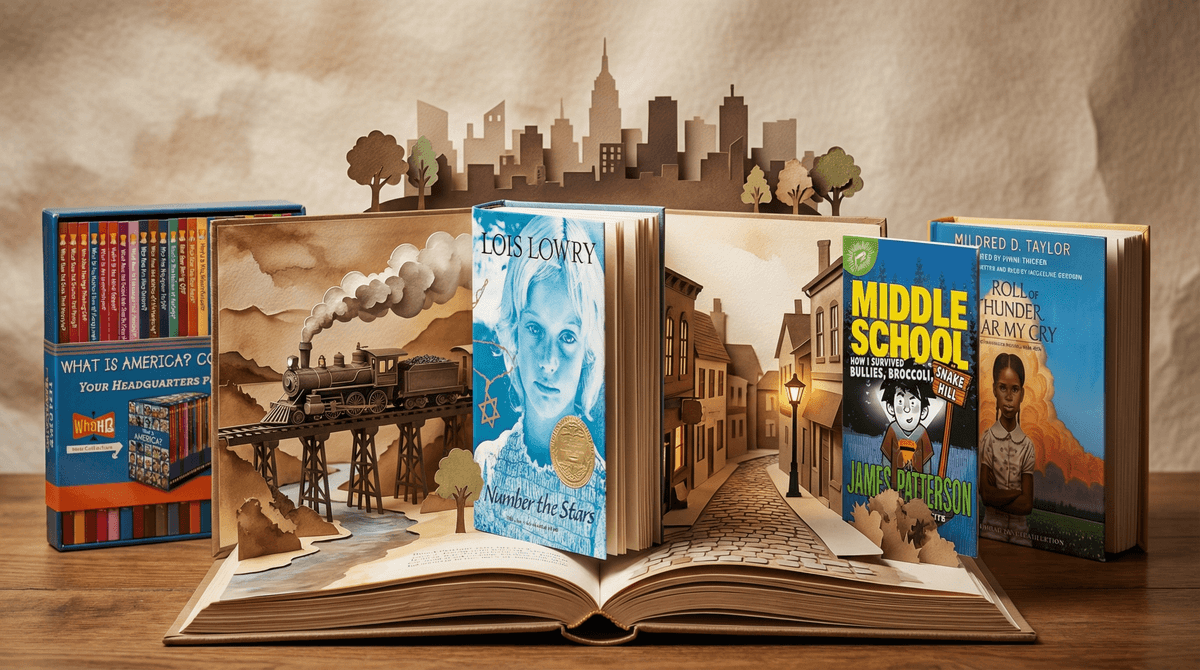
Historical fiction drops kids into real time periods through stories that feel alive. We're talking books where the history isn't just background noise—it's woven into plots about kids surviving the Holocaust, escaping slavery, or living through natural disasters.
The good ones make history click in a way that textbooks never could. When your kid reads about a girl their age hiding in an attic during WWII, suddenly the dates and facts from school have faces and feelings attached.
Popular series like I Survived, Who Was?, and standalone classics like Number the Stars and Roll of Thunder, Hear My Cry have been gateway drugs to reading for millions of kids. And yeah, we're competing with Roblox and YouTube for their attention, but historical fiction has a secret weapon: it satisfies the same craving for story and adventure without the notification dopamine hits.
Here's the thing: kids are naturally curious about "how things used to be." They want to know what life was like before smartphones, before cars, before indoor plumbing. Historical fiction scratches that itch while delivering actual narrative tension.
The I Survived series (ages 7-10) is basically the gateway drug. Each book is under 100 pages, moves fast, and puts a kid in the middle of a historical disaster—the Titanic, 9/11, Hurricane Katrina, Pearl Harbor. Are they literary masterpieces? No. Do they get reluctant readers hooked on books? Absolutely. My local librarian says these fly off the shelves faster than anything else in the elementary section.
The appeal breaks down like this:
- Adventure without fantasy rules - No need to learn a magic system or remember 47 made-up character names
- Relatability - The main characters are usually kids dealing with universal stuff (fear, friendship, family) in extraordinary circumstances
- Built-in stakes - When the setting is the Holocaust or the Civil War, you don't need to manufacture tension
- Curiosity satisfaction - Kids get answers to "what was it really like?" questions
And honestly? In an age where kids are drowning in screens, historical fiction offers something rare: sustained attention on a single narrative. No tabs, no notifications, no autoplaying next episode. Just a kid and a book and their imagination filling in the details.
Ages 6-8: Entry Points Start with lighter historical settings or biographical picture books. Magic Tree House technically counts here—Jack and Annie time-travel to historical periods, and while it's not deep, it plants seeds. The Who Was? biography series works great for this age too.
Ages 8-10: The Sweet Spot
This is when historical fiction really takes off. I Survived is the obvious choice for reluctant readers. For stronger readers, try:
- Number the Stars by Lois Lowry (Holocaust, but age-appropriate)
- The Watsons Go to Birmingham—1963 by Christopher Paul Curtis (Civil Rights era, funny and heartbreaking)
- Esperanza Rising by Pam Muñoz Ryan (Great Depression, Mexican-American experience)
Ages 10-13: Going Deeper Middle schoolers can handle more complex themes and moral ambiguity:
- Roll of Thunder, Hear My Cry by Mildred D. Taylor (Jim Crow South, required reading in many schools for good reason)
- Chains by Laurie Halse Anderson (Revolutionary War from an enslaved girl's perspective)
- Code Name Verity by Elizabeth Wein (WWII female spies, absolutely gutting)
- The Book Thief by Markus Zusak (Nazi Germany, narrated by Death—yes really, and it works)
Content warnings matter here. Historical fiction doesn't shy away from racism, violence, death, and injustice—that's kind of the point. But you know your kid. Some 10-year-olds are ready for the realities of slavery in Chains, others need another year or two.
Historical fiction is doing heavy lifting educationally. When your kid reads about the Dust Bowl in Out of the Dust, they're learning:
- Historical context and cause-and-effect
- Empathy for people in different circumstances
- Critical thinking about how societies work (and fail)
- Vocabulary and reading comprehension
- That history is made of individual human stories, not just dates
But let's be real about the limitations:
- Historical fiction is still fiction—authors take liberties
- Some books center white perspectives in stories that shouldn't be centered there
- Older classics may have outdated language or perspectives that need discussion
- Not all historical fiction is created equal (some is basically just modern kids in period costumes)
The conversation opportunity is huge. Unlike handing them an iPad and walking away, historical fiction naturally generates questions: "Did this really happen?" "Why did people think that way?" "What would I have done?" These are golden teaching moments that don't feel like teaching.
Series work great for reluctant readers because once they're invested in a format, they'll keep going. I Survived, Dear America, My Name Is America, Royal Diaries—these give kids a familiar structure while exploring different time periods.
Standalone novels often go deeper. Books like Number the Stars or Refugee by Alan Gratz (which weaves together three refugee stories across different time periods) have room to develop characters and themes that 100-page series books can't match.
For kids who are into Percy Jackson or Harry Potter, historical fiction can be a tough sell at first. Try Rick Riordan's Daughter of the Deep (historical-ish, with adventure) or books that blend genres like The Wednesday Wars (Vietnam era but also hilarious and about Shakespeare).
Historical fiction is one of the best "screen-free" investments you can make in your kid's development. It builds reading skills, historical knowledge, and empathy simultaneously. In a media landscape where everything is designed for quick consumption and constant stimulation, books that require sustained attention are increasingly valuable.
Start where your kid is. Reluctant reader who loves disaster content? I Survived. Strong reader interested in social justice? Roll of Thunder, Hear My Cry. Kid who thinks history is boring? Try a funny one like The Wednesday Wars or action-packed like Hatchet (okay, technically survival fiction, but set in recent enough past to count).
And if they get hooked? You've just given them a genre that will serve them for life. Historical fiction doesn't run out—there are literally thousands of years of human history to explore through story.
Next steps:
- Hit up your library and grab three books in different time periods—see what sticks
- Get historical fiction recommendations based on your kid's age and interests
 based on your kid's age and interests
 - Read one together—even middle schoolers sometimes love a family read-aloud, and it gives you built-in discussion time
Historical fiction won't replace screens entirely (let's be realistic), but it's one of the most powerful tools we have for building thoughtful, empathetic humans who can focus on something for more than 30 seconds. And in 2026, that feels pretty revolutionary.