

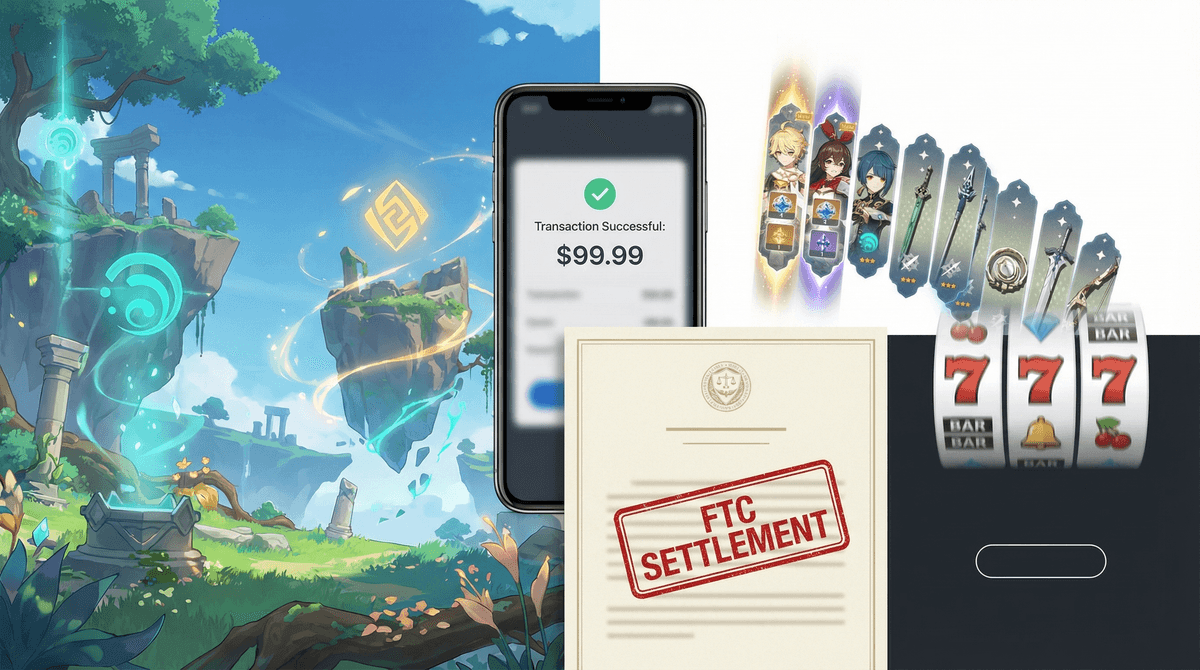
Genshin Impact's Gacha System: What Parents Need to Know After the FTC Crackdown
TL;DR: Genshin Impact just settled with the FTC for $20 million over predatory in-app purchases that particularly targeted kids. The game uses "gacha" mechanics—basically loot boxes that function like slot machines—to get players spending hundreds or thousands of dollars chasing rare characters. If your kid plays Genshin, you need to understand how this system works, what the settlement means, and how to lock down your payment methods immediately.
In January 2025, the FTC announced a $20 million settlement with Cognosphere (the company behind Genshin Impact). The charges? Using "dark patterns" and manipulative design to trick players—especially children—into spending money they didn't intend to spend.
The FTC's complaint outlined several specific problems:
- Confusing virtual currencies that obscured real-world costs
- Pressure tactics including limited-time offers and FOMO-inducing countdowns
- Easy unauthorized purchases by minors using saved payment info
- Inadequate parental controls and refund processes
Here's what makes this significant: this wasn't about a few kids accidentally buying something. This was about a systematic design intended to maximize spending through psychological manipulation. The FTC specifically called out how these mechanics were "particularly likely to trap kids and teens."
If you haven't played Genshin Impact yourself, the spending mechanics are genuinely hard to understand from the outside. Let me break it down.
The Basic Loop:
- You play the game for free (it's actually a pretty impressive open-world RPG)
- You collect characters and weapons to build your team
- The best characters and weapons are extremely rare and can only be obtained through "wishes"
- Wishes cost premium currency (Primogems, which you buy with real money)
- Each wish is essentially a lottery pull—you might get something good, probably won't
The Real Cost:
- One wish costs 160 Primogems
- You can buy 6,480 Primogems for $99.99 (roughly 40 wishes)
- The odds of getting a 5-star character (the rarest tier) are about 0.6% per wish
- There's a "pity system" that guarantees a 5-star after 90 wishes (roughly $180-200)
- But even then, you might not get the specific character you want
Do the math: to guarantee getting a specific featured character, you're looking at potentially $200-400 in spending. And that's for ONE character. The game constantly releases new characters every few weeks.
The gacha system preys on the exact psychological vulnerabilities that kids and teens are still developing defenses against:
1. Intermittent Rewards The random nature of gacha pulls triggers the same dopamine response as slot machines. That rush when you see the gold light and get a rare character? That's your brain's reward system being hijacked. Kids are especially susceptible to this because their prefrontal cortex (the part that says "maybe this is a bad idea") isn't fully developed.
2. Virtual Currency Confusion Genshin doesn't let you buy wishes directly with dollars. You buy Genesis Crystals, convert them to Primogems, then spend Primogems on wishes. This multi-step currency conversion is intentional—it psychologically distances the spending from real money. A kid doesn't think "I just spent $200," they think "I just used 32,000 Primogems."
3. FOMO and Artificial Scarcity Characters are only available for 2-3 weeks at a time. Miss them? You might wait 6-12 months for a rerun. The game constantly reminds you the clock is ticking. For kids who lack impulse control and long-term thinking, this creates intense pressure to spend NOW.
4. Social Pressure If your kid plays with friends who have rare characters, there's enormous social pressure to keep up. The game is co-op, so you're constantly seeing what others have. "Everyone has Raiden Shogun except me" becomes a legitimate source of stress.
5. Sunk Cost Fallacy Once a kid has spent $50 trying to get a character, spending another $50 feels justified because "I'm already so close!" This is the same psychology that keeps gamblers at slot machines.
Here's something most parents don't realize: Genshin Impact's business model doesn't depend on everyone spending a little. It depends on a small percentage of players (called "whales" in industry terms) spending a LOT.
Industry data suggests that in gacha games:
- About 50% of players never spend anything
- About 45% spend $5-50 total
- About 5% of players account for 90%+ of revenue
Some of those whales are adults with disposable income who understand what they're doing. But some are kids who've gotten access to a credit card and spent thousands before their parents noticed. The FTC settlement specifically addressed cases where minors racked up massive bills.
The FTC complaint included accounts from parents who discovered:
- A 16-year-old who spent $1,500 over two months
- A 13-year-old who made $2,800 in purchases using a parent's saved payment info
- Multiple cases of kids spending college savings or emergency funds
These aren't rare edge cases. Search "Genshin Impact kid spending" and you'll find Reddit threads, forum posts, and news stories about kids spending hundreds to thousands of dollars. The r/GenshinImpact subreddit regularly has posts from teens admitting they've spent their entire savings or asking how to hide purchases from parents.
The $20 million will go toward refunds for affected players. Cognosphere also agreed to:
- Improve disclosures about costs
- Make it clearer when real money is being spent
- Enhance parental controls
- Simplify the refund process
But here's the thing: the core gacha mechanics aren't going away. The game will still use randomized loot boxes. Characters will still cost hundreds of dollars to guarantee. The psychological manipulation is baked into the game's design.
The settlement is basically requiring Cognosphere to be more transparent about the fact that they're running a casino for kids, not eliminating the casino itself.
Immediate Actions:
-
Check your payment history. Look at your credit card, PayPal, Apple/Google account for charges from "COGNOSPHERE" or "miHoYo" (the parent company). The charges might be listed as small amounts ($4.99, $9.99) that add up.
-
Remove all saved payment methods from the device your kid plays on. Go to Settings > [Your Name] > Payment & Shipping on iOS, or Google Play > Payment Methods on Android, and delete everything.
-
Enable purchase approval. On iOS: Screen Time > Content & Privacy Restrictions > iTunes & App Store Purchases > Require Password > Always. On Android: Google Play > Settings > Require authentication for purchases > For all purchases.
-
Talk to your kid about what they've spent. Don't lead with anger (even if you're furious). Start with curiosity: "I saw some charges from Genshin Impact. Can you walk me through what you bought and why?" You need to understand what they were trying to accomplish.
Longer-Term Boundaries:
If your kid wants to keep playing Genshin (and honestly, removing the gacha spending, it's a legitimately good game), here are some frameworks:
Option 1: Free-to-Play Only Genshin is completely playable without spending money. You can beat all the content with free characters. This teaches delayed gratification and working with constraints. The catch: your kid will feel the FOMO hard, especially if friends are spending.
Option 2: Fixed Monthly Budget Some families do a "gaming allowance"—maybe $10-20/month that can be spent on any game. This teaches budgeting and opportunity cost. The risk: the gacha system is designed to make any fixed budget feel insufficient.
Option 3: Earned Currency Tie spending to chores, grades, or other achievements. "You can spend what you earn." This at least connects the spending to real-world effort. The downside: you're still feeding money into a predatory system.
Option 4: Alternative Games Consider steering toward games with more ethical monetization. Zelda: Breath of the Wild or Zelda: Tears of the Kingdom offer similar open-world exploration with a one-time purchase. Stardew Valley has the collecting/building elements without gambling mechanics. Check out our guide to alternatives to gacha games for more options.
This is a great opportunity for a broader conversation about how free-to-play games actually work. Some talking points:
"These games are designed by experts to make you want to spend money." Not in a judgmental way, but factually. There are teams of psychologists and data scientists whose job is to maximize spending. Understanding this helps kids recognize they're not weak-willed—they're up against professional manipulation.
"The game is fun because it's designed to be fun, but the spending is designed to never feel like enough." Help them separate the legitimate enjoyment of gameplay from the artificial scarcity of the gacha system. You can enjoy the former without engaging with the latter.
"Virtual items have real costs." Work through the math together. "If you spend $100 on Primogems, what else could you buy with $100? How many hours would you need to work to earn $100?" Make the connection concrete.
"What would it feel like to play without spending?" Explore whether the game is actually fun on its own, or if the fun has become tied to the gambling rush of pulling for characters. This is a surprisingly mature conversation many teens can have.
Genshin Impact isn't unique. The gacha model dominates mobile gaming, especially games from Asian publishers where these mechanics are more culturally accepted. Honkai: Star Rail (same company), Raid: Shadow Legends, Marvel Strike Force, and dozens of others use virtually identical systems.
The FTC settlement is significant because it's one of the first major regulatory actions specifically calling out how these mechanics harm children. But until there's broader regulation—like the loot box restrictions being implemented in some European countries—these systems will keep proliferating.
Some questions to discuss with your kids about game monetization :
:
- Why are some games free and others cost money upfront?
- How do free games make money?
- What's the difference between paying for a complete game vs. paying for chances to get items?
- When does spending in a game cross from "fun purchase" to "problem"?
Under 13: Genshin Impact probably shouldn't be on the radar anyway (it's rated T for Teen). The game has some violence, complex systems, and the gacha mechanics are absolutely inappropriate for this age group.
13-15: This is the danger zone. Old enough to be drawn in by the anime aesthetic and gameplay, not old enough to have developed resistance to the psychological manipulation. If they're playing, it should be with strict spending limits or free-to-play only, and with regular check-ins about how it feels.
16-18: Older teens can potentially handle this with education and boundaries, but it's still risky. This is a good age to have explicit conversations about gambling mechanics, budgeting, and how companies design for addiction. Some families treat this as a learning experience—let them spend their own earned money with clear limits, and use it as a real-world lesson in how easy it is to overspend.
If your child made unauthorized purchases, you may be eligible for refunds as part of the FTC settlement or through your payment platform:
Through the FTC Settlement: Watch for announcements at ftc.gov about how to file a claim. The settlement specifically allocates funds for refunds to affected consumers.
Through Apple: Go to reportaproblem.apple.com, sign in, find the charges, and select "Request a refund." Choose "I didn't authorize this purchase." Apple has been more generous with refunds for unauthorized kid purchases after regulatory pressure.
Through Google: Go to play.google.com/store/account, find the purchase, click "Report a problem" > "Request a refund." Google's policy is more restrictive, but unauthorized purchases by minors are explicitly covered.
Through Your Credit Card: If the above fail, dispute the charges with your credit card company as unauthorized purchases by a minor. Document everything—when you discovered it, conversations with your child, attempts to resolve with the game company.
The FTC's $20 million settlement validates what many parents have been saying: Genshin Impact's monetization is predatory, especially toward kids. The gacha system is gambling dressed up as a game mechanic, using every psychological trick to maximize spending.
If your kid plays Genshin:
- Lock down payment methods immediately
- Check your purchase history
- Have an honest conversation about what they've spent and why
- Set clear boundaries going forward
- Consider whether this game is worth keeping in your family's rotation
The game itself—the exploration, story, combat—can be enjoyed completely free. But the gacha system is designed to make that feel insufficient. Your kid isn't weak or bad for feeling pulled to spend. They're up against a multi-billion dollar company that hired experts to make them feel exactly that way.
You're not overreacting by being concerned about this. You're responding appropriately to a system that was literally just penalized by federal regulators for being manipulative and harmful.