

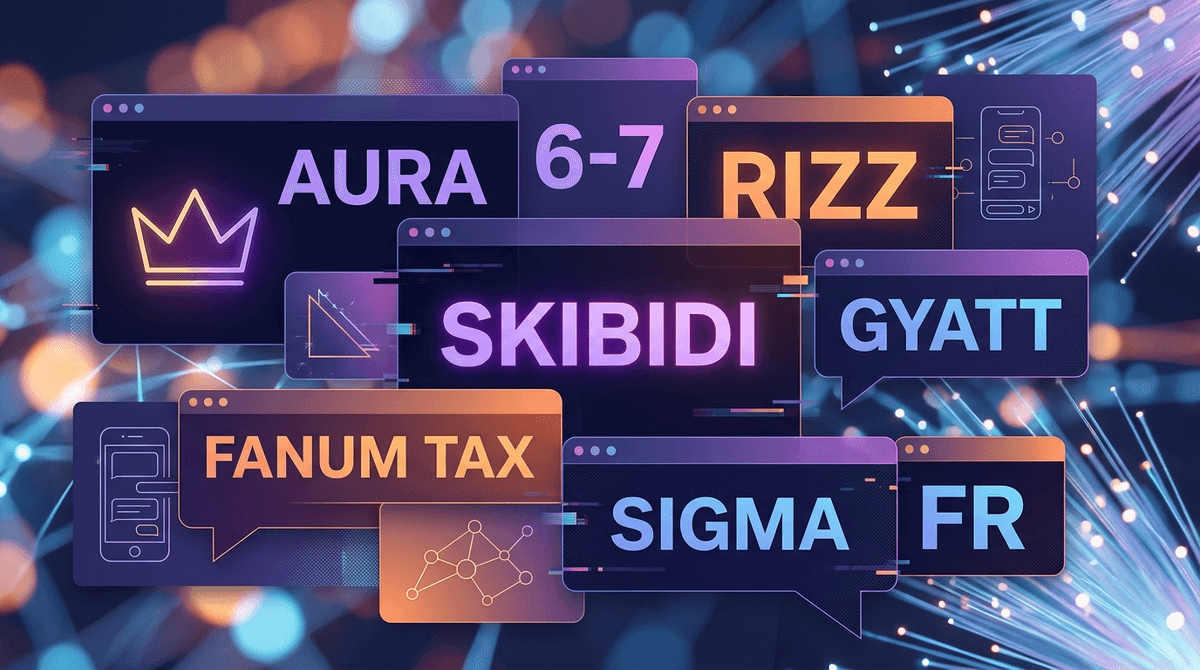
TL;DR: If your kid just told you that you have "negative aura" because your dinner choice was "mid," don't panic. Gen Alpha (kids born roughly 2010–2024) has developed a linguistic shorthand that moves at the speed of a fiber-optic connection. This guide decodes the most viral terms of 2026—from Aura and 6-7 to the ever-present Skibidi—and explains why this "brain rot" is actually a high-speed tool for community building.
Quick Links for Context:
- Skibidi Toilet - The "patient zero" of Gen Alpha memes.
- Roblox - Where most of this slang is beta-tested in real-time.
- TikTok - The primary distribution hub for new "sounds" and terms.
- The Amazing Digital Circus - High-quality surrealism that kids actually love.
If you grew up saying "talk to the hand" or "on fleek," you know that every generation needs a way to exclude adults. But Gen Alpha is different. Their slang isn't just about cool words; it’s about meme-density.
A single word like "Skibidi" can be a noun, an adjective, or a verb depending on the tone of voice and the context. This isn't just laziness; it’s a byproduct of growing up with YouTube Shorts and TikTok where information is delivered in 15-second bursts. They aren't just speaking; they are referencing. To understand the slang, you have to understand the media behind it.
Learn more about how short-form video changes how kids process language
We all know "Rizz" (charisma) and "Cap" (lying) by now. Those are basically "vintage" at this point. Here is what is actually flying around the playground in 2026:
Aura
This is the big one right now. Think of Aura as a digital credit score for coolness. If you do something impressive, you get "+1,000 aura." If you trip in the cafeteria or try too hard to be funny, that’s "negative aura."
- Why it matters: It’s a way for kids to gamify social standing. It’s less about being a "bully" and more about observing social "wins" and "fails."
6-7
This is a newer, more specific reference that stems from viral "standards" videos. Originally referring to the "6 feet tall, 7-figure salary" trope, Gen Alpha has shortened it to 6-7 to describe anything that is "top tier" or "elite." If a new game is 6-7, it means it’s the gold standard.
- The nuance: It can also be used ironically to mock people who have unrealistic expectations.
Skibidi
Yes, it’s still here. While it started with the Skibidi Toilet videos, it has evolved into a general intensifier. "Skibidi Ohio" means something is incredibly weird. "Skibidi Rizz" means someone has intense (often weird) charisma.
- The Verdict: It’s mostly nonsense, but it’s the "smurf" of 2026. It can mean anything.
Mewing / Looksmaxxing
You might see your kid putting a finger to their lips and pointing to their jawline. This is mewing. It’s a tongue-placement exercise supposed to sharpen the jawline, but for kids, it’s a meme used to say "I’m too busy being handsome/cool to talk to you."
- Parent Note: It’s usually harmless, but it’s part of a larger "looksmaxxing" culture on TikTok that can occasionally veer into body image obsession.
Fanum Tax
Named after the streamer Fanum (a member of Kai Cenat’s crew), this refers to the "tax" you pay when a friend steals a bite of your food.
- In the wild: If you take a fry from your kid's plate, you are "Fanum taxing" them.
It’s easy to dismiss this as "brain rot"—a term kids actually use themselves to describe the nonsensical, high-stimulation content they consume. But there’s a reason it sticks.
- Speed of Community: Using this slang is a "vibe check." It instantly signals that you are part of the same digital tribe. If you know what "Sigma" means in the context of Fortnite, you’re in.
- Creative Absurdism: A lot of this slang comes from surrealist humor. The Amazing Digital Circus or Skibidi Toilet are weird, yes, but they are also a form of digital folk art that kids feel they "own" because parents don't get it.
- Ownership: Gen Alpha is the first generation to have their culture generated entirely by peers and creators on YouTube rather than by movie studios or TV networks.
If you’re worried that your kid’s vocabulary is shrinking to five words, the solution isn't to ban the slang—it's to introduce higher-quality media that still feels "current." Here are some Screenwise-approved picks that bridge the gap:
The Amazing Digital Circus (Ages 10+)
It’s weird, it’s viral, and it’s actually very well-written. It deals with existential themes in a way that respects a kid's intelligence while maintaining that "glitchy" aesthetic they love.
Hilda (Netflix) (Ages 6+)
If you want an antidote to the loud, fast-paced "brain rot" of YouTube Shorts, Hilda is the move. It’s whimsical, beautifully animated, and encourages exploration and empathy.
Kurzgesagt – In a Nutshell (Ages 8+)
This is how you use the "high-stimulation" format for good. It’s fast-paced science and philosophy with incredible visuals. It’s "6-7" educational content.
Minecraft (Ages 7+)
Still the gold standard for digital creativity. Unlike Roblox, which can sometimes feel like a giant mall designed to drain your bank account, Minecraft encourages actual building and logic.
Check out our full guide on why Minecraft is better for brain development than Roblox
While most slang is just kids being kids, there are a few red flags to watch for:
- The "Sigma" Pipeline: Originally meaning a "lone wolf," the term "Sigma" has been co-opted by some corners of the internet to promote "alpha male" or exclusionary mentalities. If your kid is talking about "Sigma" in a way that seems derogatory toward women or "weak" people, it’s time for a conversation.
- Looksmaxxing Obsession: As mentioned, if your middle-schooler is suddenly obsessed with "mewing" or "canthal tilt" (the angle of their eyes), they may be falling into an algorithmic hole of body dysmorphia.
- Platform Safety: Most of this slang is born on TikTok and YouTube. If your child is under 13, they shouldn't be on the main TikTok app. Stick to YouTube Kids or supervised accounts.
The quickest way to lose "aura" is to try to use this slang seriously. If you say, "This lasagna is so Skibidi, no cap," your child will physically wither into the floor.
Instead, use it as a bridge.
- Ask for a translation: "I keep hearing people say 'negative aura.' What did that guy in the video do to lose his points?"
- Validate the humor: Acknowledge that some of it is actually funny. Skibidi Toilet is objectively weird, but the lore is surprisingly deep. Asking "So, what's the deal with the camera-head guys?" shows you're paying attention without being judgmental.
- Set the "Brain Rot" Boundary: It’s okay to say, "Hey, I noticed you’ve been scrolling YouTube Shorts for an hour and you’re starting to sound like a literal bot. Let’s go do something that requires full sentences."
Get a script on how to talk to your 10-year-old about internet slang
Gen Alpha slang is a dialect of the internet. It’s fast, it’s weird, and it’s often "mid." But it’s also a sign of a generation that is incredibly digitally literate and connected.
You don't need to speak the language fluently; you just need to know enough to know when the conversation has drifted into territory that isn't age-appropriate. Keep the lines of communication open, don't be afraid to laugh at the absurdity, and remember: even if they say you have "negative aura," you’re still the one with the Wi-Fi password.
- Audit the Feed: Spend 10 minutes looking at your kid's YouTube history. You’ll see the "source code" for their slang immediately.
- Swap the Content: If they love the weirdness of Skibidi Toilet, try introducing them to The Amazing Digital Circus.
- Take the Screenwise Survey: Understand how your family's digital habits compare to your community and get a personalized "slang sheet" for your kid's specific age group.