

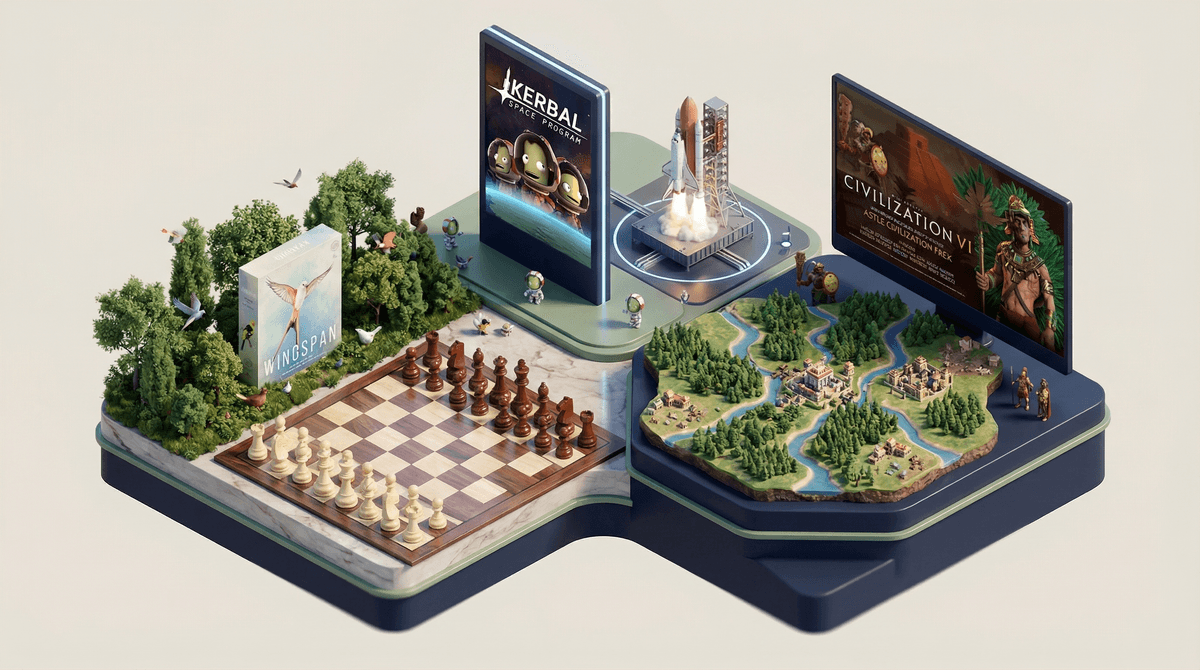
Look, we need to talk about what "strategy" actually means when it comes to games. Because there's a massive difference between a game that requires strategic thinking and a game that just... takes a long time to play.
Real strategy games require players to:
- Plan ahead (not just react to what's happening right now)
- Make meaningful choices where different decisions lead to genuinely different outcomes
- Adapt their approach based on changing circumstances
- Consider trade-offs (choosing this means you can't have that)
- Think several moves ahead (if I do X, my opponent will probably do Y, so I should actually do Z)
A lot of games market themselves as "educational" or "strategic" when they're really just time-sinks with a thin veneer of decision-making. Your kid tapping the same button 500 times to level up their character? That's not strategy. That's a dopamine loop with extra steps.
Strategic thinking is one of those genuinely transferable skills. Kids who learn to think strategically in games often get better at:
- Breaking down complex problems into manageable steps
- Anticipating consequences before acting
- Resource management (time, money, attention)
- Pattern recognition
- Handling setbacks without rage-quitting life
The catch? Not all games that look strategic actually build these skills. And some games that seem "educational" are just regular games with math problems stapled on top.
Ages 6-9: Building the Foundation
[Chess](https://screenwiseapp.com/media/chess-boardgame - Yeah, I'm starting with the obvious one. But here's the thing: chess apps like Chess Kid or the kids' mode on Chess.com actually make learning fun without dumbing it down. The game is genuinely strategic, and kids this age can absolutely learn it.
Blokus - This physical board game is spatial strategy at its finest. Kids learn to plan their moves, block opponents, and think about board position. It plays in 20 minutes, which is perfect for this age.
Ticket to Ride - Both the physical and digital versions work great. Kids learn route planning, resource management (those train cards), and how to pivot when someone blocks their path. The digital version has a great tutorial.
Minecraft (in Creative or Survival mode, not on servers) - When kids are actually building complex redstone contraptions or planning out their builds, this is legitimate strategic thinking. When they're just running around hitting things? Not so much. The difference matters.
Ages 10-13: Leveling Up Complexity
Civilization VI - This is the gold standard. Tech trees, diplomacy, resource management, long-term planning. Fair warning: games take HOURS. But the strategic thinking is absolutely real. Your kid will learn about trade-offs, opportunity cost, and how to balance competing priorities.
Into the Breach - Turn-based tactical game where you can see exactly what the enemy will do next turn. This forces kids to think ahead and plan solutions to problems they can see coming. Games are short (30-60 minutes), which is great for this age.
Slay the Spire - Deck-building strategy that teaches probability, synergy (how cards work together), and risk assessment. Every run is different, so kids learn to adapt their strategy based on what they're given.
Catan - The classic. Trading, resource management, probability (those dice matter), and long-term planning. The digital version is solid, but honestly the physical game is better for family play.
Wingspan - Engine-building strategy with gorgeous bird art. Kids learn to build combinations, plan several turns ahead, and optimize their approach. Bonus: they'll learn actual bird facts.
Ages 14+: The Deep End
StarCraft II - Real-time strategy that requires quick thinking AND long-term planning. The competitive scene is intense, but the campaign mode is excellent for learning. This is legitimately difficult and requires serious strategic chops.
XCOM 2 - Turn-based tactical combat with base management. Every decision has consequences, and the game doesn't hold your hand. Kids learn to manage multiple priorities, handle failure (your soldiers WILL die), and think probabilistically.
Factorio - This is basically "logistics and systems thinking: the game." Kids build automated factories and learn to optimize complex systems. Warning: this game is EXTREMELY addictive. Like, "I'll just optimize one more production line" at 2am addictive.
Here's how to spot games that are actually strategic vs. games that just waste time:
Good signs:
- Decisions feel meaningful (not just picking between two identical options)
- Kids talk about their strategy or plan ("I'm going to do X because...")
- Losing teaches something (they can identify what went wrong)
- Different approaches lead to different outcomes
- The game requires planning, not just reflexes
Red flags:
- Endless grinding for incremental upgrades
- "Strategy" just means waiting for timers
- Pay-to-win mechanics (real strategy games don't let you buy victory)
- Every playthrough feels basically the same
- The main "strategy" is just playing more hours than other people
Let's be real: most games marketed as "educational strategy" are just regular strategy games with a thin educational coating. Or they're educational games with minimal actual strategy.
Kerbal Space Program is one of the rare exceptions—it's genuinely educational (orbital mechanics, physics) AND requires legitimate strategic thinking (resource management, mission planning). But it's also genuinely hard.
Most of the time, you're better off with a real strategy game that builds thinking skills, plus separate educational content, rather than trying to find the unicorn that does both.
Not all strategy games are created equal. The best ones make kids think ahead, adapt to changing situations, and learn from failure. The worst ones just disguise time-wasting as "strategy."
If your kid is playing Civilization VI for three hours and can explain their tech tree strategy and why they're pursuing a science victory? That's legitimate strategic thinking. If they're playing some mobile "strategy" game and just waiting for timers to expire so they can tap the same button again? That's not strategy, that's a Skinner box.
The good news: there are tons of genuinely strategic games across all age ranges. Start with one from the age-appropriate list above, play it together if possible, and ask your kid to explain their strategy. You'll know pretty quickly whether they're actually thinking strategically or just going through the motions.
Want to dig deeper into specific games? Check out our guide to Minecraft or learn more about whether Civilization is actually educational . And if you're trying to figure out whether your kid's current favorite game is building skills or just burning time, find out directly.