

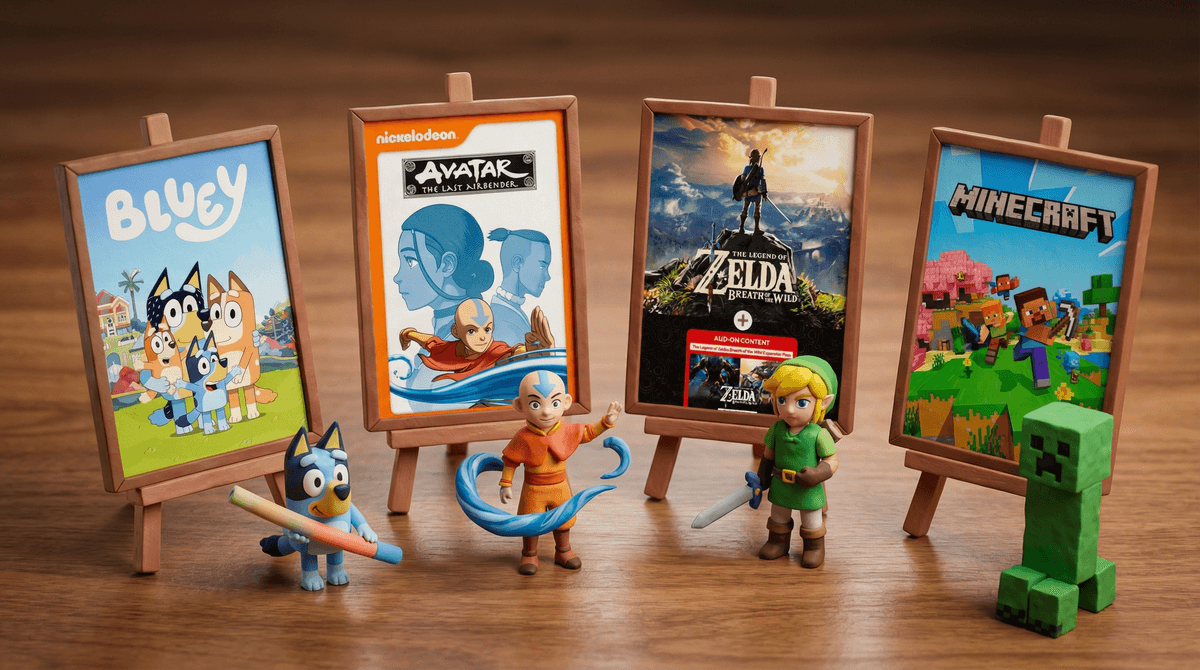
Fantasy violence is basically what happens when a cartoon character bonks another cartoon character on the head with a comically oversized hammer, or when your kid's Minecraft avatar gets attacked by a pixelated zombie. It's violence that's clearly removed from reality — think magic spells, cartoon physics, and battles with dragons rather than realistic depictions of actual human-on-human violence.
The Entertainment Software Rating Board (ESRB) defines it as "violent actions of a fantasy nature, involving human or non-human characters in situations easily distinguishable from real life." Translation: swords and sorcery, not guns and gore.
Here's the thing though — "fantasy violence" is a huge umbrella. It covers everything from Bluey episodes where the kids play-fight with pool noodles to intense boss battles in The Legend of Zelda where Link is literally fighting for his life against massive monsters. Both technically count as fantasy violence, but they're wildly different experiences.
The difference between fantasy violence and realistic violence isn't just academic — it actually matters for how kids process what they're seeing.
Fantasy violence typically features:
- Clear good vs. evil narratives
- Magical or impossible elements (fireballs, potions, respawning)
- Cartoon or stylized graphics
- Minimal or no blood/gore
- Consequences that don't mirror real life
- Heroes who fight monsters, not other humans
Realistic violence shows:
- Human-on-human conflict with real weapons
- Blood, injury detail, and realistic consequences
- Modern or historical settings
- Motivations that could exist in real life
- Graphics or cinematography that aim for realism
Research consistently shows that kids can distinguish between these two types pretty early on. A 7-year-old watching Avatar: The Last Airbender understands that people can't actually shoot fire from their hands. But that same kid watching a realistic war movie? That hits different.
The concern isn't really about whether fantasy violence "causes" real-world aggression — decades of research show that connection is way more complicated than "monkey see, monkey do." The real questions are: Is this content age-appropriate for your specific kid? Does it align with your family values? And is your child able to process what they're seeing?
Ages 3-6: Even mild fantasy violence can be intense for this age group. They're still figuring out what's real and what's pretend. Stick to truly gentle content where any "conflict" is resolved quickly and kindly. Think Daniel Tiger's Neighborhood over Pokémon.
Ages 7-9: This is when most kids can handle cartoon-style fantasy violence — think Pokémon battles, Mario Kart shells, or Percy Jackson fighting mythological monsters. They understand it's not real, but you'll still want to check in about how they're feeling. Some kids are totally fine, others are more sensitive.
Ages 10-12: Most kids this age can handle more intense fantasy violence — Minecraft survival mode, Marvel movies, Harry Potter battles. But there's still a big range. Your 10-year-old might be ready for The Legend of Zelda: Breath of the Wild while their friend has nightmares from the same content.
Ages 13+: Teens can generally handle most fantasy violence, though you might still have conversations about the difference between fantasy combat and glorifying real-world violence. Games like Fortnite blur some lines — it's cartoonish, but the weapons are realistic and players are shooting other humans (even if they're cartoon humans).
Not all fantasy violence is created equal. Here are the yellow flags that might make content less appropriate:
Glorification vs. consequence: Does the hero face actual consequences for violence, or is it just fun and games? Avatar: The Last Airbender shows characters struggling with the weight of their choices. Some games just make violence a points system.
Realistic weapons in fantasy settings: Fortnite is technically fantasy (cartoon graphics, absurd scenarios), but kids are using AR-15s, not magic wands. That's a different conversation than Zelda's Master Sword.
Your kid's specific sensitivities: Some kids are totally fine with intense action but get freaked out by jump scares. Others can handle scary but not sad. You know your kid better than any rating system.
Frequency and context: Watching one Marvel movie is different from spending three hours a day in combat-heavy games. It's not about good or bad — it's about balance.
The goal isn't to shield kids from all fantasy violence — it's to help them think critically about what they're consuming.
Try these conversation starters:
- "What did you think about that battle scene? How did it make you feel?"
- "Why do you think the hero chose to fight instead of [other option]?"
- "How is this different from real life? What would actually happen if someone did that?"
- "Do you think there was another way to solve that problem?"
Watch or play together when possible, especially with new content. You'll catch things the rating didn't mention, and you can gauge their reaction in real-time.
Don't make it a lecture. Kids shut down when they think you're going to ban their favorite game. Stay curious, not judgmental. "Tell me about that game" goes further than "that looks too violent."
Fantasy violence isn't inherently bad for kids, but it's not all the same either. A game where you're bonking cartoon turtles is different from one where you're executing realistic combat moves on human characters, even if both technically fall under "fantasy violence."
The rating systems (ESRB for games, TV ratings for shows) are a starting point, not the finish line. They'll tell you if something contains fantasy violence, but they won't tell you if your specific kid is ready for it or if it aligns with your family values.
Trust your gut, know your kid, and remember that "age-appropriate" is a range, not a rule. Your 8-year-old might be totally fine with Pokémon battles while their cousin isn't ready. Both are normal.
Check the content first. Before your kid dives into a new game or show, spend 10 minutes watching gameplay on YouTube or reading reviews on Common Sense Media. The ESRB rating will say "fantasy violence," but you want to see what that actually looks like.
Set up co-viewing or co-playing time for new content, especially if it's pushing the boundaries of what your kid has experienced before. You'll learn a lot about how they process it.
Keep the conversation going. Don't make it a one-time talk. Check in casually about what they're watching or playing. The goal is ongoing dialogue, not a lecture series.
If you're trying to figure out whether a specific game or show is right for your family, See if a specific game is appropriate — it can help you think through the specifics of your situation.