

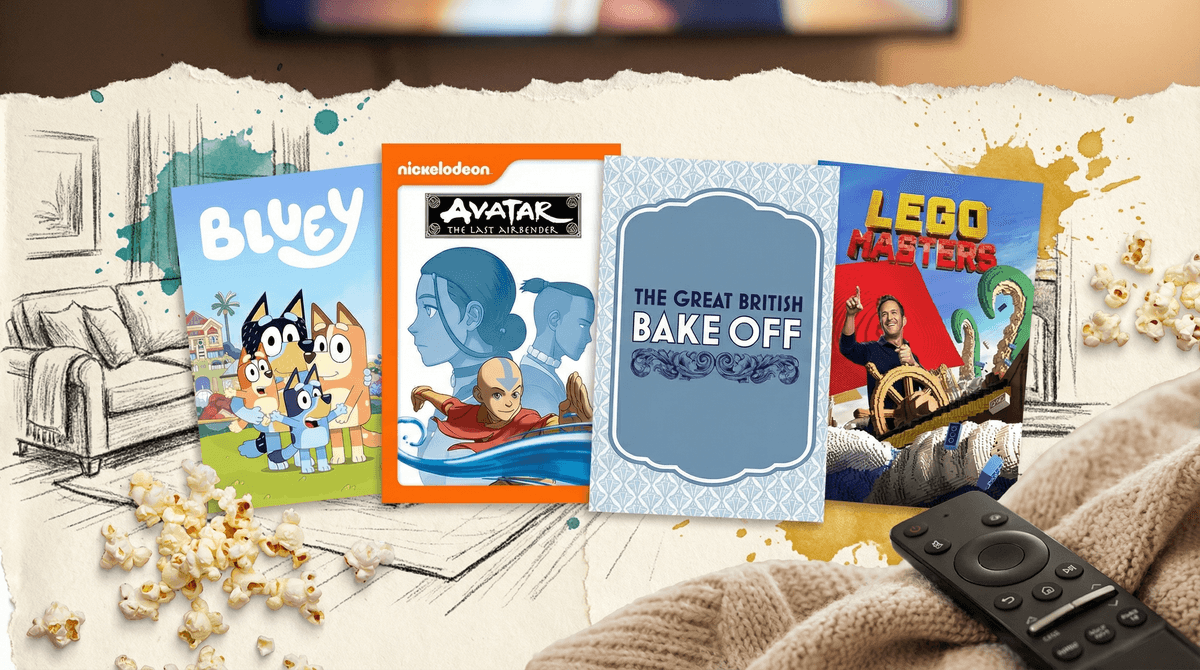
Look, I'm not going to pretend that gathering everyone around the TV for a wholesome family viewing experience is easy in 2026. Between your 7-year-old who only wants to watch Bluey for the 47th time, your tween who's convinced that anything you suggest is "cringe," and the teenager who'd rather be on Discord with friends, finding something everyone actually wants to watch feels like negotiating a UN peace treaty.
But here's the thing: shared media experiences are one of the most underrated parenting tools we have. When you watch something together, you're not just killing time—you're creating a shared cultural language, opening doors for conversations that might never happen otherwise, and honestly, just enjoying each other's company without anyone having to clean up afterward.
The trick isn't finding the "perfect" show. It's finding something good enough that nobody's actively miserable, and ideally something that gives you material to talk about beyond "that was funny when the guy fell down."
We spend a lot of time worrying about kids' solo screen time—and we should. But co-viewing is fundamentally different from passive consumption. When you watch together, you're:
- Modeling media literacy: Your running commentary ("Wait, why is that character doing that?" or "That's not how science works") teaches critical thinking
- Creating conversation opportunities: Shows give you a low-pressure way to discuss complex topics—friendship drama, ethical dilemmas, what makes something funny
- Building shared references: Inside jokes and callback moments that become part of your family culture
- Actually connecting: Revolutionary concept, I know
The research backs this up. Kids who co-view with parents show better understanding of media messages, more critical thinking about content, and yeah, better family relationships overall.
Let's be real: the wider your kids' age range, the harder this gets. A 6-year-old and a 14-year-old don't have a ton of overlap in their Venn diagram of entertainment preferences.
For families with younger kids (ages 5-10):
- Avatar: The Last Airbender remains the gold standard—genuinely great storytelling that adults can appreciate
- The Wild Robot (the recent movie) works beautifully across ages
- Gravity Falls has enough mystery and humor for older kids while being accessible to younger ones
- Hilda on Netflix is quietly wonderful—cozy, adventurous, beautifully animated
For families with tweens/teens (ages 10+):
- Abbott Elementary is genuinely funny and teaches empathy (bonus: no content you'll regret)
- The Great British Baking Show is shockingly watchable—low stakes, high competence, nice people being nice
- Only Murders in the Building works for ages 12+ and gives you a mystery to solve together
- Physical 100 on Netflix—competition show, minimal language barriers, impressive athletic feats
The nuclear option for mixed ages: Game shows and competition shows. Seriously. The Floor, Lego Masters, even Survivor (for older kids) work because everyone can play along, there's built-in conversation ("I would have done that differently!"), and nobody's bored.
Not all "family-friendly" content is created equal. Some things that are technically age-appropriate are still just... not good.
Skip the "safe" but soulless stuff: Those direct-to-streaming animated movies with B-list voice actors? They're not going to hurt anyone, but they're also not going to give you anything to talk about. Life's too short for mediocre media.
Watch out for shows that are "fine" but forgettable: If you can't remember what happened in an episode 10 minutes after it ends, it's not creating shared experiences—it's just filling time.
Be thoughtful about "mature" content: Yes, your 13-year-old has probably heard worse at school. But there's a difference between acknowledging reality and making them watch awkward scenes next to you on the couch. Read more about age-appropriate content decisions .
.
Let kids have input: Rotate who picks. Yes, this means sometimes you'll watch something that's not your first choice. That's the deal.
Keep phones away: Including yours. If you're checking email during the show, you're teaching them that this doesn't really matter.
Talk during the show: Controversial opinion, but running commentary is good! Ask questions, make predictions, point out cool details. This isn't a movie theater.
Don't force it every night: Once or twice a week is plenty. This should feel special, not obligatory.
Have snacks: Come on, this is obvious.
Perfect family TV night doesn't exist. Someone will complain. Someone will need to pee at the worst moment. Someone will spoil the ending because they already watched it with friends.
But here's what does exist: moments where you're all genuinely enjoying the same thing, laughing at the same jokes, gasping at the same plot twists, and having something to talk about over breakfast the next morning.
Start with one show, one night a week. See what sticks. And if your teenager still insists everything is cringe? They'll be back. Eventually they'll miss these nights more than they'll ever admit.
This week: Ask everyone to suggest one show or movie. Write them all down. Pick one, set a time, and commit to it—no backing out, no phones, no excuses.
Need more specific recommendations? Tell us about your family and we'll give you personalized suggestions based on your kids' ages and interests.
Want to explore specific shows? Check out our guide to the best family shows by age or how to navigate streaming services with kids.