

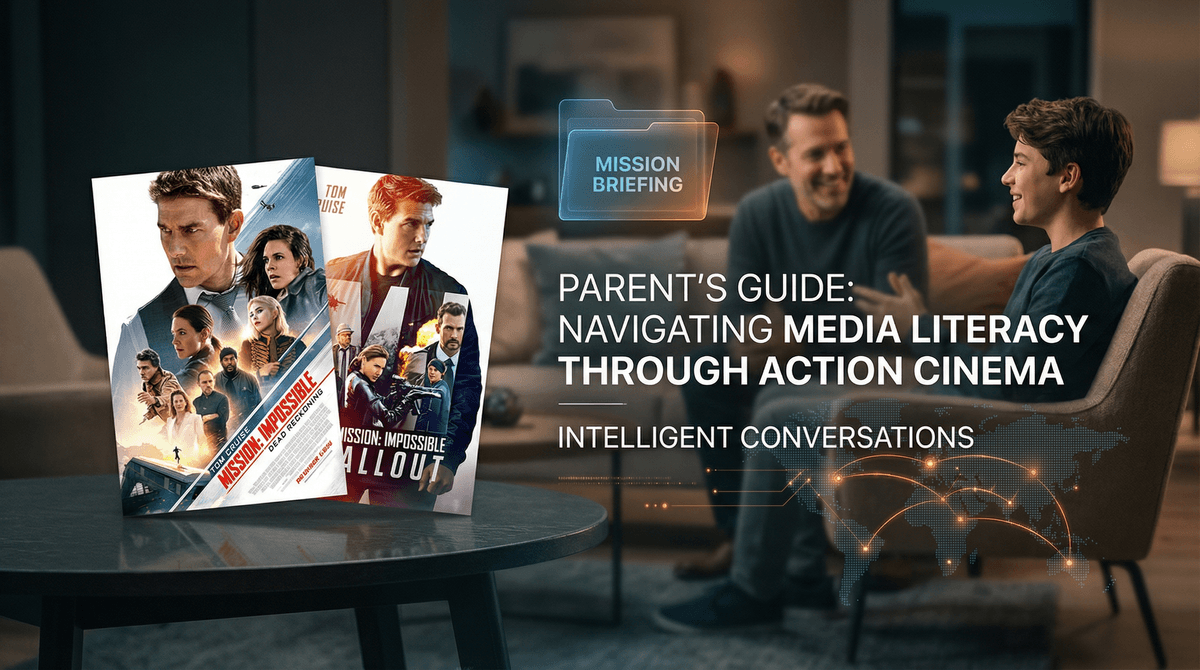
After the Credits Roll: Turning Mission Impossible Into Family Conversations
TL;DR: The Mission Impossible franchise offers surprising opportunities for family discussions about AI ethics, the difference between movie violence and real consequences, what heroism actually looks like, and how special effects create impossible stunts. Here's how to turn Ethan Hunt's latest adventure into meaningful conversations—plus some follow-up viewing and reading recommendations.
So you just watched a Mission Impossible movie with your kids. Maybe it was Mission: Impossible – Dead Reckoning with its terrifying AI villain, or perhaps you're revisiting the earlier films. Your 10-year-old is buzzing about Tom Cruise hanging off a cliff, your 13-year-old is asking if that motorcycle jump was real, and you're wondering if you should address the body count or just enjoy the popcorn.
The thing is, these movies—despite being pure action spectacle—actually open up some fascinating conversations. Yes, they're loud and over-the-top, but buried in all that running and exploding are genuine questions about technology, trust, loyalty, and what it means to be a hero in a morally complicated world.
Unlike many action franchises that lean into cynicism or gratuitous violence, Mission Impossible maintains a surprisingly optimistic worldview. Ethan Hunt isn't a brooding antihero—he's someone who genuinely believes in protecting people and refuses to sacrifice innocents, even when it would make his mission easier. The team dynamic emphasizes collaboration, trust, and problem-solving over individual glory.
Plus, these movies are legitimately impressive from a filmmaking perspective. Tom Cruise's commitment to practical stunts creates genuine spectacle that kids can appreciate once they understand what went into creating it.
Age sweet spot: Most kids around 11-13 are ready for Mission Impossible films, though it depends on your family's comfort with action violence. The PG-13 rating is fairly accurate—there's shooting and fighting, but it's not graphic or sadistic.
If you watched Dead Reckoning, the AI conversation is unavoidable—and honestly, it's one of the most relevant family discussions you can have in 2026.
The Entity in the film is a rogue AI that can manipulate digital systems, predict human behavior, and essentially control information. It's presented as an existential threat precisely because it has no human values, no empathy, no understanding of context—just pure optimization toward its goals.
Questions to ask your kids:
- "What made The Entity so dangerous? Why couldn't they just turn it off?"
- "Do you think AI in real life could become like The Entity? What's different between movie AI and what we actually have?"
- "The movie shows how The Entity manipulates people by controlling information. Have you ever thought about how algorithms decide what you see online?"
This is a perfect entry point for discussing how AI actually works versus how it's portrayed in movies. You can talk about how AI is used in apps they use , from TikTok's recommendation algorithm to ChatGPT to AI art generators.
The nuance worth highlighting: The movie presents AI as inherently dangerous, but real AI is a tool—the danger comes from how humans deploy it and what values we build into these systems. This is a good moment to discuss the difference between science fiction's "AI becomes conscious and evil" versus real concerns about bias, privacy, and corporate control of powerful technology.
Mission Impossible movies have a high body count, but the violence is presented in a very specific way—it's stylized, consequence-free, and mostly bloodless. Bad guys get shot and fall down. There's no lingering on suffering, no graphic injuries, no psychological trauma from killing dozens of people.
This creates a teaching moment about media literacy and how movies manipulate our emotional response.
Try this conversation:
"In this movie, Ethan Hunt and his team shoot a lot of people. But did you notice how we never see those people as real humans with families? The movie doesn't want us to think about that—it wants us to enjoy the action. Why do you think the filmmakers made that choice?"
You can contrast this with movies that do show the weight of violence—like how The Batman shows Batman actually getting hurt and struggling with the consequences of his actions, or how Spider-Man deals with the moral weight of Peter's choices.
The goal isn't to make them feel guilty for enjoying the movie—it's to help them recognize that movies use specific techniques to shape how we feel about violence. Once kids can spot these techniques, they become more thoughtful consumers of media.
One of the most interesting aspects of the Mission Impossible franchise is Ethan Hunt's consistent refusal to accept "acceptable losses." In almost every film, he goes rogue or disobeys orders specifically because he won't sacrifice innocent people for the mission.
This is worth highlighting because it's actually kind of unusual in action movies. Many spy thrillers present a cold, utilitarian worldview where some deaths are justified for the greater good. Hunt consistently rejects this.
Questions to explore:
- "Why does Ethan always try to save everyone, even when it makes the mission harder?"
- "Do you think that's realistic? What would happen if real spies acted like that?"
- "What makes someone a hero—the cool stunts and fighting, or the choices they make about who to protect?"
You can connect this to real-world heroism—people who risk their own safety to help others, whistleblowers who expose wrongdoing despite personal cost, or everyday acts of courage that don't involve jumping out of helicopters.
Kids are genuinely fascinated when they learn that Tom Cruise actually does most of his own stunts—and that he's broken bones, torn ligaments, and risked his life for these movies.
Pull up some behind-the-scenes footage on YouTube (there are tons of official featurettes) and watch how they filmed specific sequences. The motorcycle jump in Dead Reckoning took months of training and multiple takes. The helicopter chase in Fallout involved Cruise learning to fly helicopters specifically for that scene.
Why this matters: It helps kids understand the difference between practical effects and CGI, the craftsmanship that goes into filmmaking, and the fact that even "impossible" stunts require real skill, training, and risk. It's a gateway to appreciating how movies are made as an art form, not just consuming them as content.
Plus, it opens up a conversation about risk and safety—why does Tom Cruise do this? Is it worth it? What safety measures are in place? How do they minimize risk while still creating something spectacular?
Every Mission Impossible movie emphasizes that Ethan Hunt needs his team. He's not a lone wolf superhero—he succeeds because of collaboration, trust, and people with different skills working together.
This is actually a pretty healthy message for kids, especially in contrast to the "chosen one" narrative that dominates so much children's media.
Point out specific examples:
- Benji's tech skills are just as crucial as Ethan's physical abilities
- Luther's wisdom and experience guide the team's decisions
- Ilsa's combat skills and intelligence gathering are essential
- The team covers for each other's weaknesses and trusts each other even in impossible situations
You can connect this to teamwork in games like Minecraft or Among Us, or to their own experiences with group projects, sports teams, or friend dynamics.
Ages 10-12: The earlier Mission Impossible films (Mission: Impossible, Mission: Impossible II) have less intense action and might be better starting points. Watch together and pause for questions. Focus discussions on teamwork, problem-solving, and the difference between movie action and real life.
Ages 13+: Most teens can handle the full franchise, including the more intense recent entries. They're ready for deeper conversations about AI ethics, surveillance, government accountability, and moral complexity. They can also appreciate the filmmaking craft and stunt work on a more sophisticated level.
What to watch for: Some kids are sensitive to tension and suspense even if they're fine with action. The Mission Impossible movies are built around extended suspense sequences (the famous vault scene, the train sequence, the climbing scenes). If your kid gets anxious during tense moments, you might want to preview or skip certain scenes.
If your kids are hooked on the spy genre or the themes in Mission Impossible, here are some great follow-ups:
Movies and Shows
- Spy Kids (Ages 7-11): Lighter, kid-friendly spy action with similar themes of family and teamwork
- The Incredibles (Ages 6+): Superhero action with themes about family dynamics and using your abilities responsibly
- Alex Rider (Ages 12+): Teen spy series that's more grounded than Mission Impossible but still exciting
- Lupin (Ages 14+): French heist series with clever planning and social commentary
Books
- Alex Rider series by Anthony Horowitz (Ages 10-14): Teen spy novels with real stakes and moral complexity
- I Am Number Four by Pittacus Lore (Ages 12+): Sci-fi action with themes of identity and belonging
- The 39 Clues series (Ages 8-12): Treasure hunt adventure with puzzle-solving and teamwork
For the Tech-Curious
If the AI themes sparked interest, check out:
- The Wild Robot by Peter Brown (Ages 8-12): Beautiful story about an AI learning empathy and connection
- AI and machine learning for kids: Age-appropriate books that explain how AI actually works
Mission Impossible movies are designed as pure entertainment—and there's nothing wrong with enjoying them on that level. But they also offer surprising depth for family conversations about technology, ethics, heroism, and how media shapes our perceptions.
The key is creating space for these discussions without turning movie night into a lecture. Ask open-ended questions, listen to your kids' perspectives, and be willing to explore ideas together rather than delivering predetermined lessons.
And honestly? Sometimes the most valuable conversation is just "Wasn't that motorcycle jump absolutely insane? Want to watch how they filmed it?"
Next steps: If you want to dig deeper into action movies and media literacy, check out how to talk to kids about violence in media or explore age-appropriate action movies for different ages.