

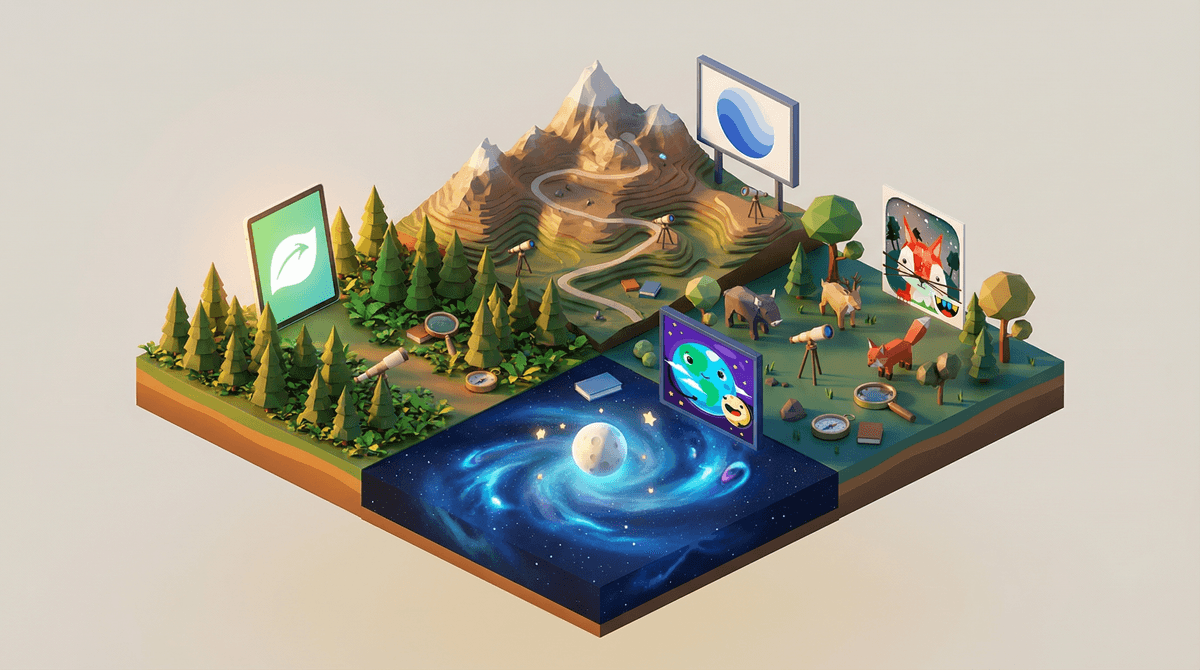
Exploration apps are digital tools that promise to turn your kid's screen time into a journey of discovery. Think virtual field trips, interactive maps, nature identification tools, space simulators, and apps that let kids "explore" everything from the human body to ancient civilizations. They're marketed as educational, curiosity-driven, and enriching—the kind of screen time you can feel good about.
The category is broad: Google Earth lets kids zoom from their backyard to the Great Barrier Reef. Star Walk Kids turns the night sky into an interactive astronomy lesson. Seek by iNaturalist encourages kids to identify plants and animals in real life using their camera. Toca Nature creates miniature ecosystems kids can manipulate and observe.
These apps sit in this interesting space between "educational tool" and "entertainment," and that's exactly where things get complicated for parents trying to figure out if they're worth the download—or the inevitable subscription fee.
The good ones? Kids genuinely enjoy them. There's something magical about a 7-year-old pointing their tablet at the sky and learning they're looking at Jupiter. Or a 10-year-old who discovers they can "visit" Machu Picchu from the couch.
The appeal is control and curiosity. Unlike a documentary they're passively watching, exploration apps let kids lead. They can zoom in on whatever interests them, skip what doesn't, and follow their own questions. For kids who are naturally curious about how things work or what's out there, these apps can genuinely spark joy.
But here's the thing: not all exploration apps hold attention equally. Some kids will spend 20 minutes absorbed in The Human Body by Tinybop, fascinated by how the digestive system works. Others will open it once, poke around for 90 seconds, and never return. The "exploration" promise only works if the app actually matches your kid's interests and developmental stage.
Let's be honest: just because an app has "educational" in the description doesn't mean your kid is learning. And just because an app looks like a game doesn't mean it's rotting their brain.
The quality range is massive. On one end, you have thoughtfully designed apps like Monument Valley (yes, it's a puzzle game, but it teaches spatial reasoning and perspective in genuinely beautiful ways) or WWF Together (which combines exploration with real conservation stories). On the other end, you have apps that slap "educational" on what's essentially a glorified ad delivery system with a thin veneer of learning content.
Red flags to watch for:
- Constant upsells. If every third tap leads to "Unlock the rainforest biome for $4.99!" it's not really about exploration—it's about monetization.
- No depth. Some apps are just digital flashcards with fancy animations. If your kid can exhaust the content in 15 minutes, it's not exploration, it's a slideshow.
- Passive consumption. True exploration apps require interaction, choice, and problem-solving. If your kid is just watching pre-programmed sequences, that's a video with extra steps.
Ages 4-7: At this age, exploration apps work best when they're tactile and immediate. Apps like Toca Nature or Metamorphabet let little kids touch, swipe, and see instant cause-and-effect. Keep sessions short (15-20 minutes max) and ideally co-explore with them—your narration and questions make the experience exponentially richer.
Ages 8-11: This is the sweet spot for true exploration apps. Kids have enough reading comprehension and patience to dig into apps like Google Earth, Solar Walk, or Civilisations AR. They can follow their own questions and don't need constant guidance. The trick is finding apps that match their specific interests—a kid obsessed with space will love Star Walk Kids, but might find a geology app boring.
Ages 12+: Older kids can handle more complex tools like Google Arts & Culture or even Duolingo if language learning counts as exploration. At this age, the best "exploration" might actually be giving them access to YouTube channels like Kurzgesagt or Vsauce where they can explore ideas, not just places.
The best exploration happens offline. I know, I know—this is a guide about apps. But the reality is that most exploration apps work best as supplements to real-world experiences, not replacements. Using Seek by iNaturalist on a nature walk? Fantastic. Using it instead of going outside? Less fantastic.
Free doesn't always mean good, paid doesn't always mean quality. Some of the best exploration apps are free (Google Earth, Seek). Some paid apps are worth every penny (Monument Valley, the Tinybop collection). And some expensive apps are absolute garbage. Check reviews from Common Sense Media before committing to a subscription.
Your kid's engagement is the real metric. If your child is asking questions, making connections, or wanting to explore related topics in other ways, the app is working. If they're just mindlessly tapping through content or asking to switch to YouTube after five minutes, it's not hitting the mark—no matter how "educational" the marketing claims.
Exploration apps can be genuinely wonderful tools for curious kids—but only if they're well-designed, match your child's interests, and are used intentionally. They're not a substitute for books, nature, museums, or conversations, but they can be a great complement.
The key is being selective. Download a few highly-rated options, see what actually captures your kid's attention, and don't be afraid to delete the ones that don't stick. Not every app will work for every kid, and that's fine.
- Start with free options like Google Earth or Seek to see if your kid even enjoys this style of app
- Look for apps that connect to existing interests—if they're into animals, try WWF Together; if they're into space, try Star Walk Kids
- Set time limits even for "educational" screen time—30 minutes of quality exploration beats 2 hours of mindless scrolling
- Co-explore when possible, especially with younger kids—your questions and enthusiasm make the experience stickier
- Learn more about evaluating educational apps and what actually makes screen time educational