

You know that moment when your kid says "just one more try" for the 47th time? Yeah, that's endless runner games doing exactly what they're designed to do.
Endless runner games are exactly what they sound like: your character runs forward automatically, forever, until you mess up. You're dodging obstacles, collecting coins, swiping left and right, jumping over barriers. The game literally never ends—there's no final level, no boss fight, no credits rolling. You just keep going until you fail, then immediately tap to start again.
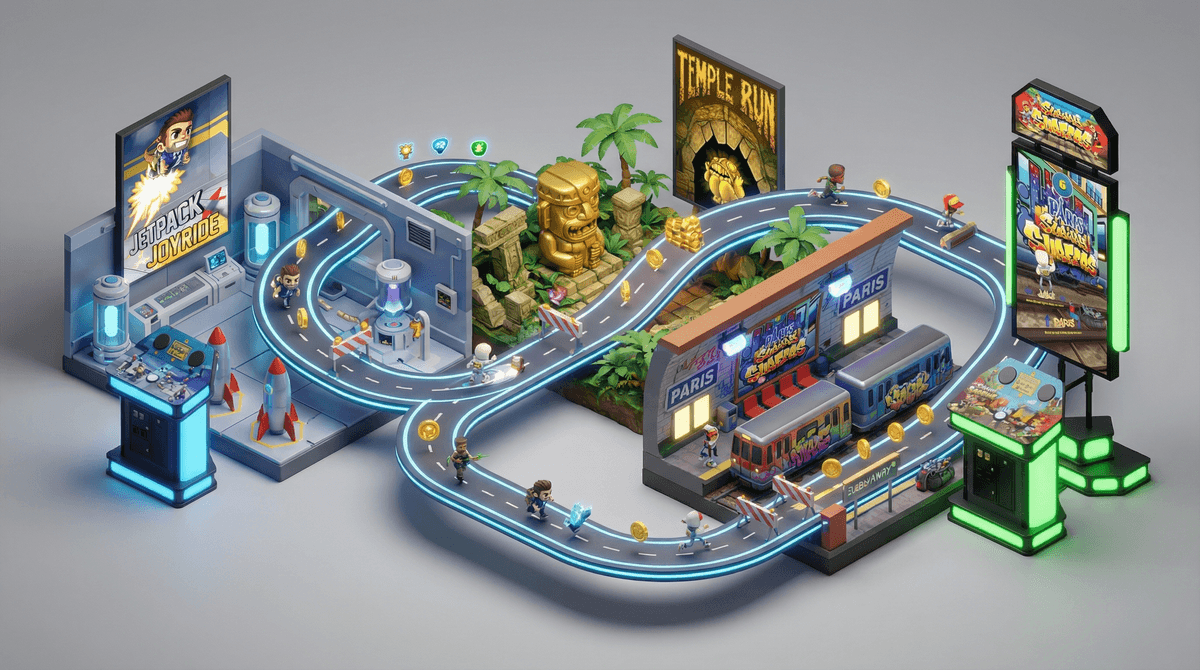
The big names? Temple Run, Subway Surfers, Jetpack Joyride. These games have been downloaded billions of times. Not millions. Billions. Your kid's friends are playing them. The kid at the grocery store waiting in line is playing them. They're everywhere because they work on any device, they're usually free, and they're incredibly simple to understand.
Here's the thing: endless runners are basically psychological perfection for creating "just one more" moments.
The loop is instant. You die, you restart in literally one second. No loading screens, no menus, no waiting. Compare that to a game where you have to reload a save file or walk back from a checkpoint—endless runners remove every possible friction point between failure and trying again.
They're "almost" games. Your kid didn't just fail randomly—they were so close to beating their high score. They made it further than last time. They can see exactly what they did wrong. The game whispers "you've almost got it" every single time. That's not an accident.
The difficulty curve is perfect. These games speed up gradually as you play. You're always operating right at the edge of your ability, which is exactly where flow state happens. It feels challenging but achievable, which is dopamine gold.
They're designed for micro-sessions. A run might last 30 seconds or 3 minutes. That makes them perfect for "waiting for mom to finish talking" or "one quick game before dinner" (which becomes 20 quick games).
And here's where it gets complicated: they're free, but they're not really free. Most endless runners make money through ads (watch a video to continue, watch a video for a power-up) or in-app purchases (buy coins to unlock characters, buy a head start, buy an ad-free experience).
Look, I'm not here to tell you endless runners are rotting your kid's brain. They're not violent. They're not inappropriate. A 7-year-old playing Subway Surfers while you're making dinner isn't a parenting failure.
But let's be real about what these games are optimized for: engagement at all costs. They're not designed to teach problem-solving or creativity or collaboration. They're designed to be played again and again and again, with minimal cognitive load, maximum dopamine hits, and strategic interruptions (ads, purchase prompts) to monetize that engagement.
The concerns worth thinking about:
The "just one more" trap is real. These games are incredibly hard to put down. Not because your kid has poor self-control, but because they're engineered by teams of designers specifically to make stopping feel bad. Transitioning away from these games is often harder than transitioning from games with natural stopping points.
They're ad delivery systems. Free endless runners show a LOT of ads. Your kid is watching ads for other games, apps, sometimes stuff that's not age-appropriate. And those ads are often more stimulating than the game itself—bright, loud, designed to get clicked.
The "skill" ceiling is low. Unlike games where your kid is building something, solving puzzles, or developing strategy, endless runners are basically advanced reflexes. They're the digital equivalent of bouncing a ball—fine as one activity, but not exactly enriching.
The spending pressure is constant. Even if you've disabled in-app purchases, your kid is seeing what they could have if you just spent money. That creates a persistent feeling of "I'm playing the worse version of this game."
Ages 4-7: Honestly? I'd skip endless runners for this age group entirely. If you want simple games for this age, look at actual kid-designed games like Toca Boca apps or Sago Mini games that have stopping points and creative play. The "never-ending" aspect of endless runners is particularly hard for this age to self-regulate.
Ages 8-12: This is peak endless runner age. If your kid is playing them, the key is context and balance. Are they playing for 10 minutes while you're cooking? Fine. Are they playing for an hour every day after school, glazed over and tapping mindlessly? That's worth addressing. Set up clear time limits and make sure these aren't the only games they're playing.
Ages 13+: Teens are usually moving past endless runners toward more complex games, but some still play them as fidget-equivalents. The bigger concern here is whether they're spending money on them without understanding the actual cost.
Check the actual app, not just the age rating. Temple Run is rated 9+, Subway Surfers is rated 9+, but both have in-app purchases and ads. The age rating tells you nothing about the psychological design or monetization.
Disable in-app purchases. Seriously, just do it. Here's how on iOS and here's how on Android. Your kid doesn't need to spend $4.99 on a character skin in a free game.
Use them strategically, not as default entertainment. Endless runners are great for specific situations—waiting rooms, car rides, the last 15 minutes before dinner is ready. They're not great as the go-to activity when your kid is bored.
Talk about the design. Older kids (10+) can understand "this game is designed to make you want to play again immediately—do you notice how that works?" That kind of media literacy is valuable.
Watch for the zombie-state. If your kid is playing but clearly not having fun—just tapping mindlessly, getting frustrated, but unable to stop—that's your cue to intervene. "Hey, this seems like it's not fun anymore. Let's take a break."
Endless runner games aren't evil, but they're not neutral either. They're designed with sophisticated psychological techniques to maximize play time and monetization. For kids, that means they're really hard to put down and really easy to zone out on.
The question isn't "are endless runners bad?" The question is: what role do they play in your kid's overall media diet?
If they're one type of game among many—if your kid also plays creative games like Minecraft, puzzle games like Monument Valley, or story-driven games like Zelda—then sure, Temple Run during the grocery store checkout is fine.
But if endless runners are the primary gaming experience, you're essentially letting engagement-optimization algorithms be your kid's entertainment curator. And that's worth reconsidering.
- Audit what's actually installed. Open your kid's device and see how many endless runners are on there. You might be surprised.
- Try the games yourself. Play Subway Surfers for 10 minutes and notice how hard it is to stop. That's useful information.
- Introduce alternatives. Check out our guide to better mobile games for kids that have actual endings, creative elements, or problem-solving.
- Set boundaries that make sense for your family. Maybe endless runners are "waiting time only" games. Maybe they're limited to 15 minutes a day. Maybe they're fine on weekends but not school nights. You know your kid and your family rhythm.
The goal isn't perfection. It's intentionality. And now you know what you're actually dealing with when your kid says "just one more try" for the 48th time.