

TL;DR: The Best Science Shows That Aren't Brain Rot
- Best for Biology: Octonauts (Ages 3-7)
- Best for "How Things Work": Ask the StoryBots (Ages 3-8)
- Best for the Scientific Method: Ada Twist, Scientist (Ages 4-8)
- Best for Zoology/Ecology: Wild Kratts (Ages 5-10)
- Best for Logic & Math: Cyberchase (Ages 6-11)
- Best for Older Kids (Biology): Cells at Work! (Ages 10+)
- Best for High-Level Concepts: Kurzgesagt – In a Nutshell (Ages 10+)
Get a science watchlist for a 7-year-old who loves space
We’ve all been there. You’re trying to get dinner on the table, and the "Skibidi Toilet" song is echoing from the living room for the 400th time. You want to swap the brain rot for something that actually matters, but you’re tired of the same three episodes of The Magic School Bus from 1994.
While Ms. Frizzle is a legend, the world of educational media has moved on. We’re currently in a bit of a "Wild West" era where a lot of shows claim to be educational just because a character wears glasses or says the word "hypothesis," but they’re actually just loud, fast-paced sensory overload designed to keep kids glued to the screen.
The goal here isn't just to find shows that "teach facts." The goal is to find shows that teach curiosity. We want our kids to ask "Why?" and "How?"—not just "Can I have more Robux?"
When we talk about "brain rot," we’re usually talking about high-stimulation, low-substance content. Think of it like digital candy. It tastes good (to them), but it leaves them irritable, hyperactive, and lacking any actual "nutrients."
Real science cartoons function differently. They use narrative structures to explain complex systems. When a kid watches Octonauts, they aren't just seeing a cute cat in a submarine; they’re learning about symbiotic relationships in coral reefs. When they watch Ada Twist, Scientist, they’re learning that failure is a data point, not an end-of-the-world scenario.
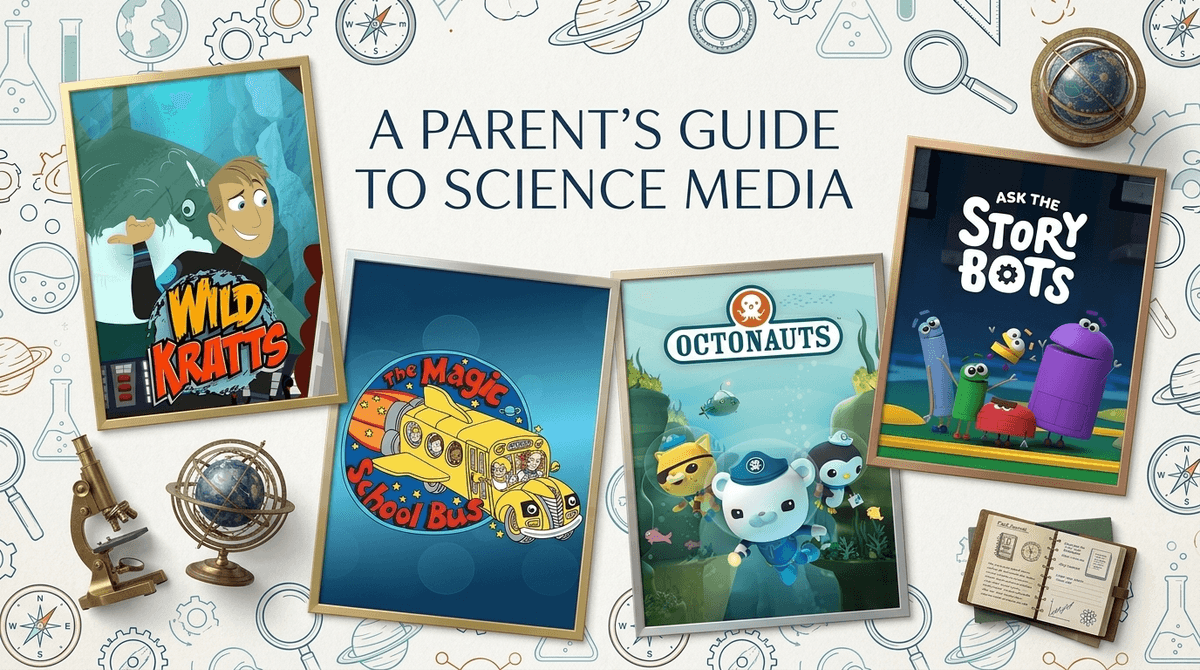
Ages 3-7 If you haven't met Captain Barnacles yet, get ready. This is arguably the gold standard for marine biology. Each episode features a specific creature, and the "Creature Report" at the end reinforces the actual biological facts learned during the mission. Why it sticks: It’s basically Star Trek but underwater and for preschoolers. It treats the animals with respect—using their real names (like the Mimic Octopus or the Siphonophore) rather than making up "cartoon" versions.
Ages 3-8 This show is a masterpiece of production. Five little robots live inside a computer and head out into the "real world" to answer questions like "How do ears hear?" or "Where do fries come from?" Why it sticks: It features incredible guest stars (think Snoop Dogg and Edward Norton) and catchy music, but more importantly, it doesn’t talk down to kids. It explains DNA, cellular respiration, and tectonic plates in ways that actually make sense. It’s the rare show that parents will actually find themselves watching instead of scrolling on their phones.
Ages 4-8 Based on the popular book series, this show focuses heavily on the scientific method. Ada, along with her friends Rosie Revere (an engineer) and Iggy Peck (an architect), tackles problems by forming hypotheses and running experiments. Why it sticks: It normalizes the idea that science is about asking questions. If your kid is constantly saying "What if we..." followed by something that might end in a mess, this show will give that energy a productive framework.
Ages 5-10 The Kratt brothers have been doing this forever, and for good reason. They combine live-action animal footage with an animated "creature power" adventure. Why it sticks: It focuses on zoology and ecology. Kids learn about "creature powers" (biological adaptations), which makes the science feel like a superhero story. It’s a huge hit for kids who are obsessed with animals and want to know exactly how fast a cheetah can run or why a sperm whale can dive so deep.
Ages 6-11 This is an oldie but a goodie. It’s technically about math, but it applies logic and environmental science to solve problems in "Cyberspace." Why it sticks: It’s great for older elementary kids who might feel "too big" for StoryBots. It deals with things like data analysis, patterns, and resource management. If your kid is into Minecraft and likes optimizing their builds, they’ll probably vibe with the logic here.
Ages 10+ Okay, this is an anime, and it’s brilliant. It personifies the cells in the human body. A Red Blood Cell is a delivery person; a White Blood Cell is a specialized soldier fighting off bacteria. The "No-BS" Review: This show is intense. When a "virus" attacks, it looks like a monster movie. There is some "cartoon blood" (which is meta, because they are inside a body), but for a middle-schooler struggling with biology class, this is an absolute godsend. They will learn more about the immune system in three episodes than in a month of textbooks.
Ages 10+ While not a "cartoon" in the traditional Saturday morning sense, this YouTube channel uses world-class animation to explain things like black holes, climate change, and the Fermi Paradox. Why it sticks: It’s visually stunning and doesn't pull punches on the big questions. It’s the "Ohio" of science—weird, existential, and deeply fascinating.
Check out our guide on the best educational YouTube channels
Not all "educational" shows are created equal. Some are just "educational-adjacent."
- Blippi: I’m going to be real with you—this isn't science. It’s a guy in a bow tie pointing at things. It’s fine for a 2-year-old for ten minutes, but it does zero to foster actual scientific thinking. It’s the junk food of the educational world.
- Ryan's World: While they have some "science experiment" videos, they are mostly just toy unboxings and high-energy chaos. The "science" is often secondary to the consumerism.
- Shows with 2-second cuts: If a show changes camera angles every two seconds and features constant screaming, your kid’s brain is too busy processing the sensory input to actually learn the "science" being presented.
When picking a show, look at the pace rather than just the rating.
- For Toddlers/Preschoolers: Slow is better. Elinor Wonders Why is a fantastic, slow-paced show about observation.
- For Elementary Kids: They want stakes. They want to see the experiment fail or the "mission" almost go wrong. This is where Wild Kratts shines.
- For Tweens/Middle Schoolers: They want the "weird" stuff. They want to know about the "zombie fungus" that takes over ants or how a nuclear reactor actually works. Don't be afraid of more mature (but clean) content like Mark Rober.
The best way to make science "stick" is to pull it off the screen and into the real world. You don't need a lab coat for this.
- Ask for a "Creature Report": After an episode of Octonauts, ask them, "So what was the creature's 'power' today?"
- The "I Wonder" Strategy: If they ask you a question you don't know the answer to, don't just Google it immediately. Say, "I wonder how we could find that out? Should we form a hypothesis like Ada Twist?"
- Bridge the Gap to Games: If they love Minecraft, talk about the geology of the rocks they're mining. If they love Roblox, look for "tycoon" games that involve resource management.
Science cartoons shouldn't just be a way to kill time; they should be a springboard. If your kid finishes an episode and wants to go outside to look under a rock or mix baking soda and vinegar in the sink, you’ve won.
Skip the high-decibel "brain rot" and lean into shows that respect your kid’s intelligence. They might start saying "Ohio" is "cringe," but at least they'll know why the sky is blue.
- Audit the Watchlist: Check your Netflix or Disney+ history. If it’s 90% unboxing videos, try "pinning" Ask the StoryBots to the top.
- Set a "Science Saturday": Pick one show from the list above and watch it with them.
- Check the Community Data: Use Screenwise to see what other parents in your school district are letting their kids watch. Are you the only one holding out on YouTube? (Spoiler: Probably not, but it helps to see the numbers).