

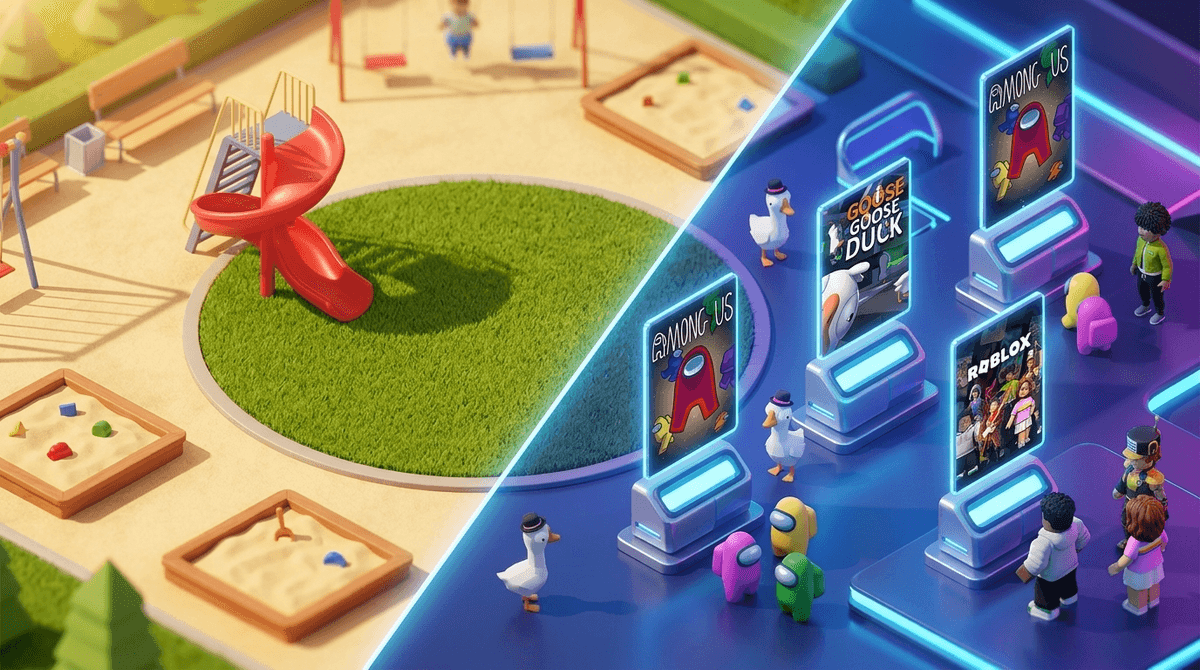
TL;DR: The game your kids are playing isn't just a circle on the grass anymore. It’s evolved into high-stakes social deduction games like Goose Goose Duck, chaotic tag variants in Roblox, and psychological thrillers like Among Us. It’s less about running in a circle and more about lying to your friends (in a fun way).
If you hear your eight-year-old screaming "HE'S THE GOOSE!" at a tablet, they probably aren't reminiscing about preschool. In the last couple of years, the core mechanic of Duck Duck Goose—the tension of waiting to be picked and the frantic chase that follows—has been digitized and "gamified" into the social deduction genre.
The most literal translation is Goose Goose Duck, a game that looks like a cute bird simulator but plays like a murder mystery. Then there’s the endless stream of Tag and Hide and Seek games on Roblox that use the same "you're it" adrenaline.
Essentially, "Duck Duck Goose" is now shorthand for any digital game where one player is secretly "it" and everyone else is trying to survive or outsmart them.
It’s the "Gotcha" factor. Modern kids are obsessed with "social deduction"—which is just a fancy way of saying they like games where you have to figure out who is lying.
- The Adrenaline Spike: Just like the playground version, there’s a physical (or digital) rush when you realize you’ve been "tapped."
- The Humor: In Goose Goose Duck, the avatars are ridiculous. It’s hard to stay mad at a goose wearing a top hat who just "eliminated" you.
- Low Barrier to Entry: You don't need the lightning-fast reflexes of a Fortnite pro. You just need to be able to talk, lie, or run away.
If your kid is asking for these games, here is the "No-BS" breakdown of what’s actually on their screen.
Ages 10+ Think of this as the "weird cousin" of Among Us. It’s free-to-play, which is parent-code for "there are a lot of skins to buy."
- The Vibe: It’s more complex than the playground version. There are roles like "The Pelican" (who can eat other players) and "The Dodo" (who actually wants to be voted out).
- The Catch: It can get a little more "mature" than the graphics suggest. Some of the elimination animations are a bit much for the 6-and-under crowd, and the proximity voice chat can be a toxic wasteland if not restricted.
Ages 9+ The gold standard for the "Duck Duck Goose" style of play. It’s cleaner, simpler, and widely considered the "entry-level" social deduction game.
- Why it works: It teaches logic and observation.
- The Catch: The "Quick Chat" feature is great for safety, but older kids will want to use "Free Chat," which opens the door to the usual internet nonsense.
Ages 7+ If your kid wants the chase more than the mystery, they are likely spending time in Roblox. There are thousands of user-created games that are essentially Duck Duck Goose on steroids.
- Why it works: It’s pure, silly fun.
- The Catch: It's Roblox. You have to watch out for the "bank account drain" via Robux. Check out our guide on how Robux works
 .
.
Ages 5+ If you’re trying to move the obsession off the iPad and onto the kitchen table, this is a solid physical alternative. It’s a racing game with rubber ducks. No one gets "murdered," and there’s zero proximity chat. It’s a win.
The jump from the playground to the screen changes the "safety" profile significantly. In a circle on the grass, the worst thing that happens is a skinned knee. In Goose Goose Duck, things get a bit more complicated.
- Ages 5-7: Stick to physical play or very simple "tag" style games on PBS Kids or ABCya. They aren't ready for the "lying to your friends" aspect of social deduction yet.
- Ages 8-10: Among Us with "Quick Chat" only. It’s a great way to build critical thinking without the exposure to 19-year-olds in a lobby.
- Ages 11+: This is where Goose Goose Duck usually enters the chat. If they are playing this, make sure they are playing with friends, not strangers. Proximity voice chat (where you can hear people as you walk past them in the game) should be toggled OFF unless you want them hearing things that would make a sailor blush.
One of the biggest hurdles for intentional parents is the fact that these games reward lying. In Among Us, the goal is to convince everyone you aren't the "imposter."
Is this teaching them to be pathological liars? Probably not. It’s actually teaching them about digital literacy and skepticism. They are learning that just because someone says they were in the MedBay doesn't mean they were. In a world of deepfakes and AI, a little healthy skepticism isn't the worst thing to learn.
Learn more about how social deduction games impact child development
Digital Duck Duck Goose is here to stay because it taps into a fundamental human desire: the thrill of the chase and the puzzle of a secret.
If your kid is obsessed, don't panic. It's not "brain rot" in the way that some mindless YouTube scrolling can be. It requires focus, memory, and social navigation. Just keep an eye on who they are playing with and how much they are spending on digital hats for their geese.
- Check the settings: If they are on Goose Goose Duck, go into the settings right now and look at the "Proximity Chat" and "Blood/Gore" toggles.
- Play a round: Seriously. Sit down and let them "tag" you. You’ll see the appeal within five minutes (and you'll probably see why the lobby chat can be a bit much).
- Set a "Robux" Budget: If they are playing these on Roblox, set a hard limit. Those "legendary" duck skins add up fast.