

TL;DR
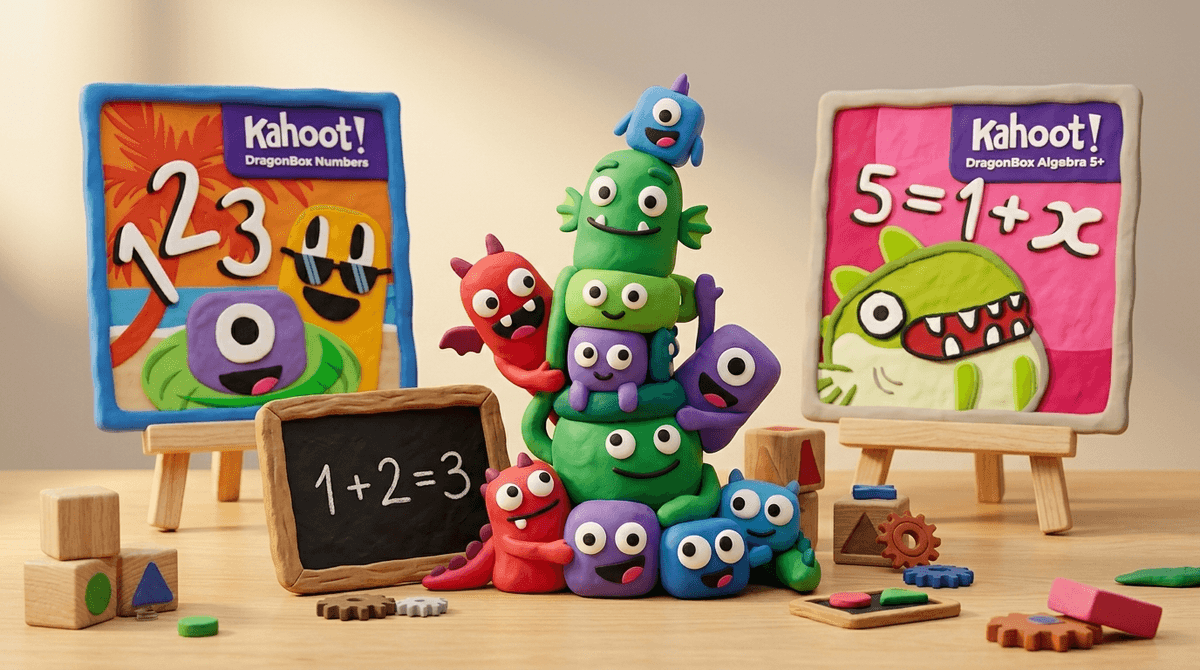
DragonBox Numbers is the rare "educational" app that actually earns the title. Instead of drilling kids with digital flashcards, it uses stackable characters called "Nooms" to help kids visualize how numbers work. It’s perfect for ages 4–8 and is a guilt-free way to use screen time for foundational math skills.
If you’re looking for more high-quality math resources, check out:
- DragonBox Big Numbers for moving into addition/subtraction of large sums.
- DragonBox Algebra 5+ for a genius introduction to variables.
- Khan Academy Kids for a broader, free curriculum.
Let’s be real: most "math games" for kids are just mediocre arcade games where a math problem pops up every 30 seconds to interrupt the fun. It’s the digital equivalent of hiding broccoli in a brownie—the kid knows it's there, and it makes the brownie worse.
DragonBox Numbers is different. It’s built by the team at WeWantToKnow (now part of Kahoot!) who clearly understand that math isn't about memorizing 2 + 2 = 4; it’s about understanding that a "4" is just two "2s" put together.
The app introduces kids to the Nooms. Each Noom is a colorful character that represents a specific number. The "1" Noom is a tiny little guy. The "2" Noom is twice as tall. When you drag the "1" onto the "2," they literally merge into a "3." If you want to subtract, you use a finger-swipe to "slice" a Noom into smaller pieces. It turns abstract arithmetic into a tactile, sandbox experience.
Kids love it because it feels like a puzzle game, not a chore. There are no timers, no high-stress "game over" screens, and no annoying characters shouting at them to hurry up. They get to explore different worlds, collect rewards, and customize their Nooms. It taps into that "collect-em-all" dopamine hit without the predatory mechanics you find in Roblox.
Parents love it because it’s a "set it and forget it" app that actually produces results. You won't find any in-app purchases, third-party ads, or weird social features. It’s a closed, safe environment. Plus, watching a five-year-old intuitively understand "regrouping" because they saw the Nooms do it is a pretty great feeling.
In the education world, we talk a lot about "number sense." This is the ability to play with numbers, to understand their relationships, and to see them as flexible quantities rather than static symbols.
Most kids struggle with math later in life because they never developed this foundation. They learned to memorize that "8 + 7 = 15," but they don't feel that 8 is just 2 away from 10, and if you take 2 from the 7, you have 10 and 5.
DragonBox Numbers teaches this through subitizing—the ability to look at a group of objects and know how many there are without counting them one by one. Because each Noom has a distinct height and shape, kids start to "see" the math before they even learn the digits.
Once your kid masters the basics in DragonBox Numbers, there’s a very clear path forward. The developers have created an ecosystem that can take a kid from "What is a number?" to "I can solve basic linear equations" before they hit third grade.
This is the logical next step. It moves away from the simple Nooms and into a world where kids manage a resource-gathering game (think very light Minecraft vibes). They have to add and subtract much larger numbers to buy tools and progress. It introduces the concept of carrying and borrowing in a way that actually makes sense.
Don't let the word "Algebra" scare you. This app is a masterpiece of game design. It starts with a "box" on one side of a line and asks kids to isolate it by moving other tiles around. Within an hour, your kid is solving basic algebraic equations without even realizing they are doing math. It’s arguably the best educational app ever made.
If you want to introduce geometry, this is the one. It’s based on Euclid’s Elements and uses puzzles to teach the properties of triangles, circles, and quadrilaterals. Like the others, it replaces boring proofs with intuitive play.
There are thousands of math apps in the App Store, but most fall into two categories: the "Drill Sergeants" and the "Theme Parks."
- The Drill Sergeants: Apps like IXL or Kumon are basically digital worksheets. They are great for fluency and test prep, but they don't teach concepts. They are also incredibly boring for most kids.
- The Theme Parks: Apps like Prodigy Math are full-blown RPGs. Kids love them because they get to battle monsters and dress up avatars. However, the "math" is often just a gatekeeper to the gameplay. Kids will often spend 90% of their time decorating their house and 10% doing math.
DragonBox Numbers sits in the "Goldilocks Zone." The gameplay is the math. You can't progress without manipulating the numbers, but the manipulation itself is the fun part.
Check out our guide on the best math websites for elementary students
Recommended Ages: 4–8
- Ages 4-5: Focus on the "Sandbox" mode. Let them just stack and slice Nooms. Don't worry about the numbers yet; let them get used to the physical relationships of the sizes.
- Ages 6-7: Encourage them to work through the "Puzzles" section. This is where the app challenges them to create specific numbers using certain combinations, which builds logic and problem-solving skills.
- Age 8+: If your kid is already solid on addition and subtraction, they might find this too easy. Move them straight to DragonBox Big Numbers or DragonBox Algebra 5+.
From a digital wellness perspective, DragonBox is about as clean as it gets.
- No Ads: You won't have to worry about your kid clicking a banner for a sketchy "free Robux" scam.
- Offline Play: It works without Wi-Fi, making it a lifesaver for long car rides or flights.
- Privacy: They don't collect data on your child to sell to advertisers.
- One-Time Purchase: Unlike the subscription-heavy world of ABCmouse, you usually pay once for DragonBox and own it forever. (Note: Since Kahoot! acquired them, some versions are bundled into a Kahoot!+ subscription, but the standalone apps are often still available).
The biggest hurdle for parents is usually the price. In a world of "free" apps, paying $5 to $10 for a mobile app can feel like a lot. But remember the "No-BS" rule: if an app is free, you (or your child's data) are the product.
Think of DragonBox Numbers as a high-quality wooden toy or a great children's book. It’s a tool that will actually help your child’s brain develop, rather than just keeping them quiet while you try to cook dinner.
How to Talk About It
You don't need to frame this as "Math Time." Just call it the "Noom Game." If they get stuck on a puzzle, don't give them the answer. Instead, ask questions like:
- "That Noom looks too tall. How can we make him shorter?"
- "What happens if you slice the 6 in half?"
- "Can you make a 10 using only 2s?"
If you are going to allow screen time for your younger kids, DragonBox Numbers is one of the best investments you can make. It transforms the tablet from a "passive consumption device" (the "brain rot" zone of YouTube Kids) into a powerful laboratory for thinking.
It’s intuitive, it’s beautiful, and it actually respects a child's intelligence. In the crowded world of educational tech, it remains the gold standard.
Next Steps
- Download the app: Grab DragonBox Numbers on your tablet or phone.
- Play together: Spend 15 minutes sitting with your child while they explore the Nooms.
- Watch for the "Aha!" moment: Wait for that second when they realize they can "make" an 8 by combining a 5 and a 3. That's the sound of a math foundation being built.
Learn more about how to choose high-quality educational apps