

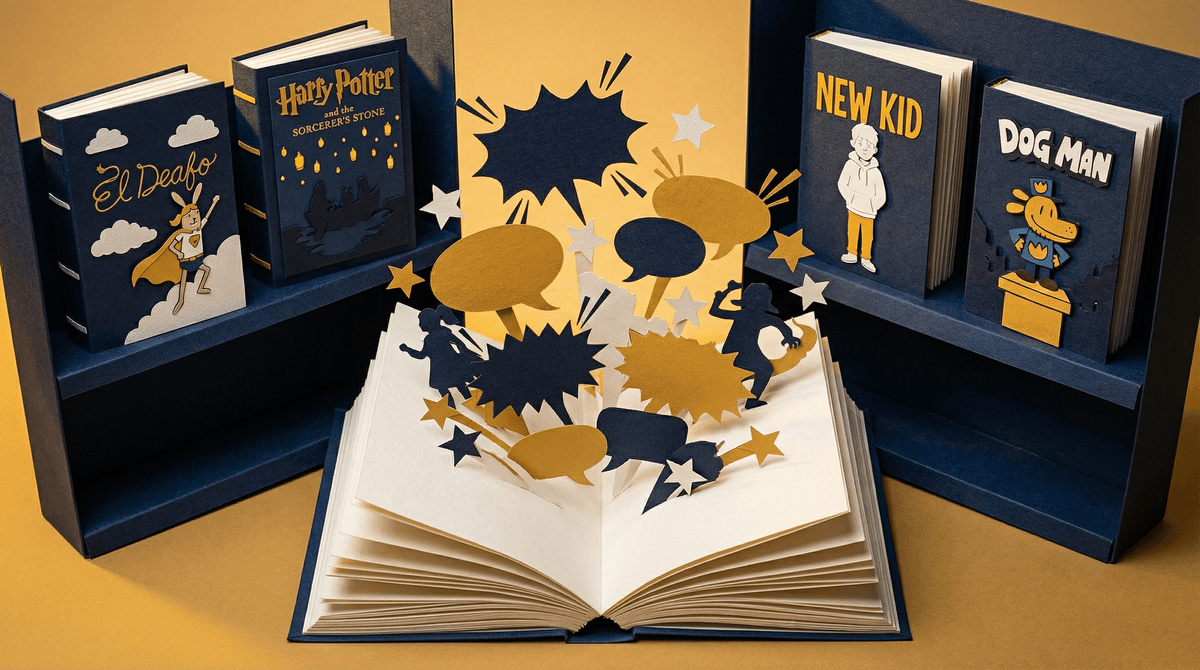
Let's cut to the chase: Yes, comics and graphic novels absolutely count as reading. Full stop.
But I know why you're here. Maybe your kid has blown through every Dog Man book in existence but won't touch a chapter book. Maybe the teacher made a comment about "real books" at conferences. Maybe your mother-in-law raised an eyebrow when she saw your 10-year-old reading manga instead of Harry Potter. Or maybe you're just wondering if you should push harder toward traditional novels.
Here's the thing: this debate reveals more about outdated ideas of what "counts" as legitimate reading than it does about actual literacy development. The research is clear, and it's been clear for decades. Visual narratives require complex cognitive skills—sometimes more complex than traditional prose.
The resistance to comics and graphic novels as "real reading" comes from a few places:
Cultural hierarchy nonsense. For generations, comics were seen as lowbrow entertainment—the stuff kids read under the covers with a flashlight while they were supposed to be reading "real" books. That stigma lingers, even though we now have Pulitzer Prize-winning graphic novels and serious literary criticism of the form.
Visual = easier assumption. There's this persistent myth that pictures somehow make reading "too easy" or that kids are "cheating" by using visual context clues. This is backwards. Good readers use all available information to construct meaning—and graphic novels require readers to synthesize text, images, panel layout, color, perspective, and sequential storytelling simultaneously.
Generational unfamiliarity. Many parents didn't grow up with the explosion of high-quality graphic novels we have now. If your reference point is Archie comics from the grocery store checkout, you might not realize that kids today are reading sophisticated narratives like Roller Girl, New Kid, or American Born Chinese—stories dealing with identity, racism, family dynamics, and social pressure with real depth.
Here's what literacy researchers have found about comics and graphic novels:
They build visual literacy. We live in an increasingly visual world. Reading graphs, interpreting infographics, understanding how images and text work together—these are essential 21st-century skills. Graphic novels teach kids to "read" images critically, understand visual metaphors, and integrate multiple information streams.
They require sophisticated comprehension. Readers have to interpret facial expressions, body language, panel transitions, speech bubble placement, and the relationship between text and image. They're making constant inferences about what happens between panels. This is high-level cognitive work.
They're especially powerful for struggling readers. The visual scaffolding helps kids who find dense text overwhelming. They can use images to support comprehension, build confidence, and stay engaged with complex stories they might otherwise abandon. For kids with dyslexia, ADHD, or processing challenges, graphic novels can be a game-changer.
They expand vocabulary just like traditional books. Studies show that graphic novels contain comparable vocabulary complexity to prose novels. Kids encounter new words, figurative language, and varied sentence structures—all the stuff that builds language skills.
They're a gateway, not a dead end. The fear that kids will "get stuck" reading only graphic novels is largely unfounded. Most kids who love graphic novels also read traditional books. And even if they don't—so what? Reading is reading.
Okay, but what if your kid genuinely only wants to read graphic novels and actively resists chapter books?
First: this is still reading. They're building skills, expanding vocabulary, and engaging with stories. This is infinitely better than not reading at all.
Second: consider why they prefer graphic novels. Are they:
- Struggling with text-heavy pages and finding them overwhelming?
- More engaged by visual storytelling?
- Reading at a level where chapter books feel like a slog?
- Just genuinely preferring a different narrative style (which is totally valid)?
If there's an underlying reading difficulty, graphic novels might be exactly what they need right now. If it's just preference, that's also fine—we all have genres we gravitate toward.
Third: broaden the definition of "variety." Instead of pushing toward chapter books, encourage variety within graphic novels. There are graphic novel memoirs, historical fiction, science fiction, fantasy, realistic fiction, non-fiction, manga, comics journalism. Nathan Hale's Hazardous Tales teaches history. Science Comics explains everything from volcanoes to bats. March is a powerful civil rights memoir.
Ages 5-8 (Early Readers):
- Narwhal and Jelly series
- Elephant & Piggie books
- Hilo series
- Early reader comics help kids transition from picture books to independent reading
Ages 8-12 (Middle Grade): This is the golden age of graphic novels. The options are endless:
- Amulet (fantasy adventure)
- Smile and other Raina Telgemeier books (realistic fiction)
- The Baby-Sitters Club graphic novel adaptations
- Guts (anxiety and mental health)
Ages 12+ (Teen/YA):
- Maus (Holocaust memoir—heavy but important)
- Persepolis (Iranian revolution memoir)
- They Called Us Enemy (George Takei's Japanese internment memoir)
- Manga series (just be aware that content ratings vary widely)
Not all graphic novels are created equal. Just like with traditional books, there's a huge range in quality, complexity, and age-appropriateness. The format doesn't tell you much—you need to actually look at the content. Some manga marketed to teens contains sexual content or violence that might surprise you.
Libraries and librarians are your friends. Children's librarians are amazing at recommending graphic novels that match your kid's interests and reading level. They know this stuff inside and out.
Reading together works great with graphic novels. The visual format makes it easy to read side-by-side and discuss what's happening. You can talk about how the artist uses color, what's happening between panels, how characters are feeling based on their expressions.
Watch for the "I already saw the pictures" trap. Some kids will flip through, look at all the images, and declare they've "read" it. This is actually a common developmental phase—they're learning how sequential art works. Encourage them to go back and read the text, follow the panel order, and really engage with the story.
Comics and graphic novels are real reading. They build literacy skills, expand vocabulary, teach visual interpretation, and engage kids with complex narratives. The format is different from traditional prose, but different doesn't mean lesser.
If your kid loves graphic novels, celebrate it. Stock your shelves with them. Let them count for reading logs and book reports (and push back if teachers say they don't). Follow their interests—if they're obsessed with Dog Man, find other funny series. If they loved New Kid, try other books about identity and belonging.
The goal is to raise readers—people who engage with stories, think critically, and find joy in books. The format is secondary.
And honestly? In a world where we're competing with TikTok, YouTube, and Fortnite for our kids' attention, a kid who's deeply engaged with any form of reading is winning. Don't let outdated ideas about what "counts" get in the way of that.
- Ask your librarian for graphic novel recommendations based on your kid's interests
- Read one yourself to understand the format better (try Roller Girl or El Deafo—both are great)
- Let your kid see you reading different formats too—articles, audiobooks, whatever works
- Explore alternatives to traditional chapter books if your kid is resistant
- Stop worrying about this. Seriously. Your kid is reading. That's what matters.