

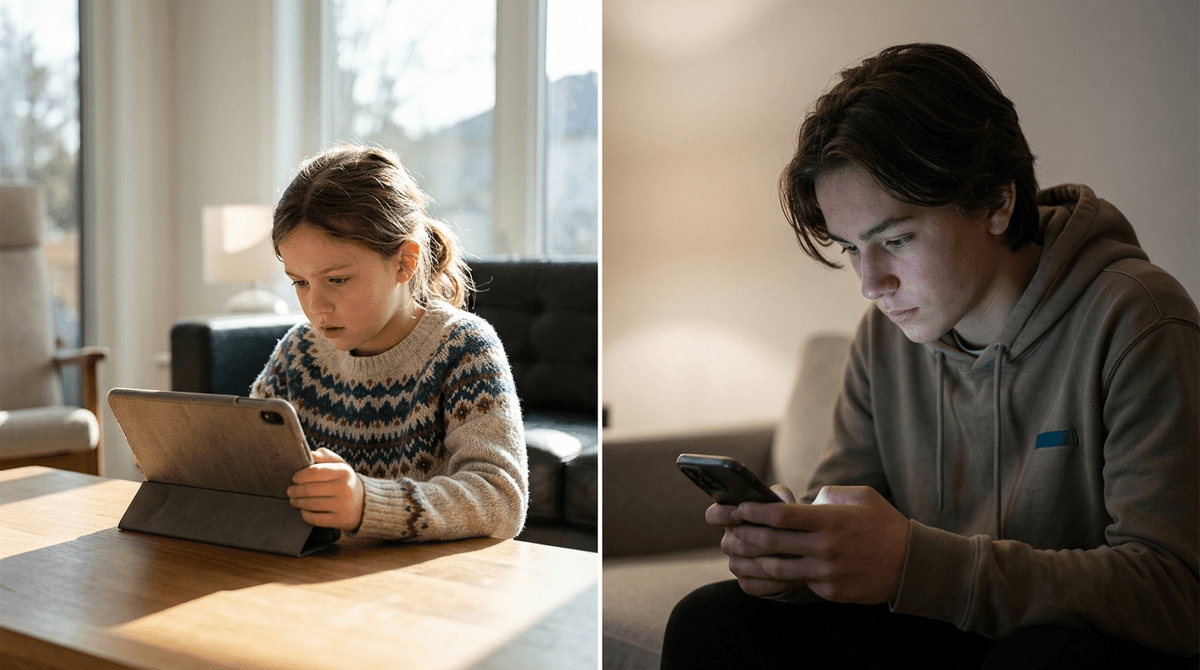

Screen time does not harm kids uniformly; instead, its specific risks track cleanly with developmental age, hitting language skills in toddlers, schoolwork in grade-schoolers, and mental health in teens. A new consensus review from child psychiatrists shows that the real threat is not the screen itself, but how manipulative app design preys on each stage of growing up.
Heavy screen exposure targets different vulnerabilities at each stage of childhood, shifting from disrupted sleep and delayed speech in toddlers to clinical behavioral addiction in teenagers.
Blanket "screen time limits" fail because a four-year-old watching videos faces entirely different risks than a fourteen-year-old trapped in an algorithmic feed.
Knowing the exact vulnerability for your child's age group changes how you intervene this week. You do not need to fight every battle simultaneously; you need to protect speech development before kindergarten, preserve focus and sleep during the elementary years, and treat obsessive teen use as a clinical mental health issue rather than bad behavior.
Child and adolescent psychiatrists needed a unified clinical standard to replace vague cultural panic with actionable developmental milestones. Tech platforms have accelerated their use of "dark patterns"—deliberate UX tricks designed to prolong screen use and bypass impulse control—prompting medical societies to treat excessive digital consumption as a public health issue with structural causes rather than a simple failure of parenting.
The developmental fallout from heavy digital media use breaks into three distinct stages:
- Ages 0 to 5: Heavy use directly threatens expressive language development and destroys baseline sleep quality.
- Ages 6 to 13: Excessive screen consumption consistently correlates with lower grades, shorter attention spans, and diminished psychosocial well-being.
- Ages 14 to 18: The danger shifts to problematic internet use and genuine behavioral addiction, often accompanied by mood and anxiety disorders.
- Apps are built to exploit: Manipulative commercial design features—such as infinite scroll, intermittent rewards, and auto-play—serve as primary drivers of excessive use across all age tiers.
- Digital access still matters: The authors emphasize that screens remain essential conduits for teenage socialization, school participation, and access to mental health resources.
Pediatric psychiatrists are quietly shifting blame away from weak willpower and placing it squarely on predatory app architecture. When a medical society calls out "dark patterns" by name, they are telling parents that personal discipline is systematically outmatched by design teams whose business model requires young users to lose track of time.
At the same time, the paper draws a firm line against total abstinence for older kids. Cutting a teenager off from digital platforms entirely creates severe social isolation, meaning hyper-restrictive bans can backfire into the very depression parents hope to prevent.
This paper is a synthesis of existing literature to establish clinical guidance for the German psychiatric society, not an experimental trial with a control group.
Nearly all underlying evidence relies on observational associations. That means researchers cannot definitively prove whether heavy screen use triggers mental health disorders, or whether children who are already anxious, isolated, or struggling with developmental delays naturally gravitate toward screens for comfort.
- If your child is under age five: Protect bedtime and talk time by cutting out background TV and handheld tablets, which crowd out the face-to-face vocal interactions required for vocabulary development.
- If your child is between 6 and 13: Intervene on bedtime devices first to defend sleep and academic focus, keeping gaming consoles and tablets out of the bedroom overnight.
- If your middle schooler gets trapped in algorithmic loops: Teach them to spot "dark patterns" directly—show them how autoplay, streak counters, and push alerts exist to steal their attention for advertising dollars.
- If your teenager cannot pull away from their phone: Treat the behavior as a clinical issue rather than a disciplinary defiance, looking for underlying depression, anxiety, or social struggle fueling the compulsive use.
Stop treating screen time as a single household enemy, and start defending the specific milestone that fits your child’s age: speech early on, sleep in the middle years, and algorithmic awareness in high school.
Brandhorst I, Lindenberg K, Paschke K et al. (2026). Digital-Media Use and Mental Health in Children and Adolescents. Zeitschrift fur Kinder- und Jugendpsychiatrie und Psychotherapie. doi:10.1024/1422-4917/a001082 — pubmed.ncbi.nlm.nih.gov