

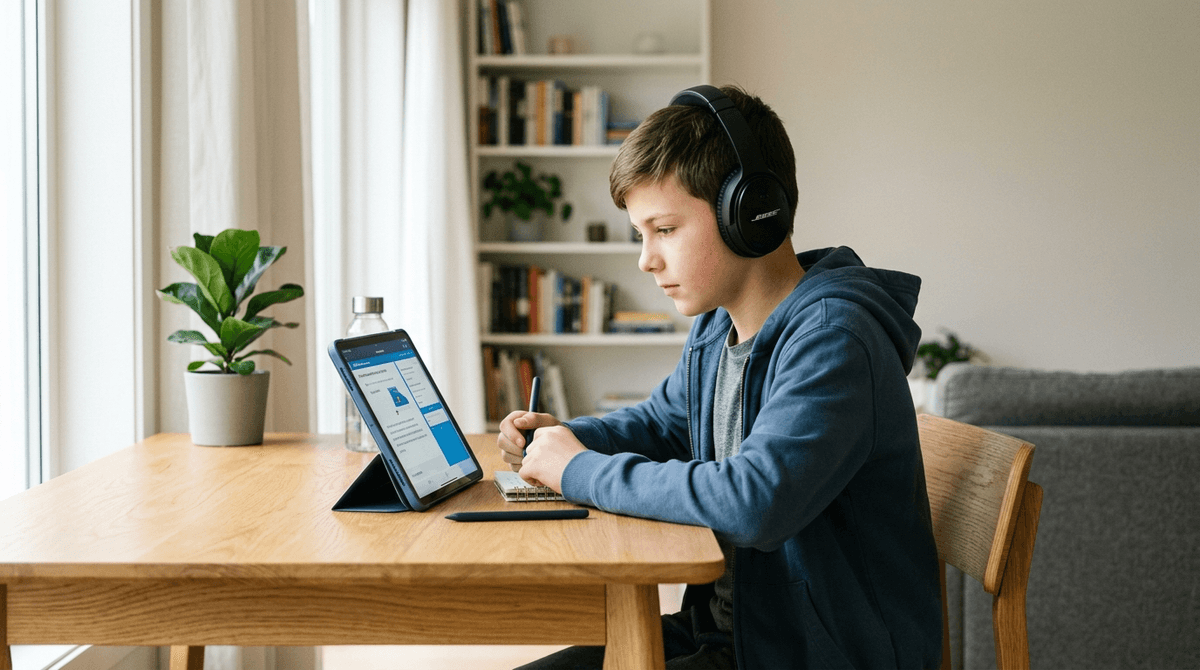

For children with neurodevelopmental conditions, screens are rarely just entertainment—they often serve as a vital lifeline for communication, learning, and emotional regulation. Standard restrictive screen guidelines frequently fail to capture the realities these families navigate every day.
Digital devices transform from optional entertainment into essential tools for communication and behavioral support when a child has a neurodevelopmental disorder.
Standard parenting advice around screens focuses on hard time limits and digital detoxes. But if your child lives with autism, a learning disability, or a genetic syndrome, a tablet might be their primary voice, learning scaffold, or de-escalation tool.
Judging your parenting against mainstream screen time rules creates unnecessary guilt. Treating screens as functional accommodations helps you focus on whether a device serves your child's specific developmental needs rather than counting arbitrary minutes.
Pediatric guidelines overwhelmingly recommend strict screen limits, yet clinicians routinely observe special-needs families relying on devices for daily management. Researchers wanted to understand how parents of neurodivergent children actually use and view digital media, bridging the gap between clinical advice and real-world domestic demands.
Parental attitudes are deeply split, but a child's functional needs dramatically change how technology is used at home.
- Attitudes are evenly divided: About a third of parents view screens positively, a third view them negatively, and a third feel neutral about their child's tech use.
- Higher needs drive higher appreciation: Parents of children with significant functional limitations hold far more positive views of technology, using devices as critical communication and educational aids.
- Fathers see more benefits: Dads report significantly more favorable views of digital tools for child development and parenting relief than mothers do.
- Younger parents automate control: Younger parents are far more likely to use built-in technical time-limiting tools than older parents.
- Half are left out of conversations: Only about half of families have discussed screen habits with health professionals, with conversations concentrated heavily among those managing severe disabilities.
Using a screen to manage behavioral outbursts or secure parental relief is common in these households out of practical necessity. Parents are often aware of strict medical screen guidelines, but they intentionally bypass them because immediate family stability takes priority over theoretical screen risks.
At the same time, healthcare providers are missing an opportunity: doctors rarely initiate discussions about digital media with parents of kids with milder disabilities, leaving those families to navigate screen boundaries without clinical guidance.
The findings rely entirely on self-reported parent surveys rather than direct observational tracking of child behavior or device logs. Because the study focused on Italian families already connected to neurorehabilitation clinics, these experiences may not reflect families without access to specialized clinical care.
- If your child relies on a tablet to communicate or self-regulate... evaluate device use like an assistive technology rather than tracking it against standard pediatric screen caps.
- If your child has a milder disability or learning difference... bring up screen habits at your next clinical appointment yourself, as providers rarely initiate these conversations unless limitations are severe.
- If you and your co-parent clash over screen limits... recognize that mothers and fathers often view digital benefits differently, and establish explicit household rules based on child function rather than intuition.
- If enforcing device boundaries triggers meltdowns... implement automated device-level time limits to remove the friction of manual enforcement.
Screen time in a neurodivergent household is an accommodation, not a discipline failure. If a device gives your child a voice or provides your family the breathing room needed to function, set aside generic rules and tailor screen use to your child's actual needs.
Butti N, Mascheroni E, Maucci V et al. (2026). Parenting in the Digital Era: Quantitative and Qualitative Insights from Families of Children with Neurodevelopmental Disorders. Children (Basel, Switzerland). doi:10.3390/children13060716 — pubmed.ncbi.nlm.nih.gov