

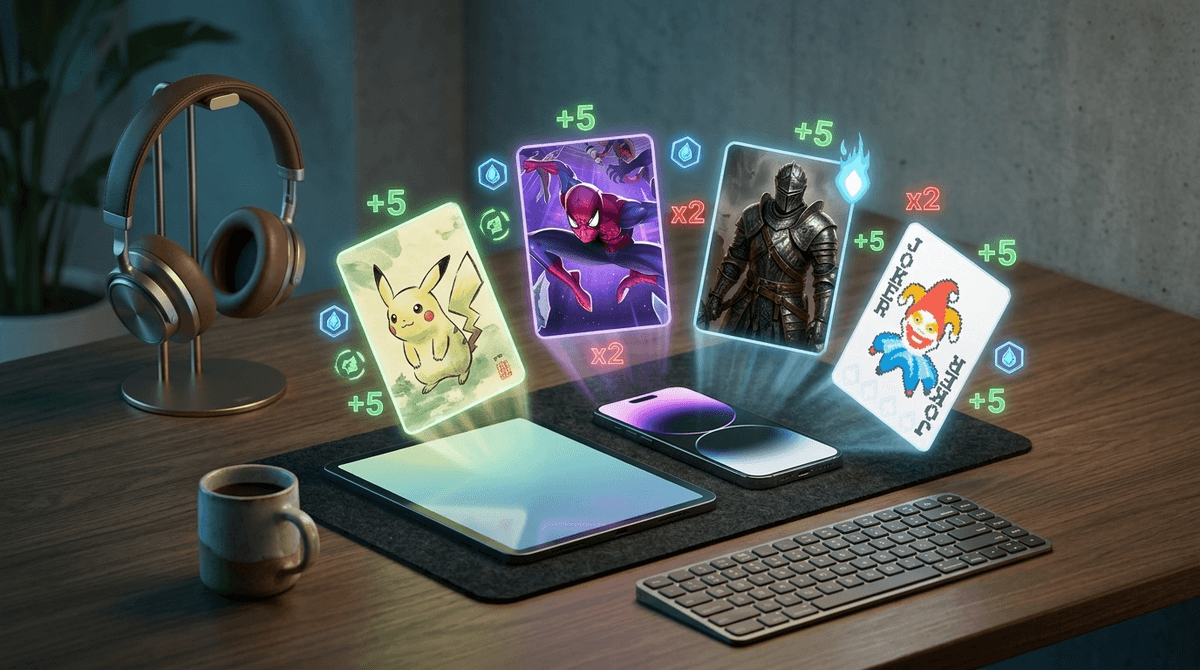
TL;DR: Digital card games are the modern equivalent of the three-ring binders we used to carry, but they come with "Gacha" mechanics that can drain a bank account faster than you can say "Pikachu." If your kid is into the strategy and the math, they’re actually building some great cognitive skills. If they’re just chasing the "shiny" cards, they’re basically playing a slot machine.
The Top Recommendations:
- Best for the Wallet (Single Player): Slay the Spire and Balatro
- Best for Quick Sessions: Marvel Snap
- The Current Obsession: Pokémon TCG Pocket
- The High-Skill "Pro" Path: Magic: The Gathering Arena
If your kid has suddenly started talking about "energy curves," "deck archetypes," or why a "God Pack" is the only thing that matters in life right now, you’ve entered the world of Digital Collectible Card Games (CCGs).
Back in the day, we had physical cards that smelled like fresh ink and lived in plastic sleeves. Today, those cards live behind a screen, they have flashy animations, and they are designed by some of the smartest psychologists in the world to keep kids (and adults) coming back for "just one more pack."
But here is the nuanced truth: Digital card games are often a "Big Brain" hobby. They require more reading comprehension and probability math than almost any other genre of gaming. The question for us is whether the strategy is worth the "monetization" (read: the constant pressure to spend money).
There are three main "hooks" here:
- The Collection High: Opening a digital pack of cards provides a dopamine hit similar to a loot box. The flashing lights and the "slow reveal" of a rare card are designed to feel like winning the lottery.
- The Strategic Flex: Winning a game doesn't usually come down to who has the fastest thumbs (like in Fortnite). It comes down to who outsmarted the other person. For kids who aren't "pro gamers" in shooters, card games are where they feel powerful.
- The Community: Whether it’s watching a YouTuber explain a new "meta" deck or trading (or showing off) cards with friends at school, these games are social currency. If every kid in 5th grade is playing Pokémon TCG Pocket, not having a cool deck feels like social "Ohio" (weird/bad).
Learn more about the "Gacha" mechanics in kids' games
This is the newest giant on the scene. It’s a simplified version of the classic Pokémon TCG.
- The Vibe: High nostalgia, very "clean" interface, and focused heavily on the act of opening packs.
- The Risk: It’s designed to make you want to log in every 12 hours to open your "free" packs. It pushes "Premium Passes" and currency to open packs faster.
- The Reward: It’s a great entry point for younger kids (Ages 7+) to learn basic strategy and resource management.
Designed by the guy who made Hearthstone famous, this game is fast. Games last 3 minutes.
- The Vibe: Every card is a Marvel hero. The "Snap" mechanic is basically like doubling the stakes in Poker—it teaches kids when to "fold" and when to "bluff."
- The Risk: The "fear of missing out" (FOMO) is high. New cards are released constantly, and the "Series" system can be confusing and frustrating if you don't spend money.
- The Reward: Incredible for teaching probability and "reading the room."
The "Granddaddy" of modern digital card games. It’s set in the World of Warcraft universe.
- The Vibe: High production value, very funny, but very complex.
- The Risk: It’s been out for a decade. A new player starting now will feel like they are 10,000 miles behind unless they spend a lot of money or play the "Battlegrounds" mode (which is more of a strategy puzzle).
- The Reward: It has a "Solo Adventures" mode that is basically a single-player strategy book.
This is the "Varsity" level. If your kid is playing this, they are likely doing complex mental math and logic puzzles.
- The Vibe: Serious, complex, and deeply strategic.
- The Risk: It’s the most expensive "hobby" on this list if you want to be competitive. It’s also the least "kid-friendly" in terms of learning curve.
- The Reward: This is basically Chess with 20,000 different pieces.
If you want the "strategy" without the "wallet-drain," you want "Roguelike Deckbuilders." These are games you buy once (usually $10-$20) and you get the whole game. There are no packs to buy. You "earn" cards by playing the game.
This is the gold standard. You pick a character and try to climb a tower.
- Why it’s great: It’s single-player. There’s no pressure to "keep up with the Joneses." It’s pure logic and synergy. It’s available on phones, iPads, and consoles.
- Age: 10+ (due to some mildly dark fantasy art and complexity).
The 2024 breakout hit. It’s "Poker," but you use "Joker" cards to cheat and break the game.
- Why it’s great: It’s incredibly addictive but entirely self-contained. No microtransactions. It teaches "multiplicative math" in a way that would make a math teacher weep with joy.
- Age: 12+ (It uses poker themes, but it's not "gambling" in the sense that you can't lose real money).
The Good Stuff (Why we say 'yes')
- Critical Thinking: You have to plan 3 turns ahead.
- Reading Comprehension: Card text is like legal jargon for kids. "If X happens, then Y occurs, unless Z is present." They have to read carefully.
- Emotional Regulation: You will lose. A lot. Learning to lose to a "lucky" draw without throwing the iPad is a major life skill.
The Bad Stuff (Why we set boundaries)
- Predatory Monetization: Many of these games use "Dark Patterns." They give you just enough "free" stuff to get you hooked, then hit a wall where you have to pay to keep winning.
- The "Gacha" Loop: Opening packs is gambling-adjacent. If your kid is more interested in the animation of opening a pack than the strategy of playing the card, that's a red flag.
- Time Sinks: These games often use "Daily Quests" to force kids to play every single day.
Check out our guide on how to spot dark patterns in games
- Ages 6-9: Stick to Pokémon TCG Pocket. Keep the "In-App Purchases" turned OFF at the system level. Talk about how the game tries to make you want to spend money.
- Ages 10-13: This is the prime time for Marvel Snap or Slay the Spire. This is a good age to introduce a "gaming budget" (e.g., $10 a month) so they learn the value of digital items.
- Ages 14+: They can handle the complexity of MTG Arena or Yu-Gi-Oh! Master Duel. At this point, the conversation is about time management and the "sunk cost fallacy."
Instead of "Get off that game," try these conversation starters:
- "Show me your favorite card. Why is it good?" (This forces them to explain the strategy/mechanics).
- "How much does it cost to get that specific card you want?" (This helps them realize that 'chasing' a card in packs is a losing game).
- "I saw a game called Balatro that is supposedly way harder to beat. Think you could do it?" (This pivots them toward a non-monetized strategy game).
Digital card games aren't "brain rot." They are actually "brain gym." However, they are gym memberships that are constantly trying to sell you expensive protein shakes you don't need.
If your kid is genuinely interested in the math and the "big brain" plays, encourage it! Just keep a very close eye on the "Shop" button. If they can't enjoy the game without spending money to get the "newest, shiniest thing," it might be time to delete the app and buy a physical board game instead.