

You know that moment when your kid comes home from school, drops their backpack, and immediately wants to game? Before you assume it's just another dopamine hit, hear me out: not all gaming is created equal.
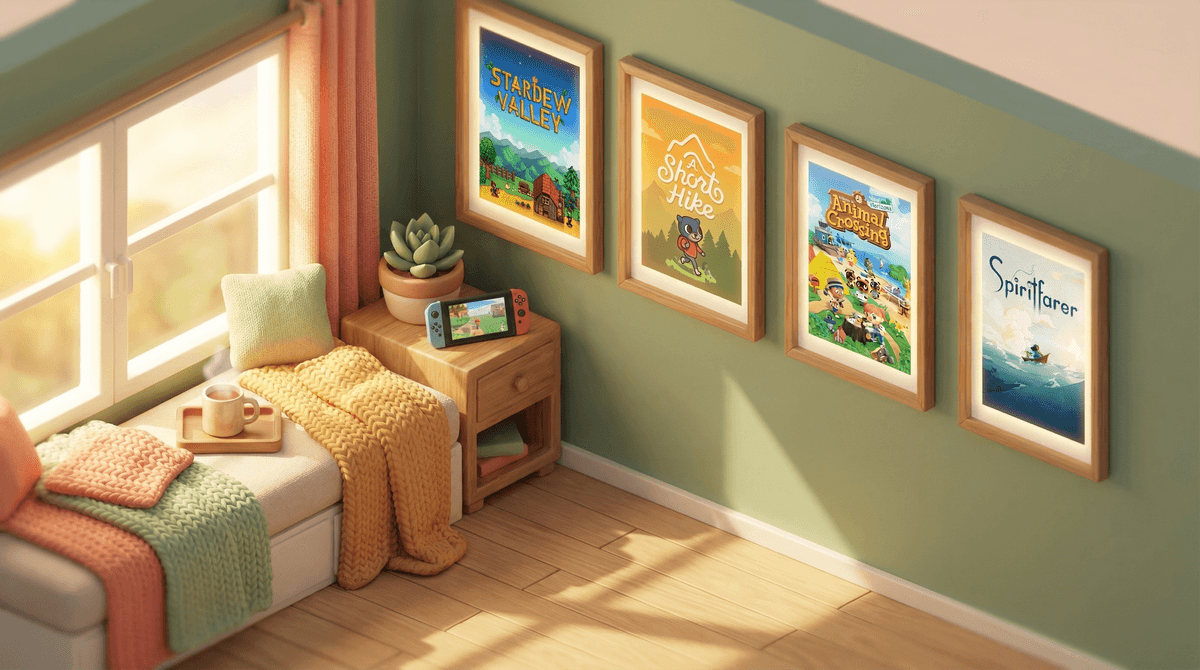
Cozy games are exactly what they sound like – low-stakes, gentle video games focused on creativity, exploration, and calm activities rather than combat, competition, or time pressure. Think farming, decorating, fishing, collecting, and building relationships with cute characters. Games like Stardew Valley, Animal Crossing: New Horizons, Spiritfarer, and A Short Hike are the poster children of this genre.
Unlike the high-intensity shooters or the endless grind of Fortnite and Roblox, cozy games don't punish you for taking breaks. There's no battle pass expiring, no ranked season ending, no teammates yelling at you for missing a shot. You can literally put the controller down mid-game, go eat dinner, and come back without penalty.
In a world where kids are juggling academic pressure, social dynamics, and an increasingly anxious news cycle, cozy games offer something rare: a space where nothing bad happens.
These games tap into what psychologists call "restorative environments" – spaces that allow our nervous systems to actually calm down. When your middle schooler is tending their virtual garden in Stardew Valley or designing their island in Animal Crossing, they're engaging in what's essentially digital self-care.
The appeal is genuine:
- Control in a chaotic world – Kids can create, organize, and manage their own little universe
- Low-pressure social connection – Many cozy games have multiplayer elements without the toxicity of competitive gaming
- Achievement without anxiety – Progress feels good, but there's no punishment for going at your own pace
- Creativity outlet – Designing spaces, planning farms, choosing outfits – it's creative play with structure
I've seen kids who get overwhelmed by the chaos of Minecraft multiplayer servers absolutely thrive in the gentler pace of Cozy Grove.
Here's where it gets interesting: there's growing evidence that not all screen time affects kids the same way. Research on gaming and mental health shows that the type of game matters as much as the time spent playing.
A 2020 study from Oxford University found that players of Animal Crossing: New Horizons reported genuine improvements in wellbeing – not just while playing, but in their overall mood. During the pandemic, therapists actually started recommending cozy games as legitimate coping tools.
The key difference? Autonomy and competence without pressure. Cozy games satisfy our psychological needs for mastery and control without triggering stress responses. Compare that to games designed around FOMO, daily login streaks, and competitive ranking systems.
Ages 6-9:
- Animal Crossing: New Horizons – Perfect first cozy game, very gentle
- A Short Hike – Completable in 1-2 hours, great for shorter attention spans
- Ooblets – Farming plus creature collecting, very colorful and kid-friendly
Ages 10-13:
- Stardew Valley – The gold standard, though note it has some mild dating/relationship elements
- Unpacking – Literally just unpacking boxes, surprisingly emotional and engaging
- Spiritfarer – Beautiful game about death and letting go (handles it gently but worth previewing)
Ages 14+:
- Cozy Grove – Designed to be played 20-30 minutes per day
- Coffee Talk – You run a coffee shop and listen to customers' stories
- Unpacking, Stardew Valley, and most of the above still work great
The good news: Cozy games are generally exactly what they claim to be. No hidden loot boxes, minimal in-app purchases, and age ratings that actually match the content.
The reality check: Even cozy games are still screen time. A kid playing Stardew Valley for four hours straight isn't getting the same benefit as the first hour. The "cozy" part works best when gaming is balanced with other activities.
Watch for: Some kids might use cozy games as avoidance – if your anxious teen is only willing to engage with their virtual farm and completely withdrawing from real-world activities, that's worth a conversation. Learn more about gaming and avoidance behaviors.
The social piece: Many cozy games have online multiplayer or sharing features. Animal Crossing lets players visit each other's islands, which means potential stranger interaction. Most games have privacy settings – actually use them.
Not all gaming is created equal, and cozy games occupy a genuinely different space than competitive multiplayer or achievement-grinding games. If your kid is going to game (and let's be real, they probably are), having some cozy options in the rotation isn't just "less bad" – it might actually be beneficial.
Think of cozy games as the digital equivalent of reading a comfort book or doing a puzzle. They're not going to replace outdoor play or face-to-face friendships, but they're a far cry from the anxiety-inducing, FOMO-driven experiences that dominate so much of kids' digital lives.
Try this: If your kid is deep into high-intensity games like Fortnite or Valorant, suggest trying one cozy game together. A Short Hike is short enough to complete in one sitting and might open their eyes to a different kind of gaming experience.
Start a conversation: Ask your kid what games help them relax versus which ones leave them feeling wound up. Most kids can actually tell the difference – they just might not have thought about it explicitly.
Set boundaries that make sense: Maybe cozy games get different time limits than competitive multiplayer. Or maybe cozy gaming time counts as "wind down" time before bed while Roblox doesn't. Explore different approaches to screen time boundaries.
Want to understand how your family's gaming habits compare to other families in your community? Screenwise can help you get that context and create a plan that actually works for your household.